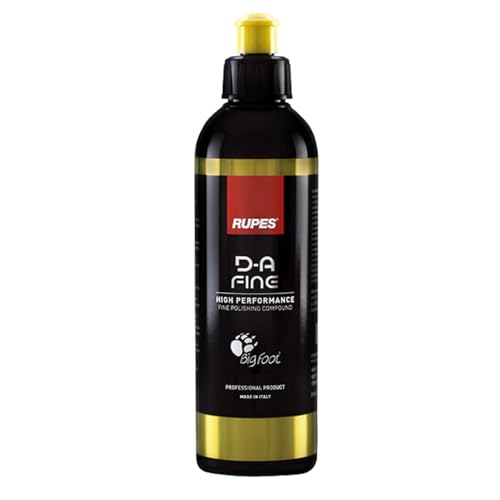
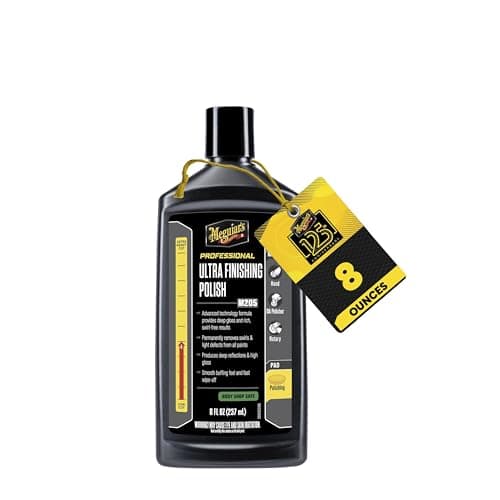
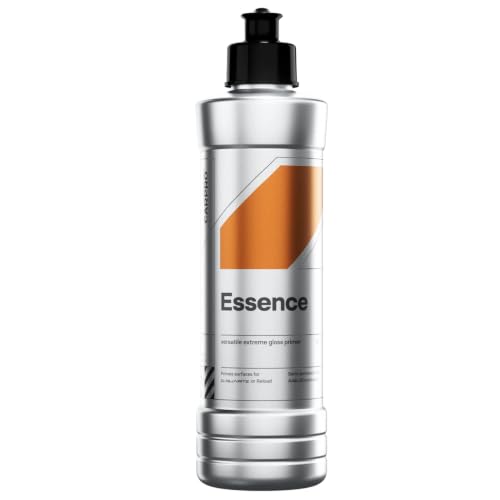
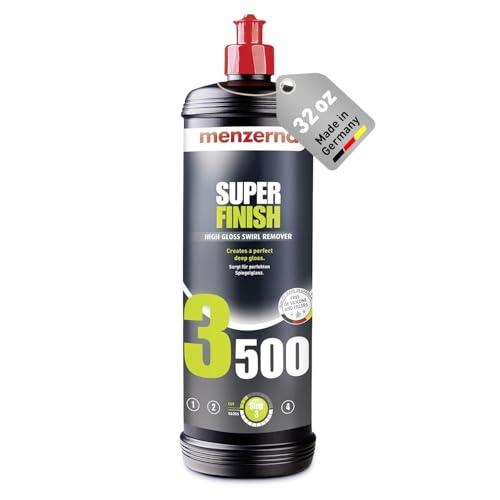
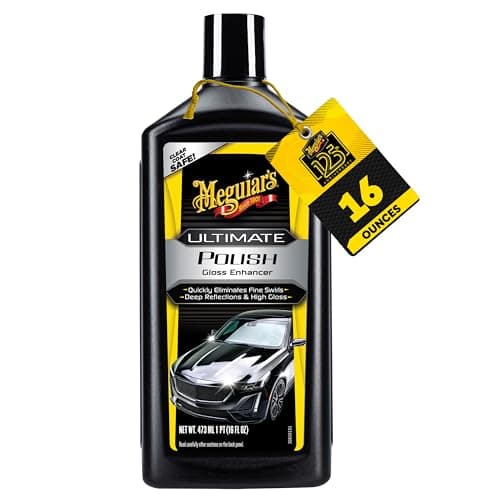
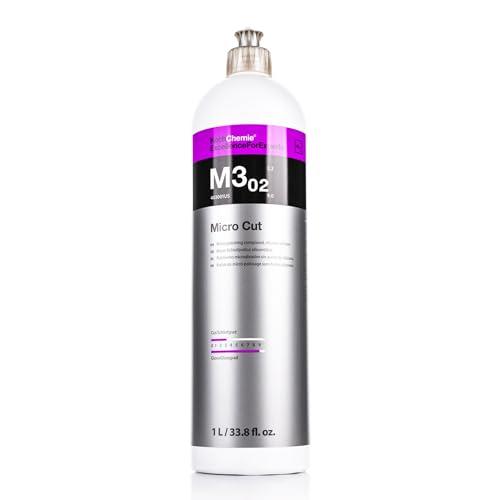
Koch-Chemie M3.02 Micro Cut is the best polish for soft paint — fine enough to finish soft clear coat without installing its own haze, and silicone-oil free, which means the gloss you see when you wipe it off is the paint rather than a filler that disappears at the second wash. The budget pick is Meguiar's Ultimate Polish, a mild consumer finishing polish that is genuinely hard to hurt soft paint with. Every price on this page is rendered from the live price layer, as of November 27, 2026.
Soft paint is the counterintuitive case in paint correction. Most buying advice is written around the problem of not being able to remove a defect: pick a stronger compound, a denser pad, a longer pass. On soft clear coat the problem runs the other way. The defect comes out almost immediately — and then the product and the pad you used to remove it leave behind a field of fine marring, hazing or buffer trails that is now the thing you have to fix. People describe this as "the polish wouldn't finish down." What actually happened is that the abrasive was coarser than the paint could tolerate.
You will meet soft paint most often on Japanese marques — Honda, Mazda, Subaru, Lexus and Nissan black in particular — on some Tesla panels, on a lot of modern waterborne-basecoat repaints, and on any single-stage paint, where there is no clear coat at all and you are abrading pigment directly. Our hard paint vs. soft paint explainer covers how to identify which one you have with a test spot rather than a guess, and it is worth five minutes before you buy anything on this page.
The practical consequence is that on soft paint the finishing polish is not the optional last step — it is frequently the only step you need. A fine polish on a soft finishing pad will remove light swirls on soft clear that would need a compound on hard German paint. That is the good news, and it is the reason this page does not rank a single cutting compound.
How we ranked these
Finishing ability first, cut a distant second. Every product here is judged on what the panel looks like after the final pass, not on how fast it kills a scratch. That inverts the order we use on the hard-paint compound page, where cut is the whole point, and it is why two of these picks score in the fives and sixes for cut and still rank.
Then filler honesty.This is the criterion almost no roundup applies, and on soft paint it matters more than anywhere else. Many finishing polishes carry silicone oils, glazes or resins that fill the fine marring rather than remove it. The panel looks perfect when you wipe it, and the marring reappears after two or three washes once the filler is gone. A polish that states it is silicone-oil free lets you trust what you are looking at. A polish that adds something can still be the right product — two on this page deliberately are — but you should know which kind you bought.
Then whether it was formulated for the machine you own. Soft paint is hazed far more often by a rotary-oriented abrasive used on a random orbital than by the wrong grade. Products engineered around the dual-action motion break down differently, and one pick here is explicitly built for it.
Then working time. A polish that flashes off early grabs, and a grabbing pad on soft clear is exactly how you get buffer trails. Long open time is a soft-paint feature, not a convenience.
Then cost per car. Two of these come in 250 ml bottles that will do several cars and cost less than a tank of gas; one is a 32 oz professional bottle that only makes sense if you polish constantly. We say which is which rather than pretending the big bottle is better value for a one-car owner.
What "soft" actually means here
Paint hardness is not a published spec and no manufacturer prints a number on the window sticker, so treat any chart claiming exact hardness ratings by model with suspicion. What detailers mean by soft is a clear coat that abrades with less mechanical effort than average: a mild polish removes defects a mild polish should not be able to remove, and a medium compound leaves visible haze a medium compound should not leave.
That has two consequences for shopping. The first is that your product budget shifts from the compound to the polish. The second is that pad choice carries more of the outcome than the bottle does — a fine polish on an aggressive pad is still an aggressive combination. Polishing vs. finishing pads explains where the line sits, and best finishing pads ranks the soft foam that belongs with everything on this page.
The one-step case, and when it fails
On soft paint a single fine-polish step genuinely does finish most cars: light wash marring, swirls from an automatic car wash, the general dullness of a three-year-old daily driver. If that is your car, buy one bottle from this page and one soft pad and you are done.
It fails in three situations, and all three are worth knowing before you spend money. Deeper scratches that catch a fingernail are not a polishing problem at any grade. Sanding marks, whether from wet sanding or from someone else's heavy-handed correction, need a real compound step and a careful refinement after it. And genuine oxidation on neglected soft single-stage paint needs cleaning power this page does not rank — best compound for single stage paint is the page for that car.
How to choose
Do a test spot before you buy the second bottle
Tape off a two-foot square on a horizontal panel, run the mildest combination you own — finishing pad, fine polish, moderate pressure, four slow passes — and look at it under a bright light. On soft paint that will frequently be the whole answer. If it is, you have learned you do not need a compound at all, which is a cheaper discovery than the alternative. A proper detailing light is what makes the test spot readable; a work lamp hides exactly the marring you are looking for.
Match the polish to the machine, not to the review
- Random orbital / dual action — the normal home machine, and the safest on soft paint. A DA-formulated fine polish is the natural pairing.
- Rotary — generates real heat and will haze soft clear if the abrasive does not break down. Use the finest grade you can and keep the pad clean; how to remove buffer trails covers the fix when it goes wrong.
- By hand — limited, but on soft paint it does more than it does on hard paint. How to polish a car by hand is honest about the ceiling.
Keep the pad clean and the pressure light
A loaded pad is an aggressive pad. Spent abrasive and removed clear coat build up in the foam and turn a fine polish into something coarser than it started, which is the most common cause of "my finishing polish left marring." Brush or blow the pad out after every panel and swap pads sooner than you think. How to clean polishing pads covers the routine, and priming a pad matters more on soft paint because a dry pad grabs.
Decide whether you want a filler or not — deliberately
If you are about to put a ceramic coating on the car, a filler is a problem: the panel wipe strips it, the marring comes back, and now it is locked under a coating for two years. Use a filler-free polish and a panel wipe to confirm the real result before anything goes on top. If you are just making a daily driver look good before winter, a polish with resins in it is a perfectly reasonable choice and will look better for less work. How to polish a car before ceramic coating walks the coating-bound version of this decision.
Buy the bottle size that matches your actual year
A 250 ml bottle of fine polish is several cars' worth for a home detailer, because a finishing pass uses very little product. The 32 oz professional bottles on this page are cheaper per ounce and worse value for one car, because polish does not improve in the cupboard. Buy small, use it up, buy again.
What soft-paint owners over-buy
Cutting compound. It is the first thing recommended in every forum thread about swirl removal, and on soft clear coat it is usually a step too far — it removes the defect in one pass and then requires a second product and a second hour to clean up after itself. If you are choosing between a compound and a finishing polish for a soft Honda or Mazda, buy the polish first. You can always add the compound later; you cannot un-remove clear coat. A paint thickness gauge is the only way to know how much you have to spend, and on soft paint it goes faster per pass than the numbers in most guides assume.
The second over-buy is the aggressive pad bought to "speed things up." A microfiber or heavy foam cutting pad will out-cut the polish you paired it with, and on soft paint the pad is what leaves the marks. Polish vs. compound sets out the distinction, and how to remove swirl marks is the process version of this page.