HUB 02
Cutting & Polishing Pads
Foam or microfiber, cutting or finishing — how to pick the right pad for your polisher, your compound, and the defect you're actually trying to fix.
We earn a commission when you buy through our Amazon links, at no extra cost to you. It never affects our rankings, and we say so when the cheaper product is the better buy. How this works.
Foam or microfiber, first
Almost every pad you'll put on a dual-action polisher is either foam or microfiber, and the difference is bigger than color. Foam pads are the default: they're forgiving, they come in a full range from aggressive cutting foam to ultra-soft finishing foam, and they're what most published pad line-ups are built around. Microfiber pads use a napped fabric face bonded to a foam core, and they cut noticeably faster than foam of the same rating — useful for stubborn oxidation or deep swirls, but they also leave a coarser finish and need a separate finishing pad to refine it back down. A practical rule most enthusiasts land on: foam covers the whole cut-to-finish range on its own, so buy foam first, and add one microfiber cutting pad later only if you routinely hit paint foam can't correct in a reasonable number of passes. Our best polishing pads for DA roundup is built around that foam-first logic.
What the color actually tells you
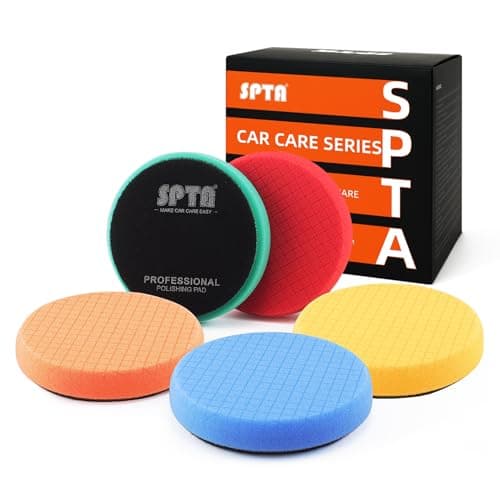
Pad manufacturers color-code the foam so you can tell aggressiveness at a glance without reading a label mid-polish. Yellow and orange foams are typically the cutting pads — dense, aggressive cell structure that removes compound fast and levels moderate-to-severe defects. White and similar mid-tone foams sit in the middle as polishing pads, less aggressive but still capable of refining what the cutting pad left behind. Black, gray and the softest colors are the finishing pads — low-cut foam meant to jewel a finish with a light polish or apply a wax or sealant, not correct anything. The catch: this scheme is a convention, not a law. Every brand assigns its own colors to its own cut levels, so a "white" from one line isn't guaranteed to match a "white" from another. Read the actual foam density or cut rating printed on the pad or listing, not just the color, and when in doubt check our full pad color guide, which lays out one common brand's convention as a worked example.
Size has to match your backing plate and throw
A pad only works correctly on a backing plate close to its own diameter — oversized pads flare out and slap paint at the edges, undersized pads leave the plate's hook-and-loop exposed and prone to snagging. 5.5-inch foam pads are the practical standard for a 5-inch or 5.5-inch backing plate, which is what most dual-action polishers ship with. Pad choice also has to account for orbit, or throw: a short 8 mm-throw DA and a long 15 mm/21 mm-throw DA move the same pad through very different amounts of travel, and pads engineered for long-throw machines (thicker, with more support in the foam) stay flatter and cooler under a bigger orbit than a thin pad designed for an 8 mm tool. Buying a pad without checking both numbers — plate diameter and your machine's throw — is the single easiest way to end up with a pad that hops, overheats, or barely contacts the paint.
Pair the pad with the compound, not just the paint condition
The pad and the compound you load onto it are doing the job together, and picking one without the other wastes both. Load an aggressive cutting compound onto a soft finishing pad and the pad can't develop enough friction to let the abrasives break down properly — you'll haze the paint without actually correcting it. Run a finishing polish on an aggressive cutting pad and you get almost no refinement; the pad's own cut overwhelms the product's gentler abrasives. The working rule: match pad aggressiveness to compound aggressiveness, then let the compound do most of the cutting and the pad do the finishing touch. Our rubbing compound roundup notes which cut level each product is meant to pair with.
Keep pads clean and they last
Foam and microfiber pads both load up with spent compound and paint residue as you work, and a saturated pad stops cutting evenly — it starts sliding compound around rather than working it. Rinse or brush pads clean between panels, spin them dry (a dedicated pad washer or even a bucket and towel works) before the next section, and let them fully air-dry before storage so the foam doesn't mildew or compress. A clean, dry pad rotation is the cheapest thing you can do to keep results consistent panel to panel.
The mistake that undoes good technique
The single most common pad mistake is buying only a cutting pad — usually because "cutting" sounds like the important one — and expecting it to also deliver a flawless, swirl-free finish. A cutting pad's job is to remove defects, not to leave a jeweled finish; it will always leave some haze of its own that needs a polishing or finishing pad, and a milder compound, to clear. Budget for at least two pads — one to correct, one to finish — or the "cutting" pad you bought will get blamed for a finish problem it was never built to solve. If cutting is the end of the range you are shopping in, our foam cutting pad picks rank that field on its own terms, the finishing pad picks cover the pass that comes after it — and how to clean polishing pads is what keeps whichever set you buy cutting past the second panel. If the two soft grades blur together for you, polishing vs finishing pads draws the line: one still removes light defects, the other only adds gloss.
When foam is not the answer
Foam is the default because it is predictable, cheap and safe. It is not the most capable material available. A microfiber pad cuts markedly harder than any foam at the same machine speed, which is what lets an ordinary dual-action clear defects that would otherwise need a rotary — at the cost of a haze that a finishing pass then has to remove. If your paint has more damage than a foam cutting pad is clearing, that is the next step rather than a more aggressive compound; our microfiber cutting pad picks rank that field, and foam vs microfiber pads explains the trade-off before you commit. Whichever material you settle on, pads are consumables — how often to replace polishing pads covers the point at which a tired pad starts costing you results.
Rotary pads, and the size you standardize on
Everything above assumes a dual-action. A rotary drives its pad continuously in one direction, which puts heat somewhere a DA never does and makes wool a genuine option rather than an oddity — the field is ranked separately in best polishing pads for a rotary. Whichever machine you run, settle the diameter question early, because it decides which backing plate you own and therefore which pads you can buy next time; 5-inch vs 6-inch polishing pads works through what the extra inch costs and buys.
Two decisions sit either side of the grade you buy. The first is material: foam is the default, but a rotary opens up wool, which cuts faster than any foam and finishes worse — foam vs wool pads draws that line. The second is what you do to a pad before its first pass, because a dry pad wastes it; how to prime a polishing pad is the two-minute habit that makes a new pad cut from the start rather than the fourth section.
Start here
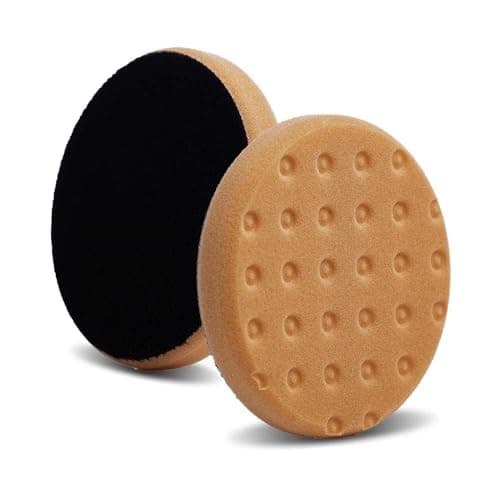
The Best Polishing Pads for a DA Polisher
Five foam pad picks that cover cutting through finishing on any dual-action polisher.
Read it →
Everything in this hub
All cutting & polishing pads
Roundup
The Best Polishing Pads for a DA Polisher
Five foam pad picks that cover cutting through finishing on any dual-action polisher.
Top pick: Lake Country CCS 5.5" Foam Pads
#ad · price as of October 20, 2026 · 5 products · 5 priced
Roundup
Best Foam Cutting Pad
Five foam cutting pads compared on cut level, cell structure and how much finishing work each one leaves behind.
Top pick: Lake Country CCS 5.5" Foam Pads
#ad · price as of October 20, 2026 · 5 products · 5 priced
Roundup
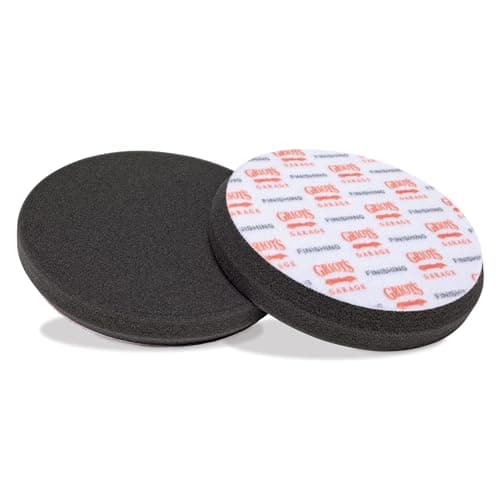
Best Finishing Pads for Polishing
Five soft finishing pads for the gloss pass after correction, from a value hex face to a 12-pack of microfiber discs.
Top pick: Griot's Garage 5.5" Black Foam Finishing Pads
#ad · price as of October 20, 2026 · 5 products · 5 priced
Roundup
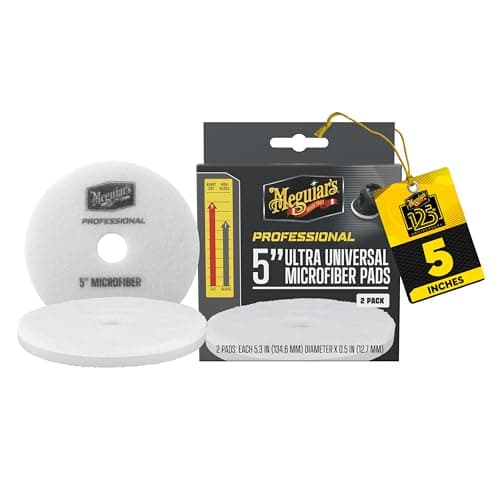
Best Microfiber Cutting Pads
Five microfiber cutting pads ranked on cut, finish and how long the nap survives, plus who should stay on foam.
Top pick: Meguiar's Professional 5" Ultra Universal Microfiber Pad (2 Pack)
#ad · price as of October 20, 2026 · 5 products · 5 priced
Roundup
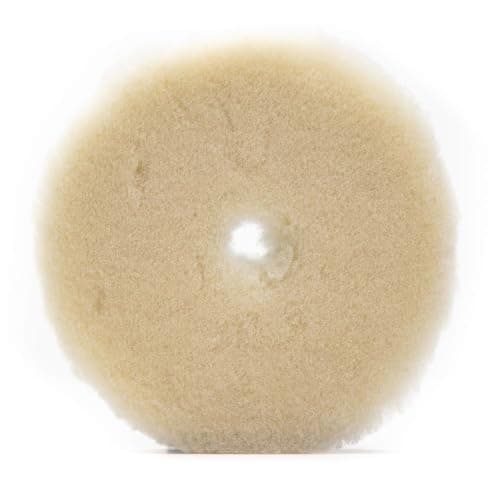
Best Polishing Pads for a Rotary Polisher
Wool, wool-foam hybrid and rotary foam pads ranked on cut, heat handling and the haze each one leaves behind.
Top pick: Lake Country 6" Low-Lint Wool Buffing Pad
#ad · price as of October 20, 2026 · 5 products · 5 priced
Head to head
5-Inch vs 6-Inch Polishing Pads
How pad diameter changes coverage, motor load and control — and why most people should standardize on one size and stay there.
Top pick: Lake Country CCS 5.5" Foam Pads
#ad · price as of October 20, 2026 · 4 products · 4 priced
Head to head
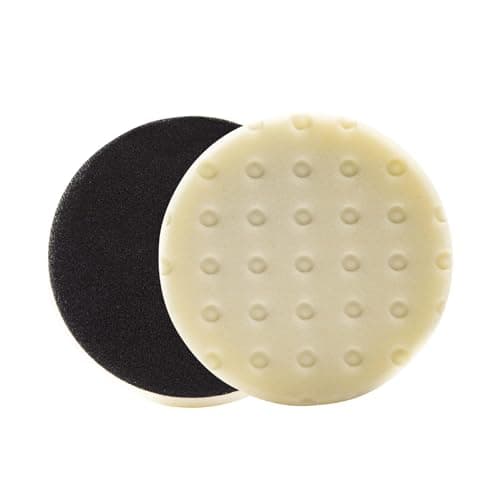
Polishing vs Finishing Pads
The real difference between a light-cut polishing pad and a no-cut finishing pad, which liquid belongs on each, and whether a home kit needs both.
Top pick: Lake Country CCS 5.5" White Polishing Pad (2-Pack)
#ad · price as of October 20, 2026 · 5 products · 5 priced
Head to head
Foam vs Wool Pads
Wool versus foam on cut speed, finish quality, heat and machine compatibility — plus the wool/foam hybrid that splits the difference.
Top pick: Lake Country CCS 5.5" Foam Pads
#ad · price as of October 20, 2026 · 5 products · 5 priced
Buyer's guide
How to Prime a Polishing Pad
Priming a new pad so it cuts from the first pass instead of the fourth: the method for foam and microfiber, product amounts, and when to re-prime mid-job.
Top pick: Lake Country CCS 5.5" Foam Pads
#ad · price as of October 20, 2026 · 4 products · 4 priced
Buyer's guide
How Many Polishing Pads Do I Need?
The per-car pad math: roughly one pad per two to three panels per stage, why saturation kills cut, and how many of each type a one-step or two-step correction really takes.
Top pick: SPTA 5.5" Buffing & Polishing Pad Kit
#ad · price as of October 20, 2026 · 4 products · 4 priced