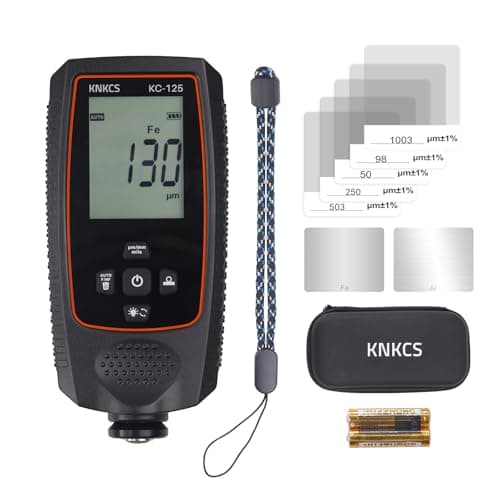
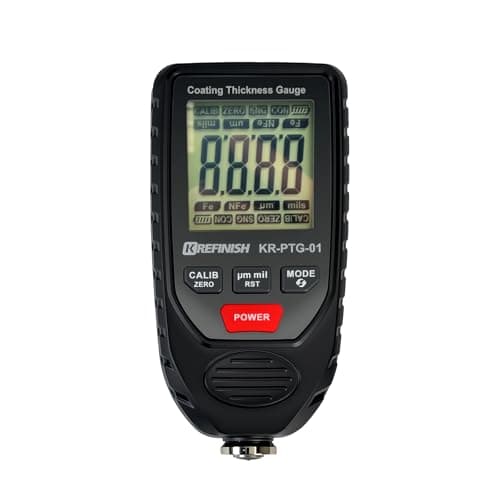
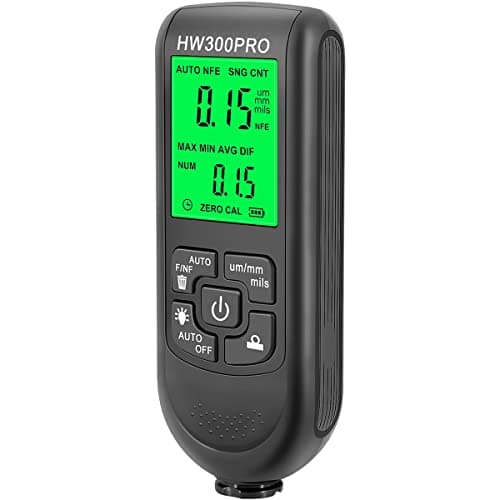
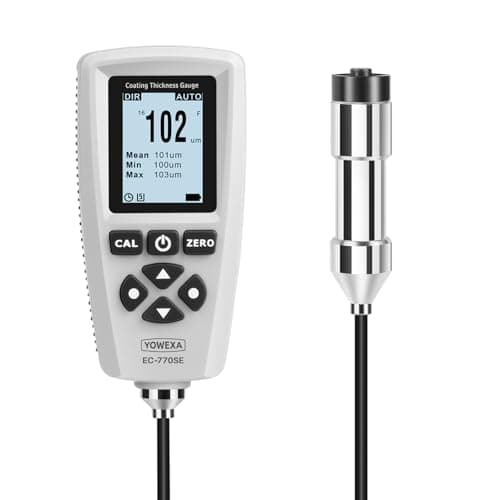
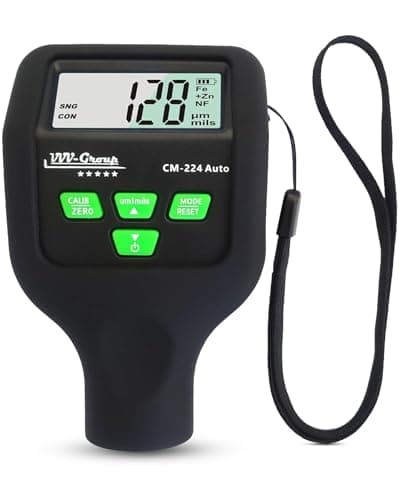
Every other page on this site is about removing something. This one is about knowing when to stop. Machine polishing works by abrading clear coat — that is not a side effect, it is the mechanism — and the one resource you cannot replace is the clear coat you started with. A paint thickness gauge is the only tool that turns that from a feeling into a number.
We have been honest about this gap before. Our page on does polishing remove clear coat walked through the arithmetic of film thickness and then declined to recommend a gauge, because we had not verified a live listing for one. This page closes that gap: six gauges that are currently purchasable, ranked on the two things that separate a useful instrument from a novelty, plus a frank section on what the reading does not tell you — which is the part most roundups skip.
What is actually being measured
Factory automotive paint is a stack. Electrocoat primer on the metal, a primer-surfacer, the color basecoat, and on top of all of it the clear coat that provides gloss and UV protection. The whole stack on a modern mass-market car is typically in the region of 100 to 150 microns — about the thickness of a sheet of copier paper — and the clear coat is a minority share of that, commonly in the 35 to 60 micron range depending on the manufacturer and the plant. Those are published industry ranges, not measurements we made, and they vary enough by maker and model year that your own car's numbers are the only ones that matter.
A gauge does not measure the clear coat. It measures total film build — everything sitting on top of the metal, in one number. That distinction is the single most misunderstood thing in this category, and it has two consequences that matter. First, an absolute reading in isolation tells you less than you think. Second, and far more usefully, differences between panels tell you a great deal: a door reading 250 microns next to a fender reading 120 has been repainted, and a quarter panel reading 600 has body filler under it.
That is why a gauge earns its money before a correction rather than during one. You are not titrating your way through a polishing stage micron by micron. You are answering three questions in about five minutes: has any panel on this car been resprayed, is any panel alarmingly thin, and is there filler hiding anywhere I am about to run an aggressive cutting compound over.
The criteria, in the order that matters
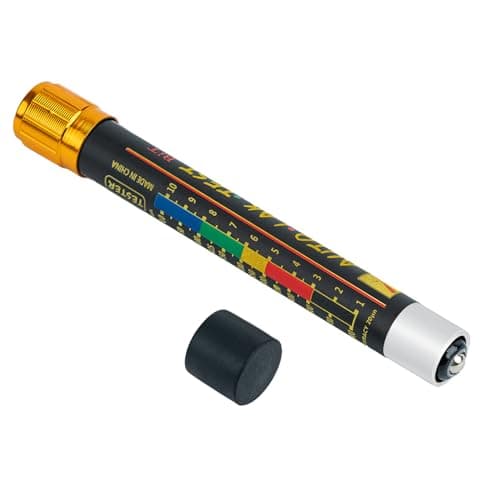
1. Does it read non-ferrous panels? This is the first filter and it disqualifies a whole product tier. Cheap testers work by magnetic attraction: the magnet is pulled toward the steel under the paint, and the force tells you roughly how much coating is in the way. On an aluminum hood, a composite bumper or a carbon panel there is nothing magnetic to pull toward, so the tool reads nothing — and crucially, most of them will not tell you that. Modern cars use aluminum hoods and fenders routinely. A gauge with a genuine Fe/NFe probe handles both; a magnetic tester handles steel and silently fails everywhere else.
2. Does it publish a resolution and a calibration claim? A listing that states 0.1 micron resolution and factory calibration is making a specific, checkable claim. A listing that says "accurate" is making none. For the comparative work that matters most — panel versus panel on the same car — even a mediocre gauge is useful, because its errors are consistent. For absolute numbers you would stake a customer conversation on, published specifications are the whole difference.
3. How fast is a full-car survey? A proper baseline is 30 to 40 readings: several points on each panel, including edges and high spots, because paint is thinnest exactly where polishers linger. Gauges with a continuous-measurement mode turn that from a tedious chore into a sweep, which matters mostly because a survey you find tedious is a survey you will skip next time.
4. Can you hold it square? Every probe gauge reads low if it is tilted off perpendicular to the surface, and reads erratically if it is moving. On a flat hood that is easy. On a curved rocker panel or inside a door shut it is not, and a gauge with a rotating display or a well-shaped body genuinely helps.
5. What it cannot do. No gauge in this price class separates clear coat from basecoat. None of them measures how hard the paint is, which is a completely separate variable that decides how your compound behaves — see hard paint vs soft paint. And no gauge tells you how many corrections a panel has already had. It tells you what is there now, which is enough to keep you out of trouble and not enough to make the decision for you.
How to read the numbers you get
Take your readings on a clean, dry, decontaminated car — a layer of bonded grime will skew a measurement, which is one more reason decontamination comes first. Record several points per panel rather than one, and write them down; a photo of a notepad with panel names and numbers is worth more at the end of the day than a figure you half remember.
Then look for patterns rather than verdicts. A set of readings clustered within roughly 20 microns of each other across the whole car is an original, untouched finish and your baseline. One panel sitting substantially higher than its neighbors has been resprayed, which means an unknown clear coat of unknown age and quality — respray clear is usually softer than factory clear, it may have been sanded thin during bodywork, and it is where people burn through. A reading several times the baseline means filler, and filler means you keep a machine polisher away from the area entirely. A panel reading well below the baseline has already been cut, by a previous owner or a previous detailer, and it is the panel you treat most conservatively.
The practical rule that falls out of all this: decide your aggression per panel, not per car. Start with the least aggressive combination that works, test it on a small section first, and let the readings tell you which panels get the lighter polish rather than the compound. That is a workflow decision, and the gauge exists to inform it — the sequence itself is covered in paint correction for beginners.
Do you actually need one?
Honest answer: not for a single light polish on a car you know the history of. A one-step finishing polish with a soft pad on a dual action removes a very small fraction of a micron per pass, and the risk of trouble is close to zero. If that is your whole plan, buy a better pad instead.
A gauge starts earning its place the moment any of four things is true. You bought the car used and do not know its history. You are planning multi-step correction with a cutting compound, or any kind of wet sanding. You are working on someone else's car for money. Or you have already corrected this car once or twice and want to know how much headroom is left before a third pass. In those situations the cost of the gauge is a rounding error against the cost of a respray, and the ten-dollar magnetic tester in last place on this page is still better than guessing — as long as the panel is steel and you understand exactly what it is and is not telling you.
Using a gauge well
Survey the car before you open a single bottle
The survey belongs at the start of the job, after the wash and decontamination and before the first test spot. Readings taken on a dirty car are not trustworthy, and readings taken after you have started polishing have lost their reference point. Thirty to forty points, written down, panel by panel.
Measure the places that actually fail
Paint is thinnest on sharp body lines, panel edges, the crowns of curves and the high points of a crease — the places a pad bears down hardest and dwells longest. Those are the readings that matter, and they are the ones people skip because they are awkward to reach. Flat panel centers almost never burn through. Edges do.
Hold the probe square, still, and on a flat spot
Perpendicular to the surface, resting without pressure, and held still until the reading settles. Tilt reads low, movement reads erratic, and a reading taken on a tight curve is worth less than one taken two inches away on the flat. If a number looks surprising, take it again before you believe it.
Compare, do not adjudicate
The most reliable output of a cheap gauge is the comparison between two panels on the same car, measured minutes apart with the same tool and the same technique. Whatever systematic error the instrument has is common to both readings, so the difference survives even when the absolute figures are soft. Treat the comparison as the signal and the absolute number as context.
Keep the records
Write the readings down with the date, and keep them. The second time you correct the car, two or three years later, that sheet is the only thing in the world that can tell you what the first correction actually cost you. Nobody regrets having kept it, and the people who work on cars for money quote from it.
Know the tool's limits and say them out loud
A gauge measures total film build on metal. It does not isolate clear coat, it does not work on plastic bumpers, it does not measure paint hardness, and it does not know what the previous owner did. It removes one specific category of expensive surprise — unknown respray, hidden filler, an already-thin panel — and leaves every other judgment where it was. That is worth real money, and it is not the same thing as safety.