Skip to content
Pad & Polish

HUB 03 · Compounds & Polishes

Best Polishing Compound for Cars

The bottle that turns a corrected panel into a glossy one — five finishing polishes ranked on gloss, not on cut.

By Stephen V.Updated How we research
#ad

We earn a commission when you buy through our Amazon links, at no extra cost to you. It never affects our rankings, and we say so when the cheaper product is the better buy. How this works.

"Polishing compound" is one of the most confusing labels on a detailing shelf, because half the industry uses it to mean a mild abrasive that refines a surface and the other half uses it as a synonym for anything in a bottle you rub on paint. This page uses the first meaning, which is the useful one: a polish is the fine-abrasive product that comes after a cutting compound and turns a corrected but slightly hazy panel into a genuinely glossy one.

If you are still working out which product you actually need, read polish vs compound first — it is the single most useful ten minutes in this category, and it will stop you buying a finishing polish to fix scratches it cannot touch.

What a finishing polish is doing

A cutting compound removes defects by abrading a very thin layer of clear coat. In doing so it leaves its own marks — far finer than the swirls it removed, but present, and on dark paint clearly visible as a slight cloudiness in reflections. A finishing polish uses much smaller abrasives, usually ones that break down further as you work them, to refine that surface until it reflects cleanly.

The result is not "more shine" in any additive sense. Nothing is being added. The panel simply becomes flat enough at a microscopic level to reflect light coherently, which the eye reads as depth and gloss. That is also why a finishing polish cannot rescue a poor correction: it refines whatever surface you hand it, swirls included.

Fillers, and why we care

Some consumer polishes contain oils and fillers that temporarily hide fine defects. They make a panel look superb on the day and let it revert over the following few washes. That is not fraud — for someone selling a car next week, it is arguably exactly the right product — but it does mean you cannot tell whether your correction actually worked.

Body-shop-safe or "no filler" polishes deliberately leave nothing behind, so what you see after the wipe-down is what you have. If your polish is the last step before a ceramic coating, a filler-free product is not optional: a coating bonded over filler oils fails early, and the panel wipe step in our panel wipe picks exists specifically to remove them.

Pad pairing decides half the result

A finishing polish on a cutting pad is not a finishing step — the pad is doing the work and you will still have haze. Load it on a soft finishing pad instead, run a moderate speed, and use the weight of the machine rather than pressure. If a polish seems to be doing nothing, that is closer to correct than the alternative; the change shows up in reflections, not in the pad.

One-step polishes are the exception worth knowing about. A well-formulated one-step carries enough abrasive to remove light swirls and enough refinement to finish in the same pass, which collapses two steps into one on paint that is not badly damaged. It is the shortest honest route from dull to done, and one sits third below for exactly that reason.

The short answer

Quick picks

#ProductBest forScorePrice
01
Meguiar's Meguiar's Professional M205 Ultra Finishing Polish
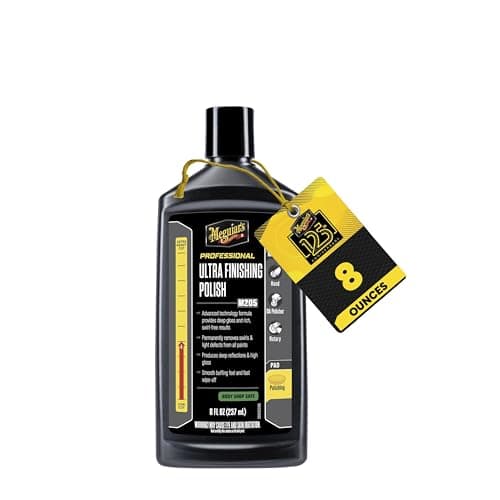
Meguiar's Professional M205 Ultra Finishing Polish

The professional finishing polish the whole hobby benchmarks against: it removes the haze a cutting compound leaves and finishes clear, with no fillers hiding what is still underneath.

The gloss pass after a cutting compound
8.1
$16.92Amazon
02
Menzerna Menzerna Super Finish Plus 3800
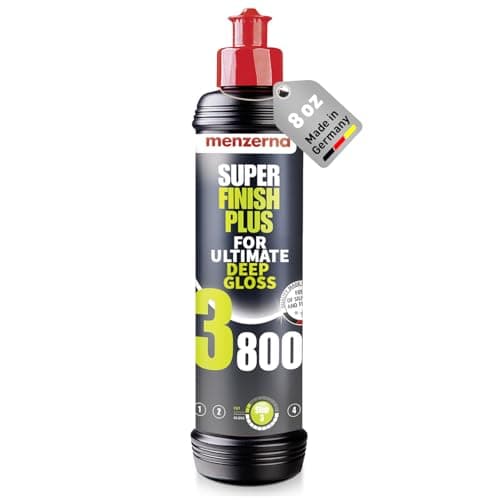
Menzerna Super Finish Plus 3800

The specialist's finishing polish: a German body-shop-lineage formula aimed squarely at the holograms and micro-marring a rotary leaves behind, which is the exact defect that ruins black paint under sunlight.

Removing holograms and micro-marring from dark paint
7.1
$15.99Amazon
03
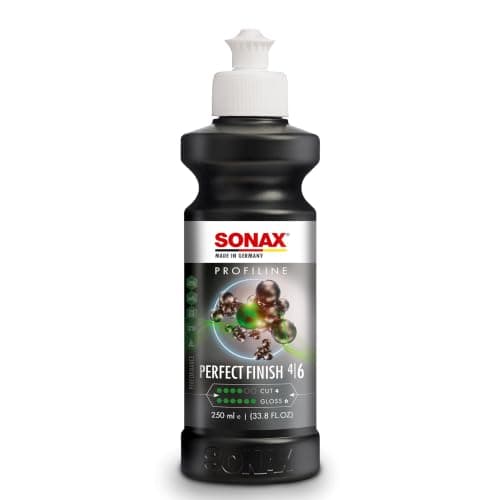
SONAX SONAX Perfect Finish
SONAX Perfect Finish

A genuinely capable one-step: enough abrasive to take out light swirls and enough refinement to leave gloss behind, which makes it the shortest honest route from dull to done.

A single-bottle correction on ordinary swirl damage
8.2
$24.86Amazon
04
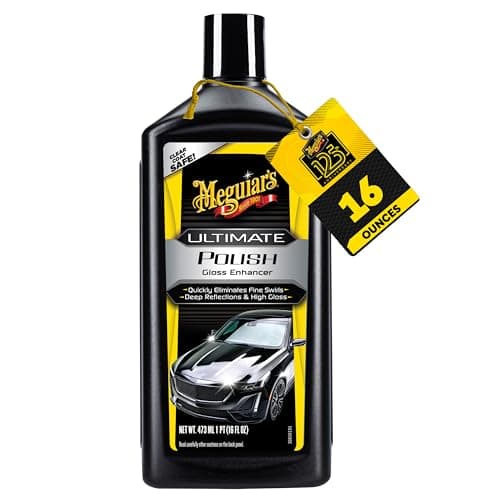
Meguiar's Meguiar's Ultimate Polish
Meguiar's Ultimate Polish

The gloss step, not a correction step: an extremely fine polish that darkens and deepens paint after compounding, which is exactly what black and dark-metallic finishes need before wax goes on.

The gloss pass after compounding, especially on dark paint
7.7
$9.67Amazon
05
Chemical Guys Chemical Guys V38 Optical Grade Final Finishing Polish
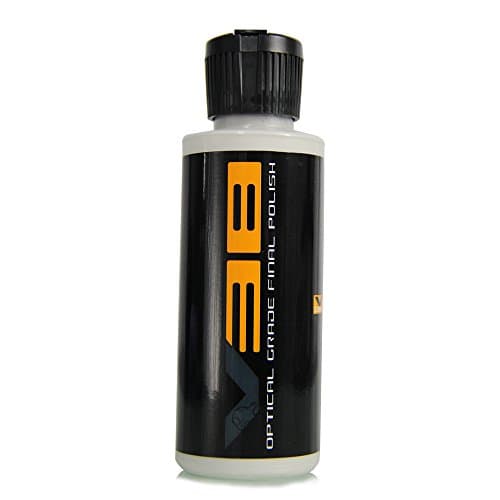
Chemical Guys V38 Optical Grade Final Finishing Polish

The last rung of the V-Line ladder, sold in a 4 oz bottle — the cheapest way to find out whether a dedicated final-finish step visibly changes your paint before you buy a full-size bottle.

Sampling a true final-finish step cheaply
7.6
$10.99Amazon

#ad · Live prices from the Amazon Product API, as of Sep 4, 2026. Where we have no verified live price, we show none — we would rather leave a gap than print a number that has rotted.

In detail

The picks, in full

01
Meguiar's Meguiar's Professional M205 Ultra Finishing Polish

The gloss pass after a cutting compound

Meguiar's Professional M205 Ultra Finishing Polish

8 ozUltra-finishing polishBody-shop safePairs with M105
8.1/10

The professional finishing polish the whole hobby benchmarks against: it removes the haze a cutting compound leaves and finishes clear, with no fillers hiding what is still underneath.

Gloss
9.4
Cut
5.4
Ease of use
8.6
Value
8.8

Pros

  • Body-shop safe formula leaves nothing behind to mask defects
  • Long working time, so a panel does not dry out mid-pass
  • The other half of the most-documented two-step in detailing

Cons

  • Almost no cut — it will not remove swirls on its own
  • Professional-line packaging with no applicator included

Don't buy this if…

you want one bottle that both corrects and finishes.

$16.92View on Amazon

Price as of Sep 4, 2026. Prices change — Amazon's is the one that counts.

#ad · we may earn a commission from this link to Meguiar's Professional M205 Ultra Finishing Polish

02
Menzerna Menzerna Super Finish Plus 3800

Removing holograms and micro-marring from dark paint

Menzerna Super Finish Plus 3800

8 fl ozFinishing polishHologram removalSilicone-free
7.1/10

The specialist's finishing polish: a German body-shop-lineage formula aimed squarely at the holograms and micro-marring a rotary leaves behind, which is the exact defect that ruins black paint under sunlight.

Cutting power
3.4
Finish quality
9.4
Ease of use
8
Value
7.6

Pros

  • Targets rotary holograms that ordinary polishes just hide
  • Silicone-free, so it does not mask what is left underneath
  • Long working time makes it forgiving to spread

Cons

  • Small bottle for the money compared with mainstream polishes
  • Needs a soft finishing pad and patience to show its advantage

Don't buy this if…

you only ever run a dual-action — a mainstream finishing polish covers you for far less.

$15.99View on Amazon

Price as of Sep 4, 2026. Prices change — Amazon's is the one that counts.

#ad · we may earn a commission from this link to Menzerna Super Finish Plus 3800

03
SONAX SONAX Perfect Finish

A single-bottle correction on ordinary swirl damage

SONAX Perfect Finish

250 mlOne-step correction + glossMachine polishFine abrasive
8.2/10

A genuinely capable one-step: enough abrasive to take out light swirls and enough refinement to leave gloss behind, which makes it the shortest honest route from dull to done.

Gloss
8.8
Cut
7.4
Ease of use
8.8
Value
7.8

Pros

  • Correcting and finishing in one pass saves an entire pad change
  • German professional line with a long, consistent track record
  • Works on a DA without needing rotary speeds

Cons

  • Not enough cut for deep scratches or heavy oxidation
  • Costs more per ounce than the American value polishes

Don't buy this if…

your paint has real defects — a dedicated compound comes first.

$24.86View on Amazon

Price as of Sep 4, 2026. Prices change — Amazon's is the one that counts.

#ad · we may earn a commission from this link to SONAX Perfect Finish

04
Meguiar's Meguiar's Ultimate Polish

The gloss pass after compounding, especially on dark paint

Meguiar's Ultimate Polish

16 ozFine finishing polishHand or DAUse before wax or sealant
7.7/10

The gloss step, not a correction step: an extremely fine polish that darkens and deepens paint after compounding, which is exactly what black and dark-metallic finishes need before wax goes on.

Cutting power
3
Finish quality
9.2
Ease of use
9.2
Value
9.2

Pros

  • Adds visible depth to dark paint that compound alone leaves flat
  • Almost impossible to over-correct with — very low cut
  • One of the cheapest bottles in the whole category

Cons

  • Removes essentially no defects on its own
  • Adds a whole extra step to an already long job

Don't buy this if…

your paint still has swirls — compound first, then come back to this.

$9.67View on Amazon

$12.9926% off

Price as of Sep 4, 2026. Prices change — Amazon's is the one that counts.

#ad · we may earn a commission from this link to Meguiar's Ultimate Polish

05
Chemical Guys Chemical Guys V38 Optical Grade Final Finishing Polish

Sampling a true final-finish step cheaply

Chemical Guys V38 Optical Grade Final Finishing Polish

4 ozFinal finishing stepOptical-grade abrasivesV-Line step 4
7.6/10

The last rung of the V-Line ladder, sold in a 4 oz bottle — the cheapest way to find out whether a dedicated final-finish step visibly changes your paint before you buy a full-size bottle.

Gloss
8.8
Cut
5
Ease of use
8.4
Value
8.2

Pros

  • Small bottle keeps the cost of experimenting near nothing
  • Slots cleanly into the V32/V34/V36 ladder if you already run it
  • Diminishing abrasives break down predictably on a DA

Cons

  • 4 oz does not go far past a couple of panels
  • Cut is deliberately minimal — strictly a final step

Don't buy this if…

you are polishing a full car — buy the 16 oz size or the kit.

$10.99View on Amazon

Price as of Sep 4, 2026. Prices change — Amazon's is the one that counts.

#ad · we may earn a commission from this link to Chemical Guys V38 Optical Grade Final Finishing Polish

How to choose a polishing compound

Work backwards from the defects you have left after correcting, not from the product hierarchy on the shelf.

Decide what is actually still there

  • Light haze from a cutting pass — a dedicated finishing polish. This is the intended use of everything on this page.
  • Fine swirls and nothing worse — a one-step polish, which corrects and finishes together and saves you a pad change.
  • Visible scratches or oxidation — you are in the wrong category. See cutting compounds or compounds for oxidized paint.

Abrasive behavior

Diminishing abrasives start coarser and break down as you work them, which means a single pass cuts first and refines afterwards — forgiving, and the reason working time matters. Non-diminishing abrasives hold a constant cut for as long as you work, which is more predictable but requires you to know when to stop. Either works; what matters is following the manufacturer's pass count rather than improvising.

Working time

A polish that flashes dry halfway across a panel is unpleasant to use and finishes badly. Professional-line products generally have longer working times, which is one of the real differences between a body-shop bottle and a consumer one, and it matters more in a hot garage than any specification on the label.

Bottle size and honest math

Finishing polish is used sparingly — a few pea-sized drops per section — so a small bottle goes a long way, and the cheapest way to find out whether a dedicated finishing step visibly changes your paint is to buy the smallest size available rather than committing to a liter. Two of the picks below exist on this page specifically because they are cheap to try.

The mistake to avoid

Skipping the test spot. Paint hardness varies enormously by manufacturer, color and whether the panel has been repainted, and a polish that finishes perfectly on soft Japanese clear can leave faint haze on hard German clear with the same pad and speed. Work a small low-visibility section, wipe it with a clean towel, and inspect under bright light before committing to a panel — the full sequence is in how to polish a car step by step.
How we picked

We do not run a testing lab

We compiled published specifications, manufacturer data sheets and aggregated owner reviews, computed the cost of ownership from real sizes and coverage, then scored each product against a published rubric. The scores are judgments from documented research — they are not measurements we took, because we do not own a lab and we are not going to pretend we do. Where a number came from someone else, we name them and link them in Sources.

Questions

Frequently asked

What is the difference between polishing compound and rubbing compound?
Rubbing compound is the coarser product that removes defects; polishing compound is the finer product that refines the surface afterwards. Rubbing compound corrects and hazes, polish clears the haze and produces gloss.
Do I need a polishing compound after a cutting compound?
On dark paint, almost always — a cutting pass leaves a fine haze that is clearly visible in reflections. On white or silver paint it is often invisible, and you may reasonably skip it.
Can polishing compound remove scratches?
Only the very finest marring. A polish uses small abrasives to refine a surface, not to level a scratch. Anything you can see clearly, let alone catch with a fingernail, needs a cutting compound or a body shop.
What pad should I use with a polishing compound?
A soft finishing pad, at moderate speed, using the weight of the machine rather than pressure. Running a fine polish on a cutting pad defeats the point — the pad will keep hazing what the polish is trying to refine.
Are fillers in a polish a problem?
Only sometimes. Fillers temporarily hide fine defects, which is fine before a sale and misleading if you are assessing your own correction. Before a ceramic coating they are a real problem — the coating bonds to the filler, not the paint.

Keep reading

Receipts

Sources

We do not run a testing lab, and we do not pretend to. Where a measured number came from someone else's lab, we name them and link them. Where we could not verify something, we say so on the page rather than quietly leaving it out. Read our full method.