Skip to content
Pad & Polish

HUB 03 · Compounds & Polishes

Hard Paint vs Soft Paint

The variable that decides every other correction decision, and a twenty-minute test that settles it on your car rather than on a forum's car.

By Stephen V.Updated How we research
#ad

We earn a commission when you buy through our Amazon links, at no extra cost to you. It never affects our rankings, and we say so when the cheaper product is the better buy. How this works.

Every buying guide on this site assumes a fact about your car that none of them can know: how hard its clear coat is. Hardness decides how much abrasive a defect needs, which pad will present it properly, how many passes the job takes, and — on the soft end — whether the thing you are about to buy will create more marring than it removes. Two identical cars in the same color, one of them repainted, can sit at opposite ends of this scale.

The short version: hard paint resists correcting and resists marking. It holds up well to washing and holds onto its swirls when you try to remove them. Soft paint does the opposite — it corrects in a pass or two and picks up marring from a drying towel. Neither is better. They want completely different shopping lists, and buying the wrong one is the most common expensive mistake in home paint correction.

The badge is a hint, not an answer

The industry shorthand is real and worth knowing. German manufacturers have long used ceramic-reinforced and scratch-resistant clear coat systems, and detailers consistently describe BMW, Audi, Mercedes-Benz, Volkswagen and Porsche finishes as hard to correct. Many Japanese finishes sit at the other end — Honda in particular has a decades-old reputation for soft, easily marred clear. Detailed Image, Jimbo's Detailing and the long-running Autogeek thread on paint hardness by make all describe that same split.

And all of them add the same warning. Hardness varies by model year, by assembly plant, by color, and completely by repaint history — a resprayed fender on a German car can be softer than anything the factory ever applied, and fresh refinish paint is softer again while it cures. Treat the badge as a prior, then test.

The test spot that settles it

This takes about twenty minutes and it is the only method that describes your car rather than a category.

  1. Wash and decontaminate one low-visibility panel. Grit dragged under a pad is a false result and a new defect at the same time.
  2. Pick a two-foot square and run your mildest realistic combination — a medium one-step on a light-cut foam pad — for four or five slow, overlapping passes.
  3. Wipe the section down with a panel wipe or a diluted isopropyl alcohol solution. Polishing oils temporarily fill and hide the very defects you are grading, so skipping this step is how people conclude they have soft paint when they do not.
  4. Inspect under a hard, focused light, from more than one angle.
What you see after the wipe-downWhat it meansWhat to buy
Swirls gone in two or three passes, surface clearSoft to medium paintStay where you are — a one-step and a finishing polish is the whole kit
Swirls gone, but a faint uniform haze replaced themSoft paint, marring easilyA fine finishing polish on a soft pad, and gentler technique
Clearly improved, not clearMedium-hardMore cut: a dedicated compound on a light-cut pad
Essentially unchangedHard paintA heavy SMAT compound and, first, a microfiber cutting pad
Color rather than neutral gray transferring to the padSingle-stage paint, or you are through the clearStop immediately — this is not a hardness question any more

What hard paint needs

More abrasive, a more aggressive pad, firm pressure, slow arm speed, and patience. The most useful single change is the pad: microfiber or knitted wool presents abrasive to the surface far more aggressively than foam, and on hard clear that usually moves the result more than swapping one compound for a slightly heavier one. SMAT-style compounds are preferred here because their abrasives do not finish breaking down before the defect finishes leveling. The full shopping list is on best compound for hard paint, and the pad half is ranked on best microfiber cutting pads.

What soft paint needs

Less of everything, and a different failure mode to watch for. Soft clear corrects quickly and then keeps recording what you do to it — so the risk is not that you fail to remove the swirls, it is that you remove them and leave a new haze behind. That means a lower machine speed, a softer pad, a fine finishing liquid, and a discipline about stopping. Body-shop-safe, filler-free finishing polishes matter more here than anywhere, because a filler-containing product on soft paint will look perfect for three weeks and then look exactly as it did before.

Soft paint is also the reason to be careful with everything downstream of the polish. Drying towels, wash mitts and an over-enthusiastic buff-off can put marks back into a freshly finished soft panel in minutes — see our microfiber towel picks and how to wash a car without scratching it.

The five products below, split by end of the range

The first two picks are the hard-paint end — a professional SMAT cutter and a heavy European compound, both of which expect a second stage behind them. Picks three and four are the soft-paint end: fine finishing liquids with almost no cut, which is the point. The fifth sits in the middle, for paint that turns out to be ordinary and for anyone who would rather own one bottle than four. Prices are live and date-stamped.

The short answer

Quick picks

#ProductBest forScorePrice
01
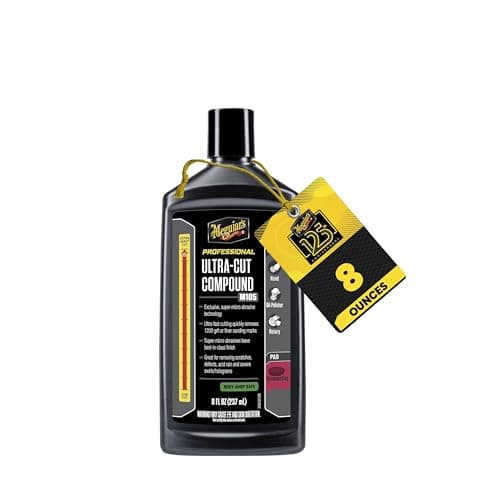
Meguiar's Meguiar's Mirror Glaze M105 Ultra-Cut Compound
Meguiar's Mirror Glaze M105 Ultra-Cut Compound

The body-shop heavy cutter: a professional SMAT compound that removes serious defects and sanding marks fast, but it works best in trained hands and usually needs a finishing polish after.

Heavy correction and sanding-mark removal
7.8
$16.99Amazon
02
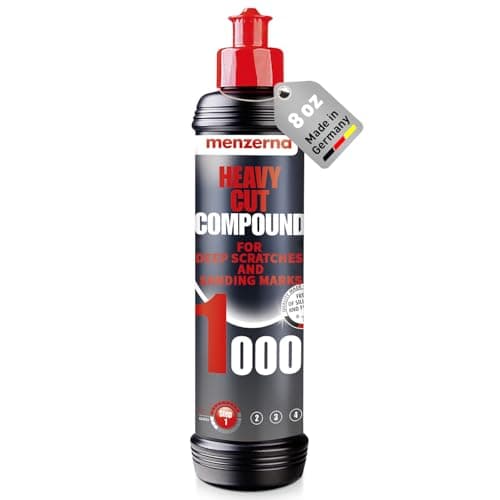
Menzerna Menzerna Heavy Cut Compound 1000
Menzerna Heavy Cut Compound 1000

The cut half of the ladder this site already recommended the polish half of: rated 9 for cut and 3 for gloss on Menzerna's own scale, which is exactly the trade you want when the defects are past what a consumer one-step will level and a finishing polish is already lined up behind it.

The heavy cut stage of a true two-stage correction
7.8
$15.99Amazon
03
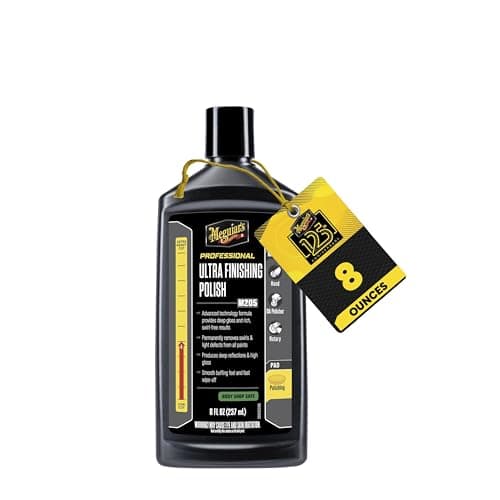
Meguiar's Meguiar's Professional M205 Ultra Finishing Polish
Meguiar's Professional M205 Ultra Finishing Polish

The professional finishing polish the whole hobby benchmarks against: it removes the haze a cutting compound leaves and finishes clear, with no fillers hiding what is still underneath.

The gloss pass after a cutting compound
8.1
$13.99Amazon
04
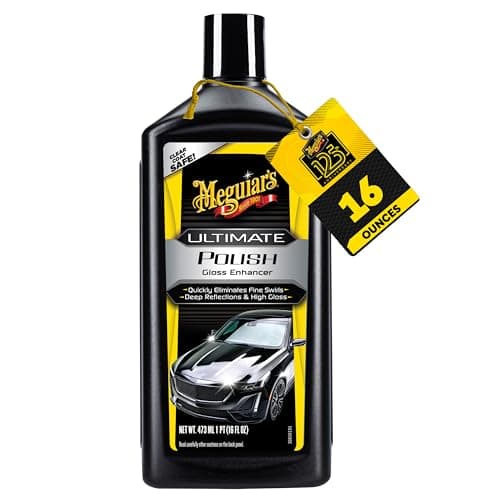
Meguiar's Meguiar's Ultimate Polish
Meguiar's Ultimate Polish

The gloss step, not a correction step: an extremely fine polish that darkens and deepens paint after compounding, which is exactly what black and dark-metallic finishes need before wax goes on.

The gloss pass after compounding, especially on dark paint
7.7
$9.67Amazon
05
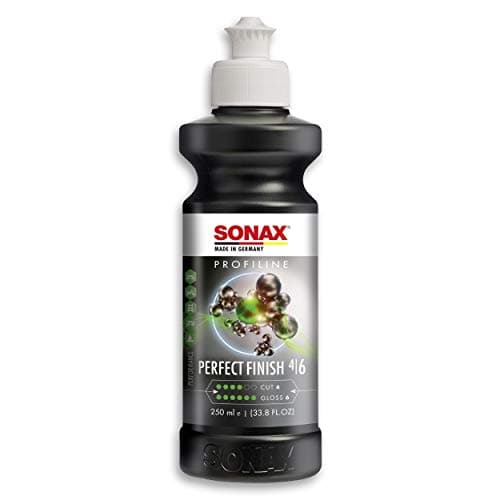
SONAX SONAX Perfect Finish
SONAX Perfect Finish

A genuinely capable one-step: enough abrasive to take out light swirls and enough refinement to leave gloss behind, which makes it the shortest honest route from dull to done.

A single-bottle correction on ordinary swirl damage
8.2
$25.31Amazon

#ad · Live prices from the Amazon Product API, as of Sep 18, 2026. Where we have no verified live price, we show none — we would rather leave a gap than print a number that has rotted.

In detail

The picks, in full

01
Meguiar's Meguiar's Mirror Glaze M105 Ultra-Cut Compound

Heavy correction and sanding-mark removal

Meguiar's Mirror Glaze M105 Ultra-Cut Compound

Aggressive cutSMAT abrasivesBody-shop gradeFast defect removal
7.8/10

The body-shop heavy cutter: a professional SMAT compound that removes serious defects and sanding marks fast, but it works best in trained hands and usually needs a finishing polish after.

Cutting power
9.3
Finishing ability
7
Ease of use
6.6
Value
8.2

Pros

  • Removes deep defects and sanding marks quickly
  • SMAT chemistry means no long break-in of the abrasives
  • A professional standard for heavy correction

Cons

  • Can dust and grab; less beginner-friendly
  • Almost always needs a follow-up polish to refine

Don't buy this if…

you're new to machine polishing — start with a forgiving all-in-one like Ultimate Compound.

$16.99View on Amazon

Price as of Sep 18, 2026. Prices change — Amazon's is the one that counts.

#ad · we may earn a commission from this link to Meguiar's Mirror Glaze M105 Ultra-Cut Compound

02
Menzerna Menzerna Heavy Cut Compound 1000

The heavy cut stage of a true two-stage correction

Menzerna Heavy Cut Compound 1000

Cut 9 / gloss 3Clears P1500–P2000 sanding marksSilicone- and filler-free8 fl oz
7.8/10

The cut half of the ladder this site already recommended the polish half of: rated 9 for cut and 3 for gloss on Menzerna's own scale, which is exactly the trade you want when the defects are past what a consumer one-step will level and a finishing polish is already lined up behind it.

Cutting power
9.4
Finishing ability
6.2
Ease of use
7
Value
8.4

Pros

  • Levels defects a consumer one-step slides straight over, including refinish sanding marks
  • Silicone- and filler-free, so the wipe-down shows what you actually corrected rather than what is being hidden
  • Runs on a dual-action as well as a rotary, and pairs directly with Super Finish Plus 3800

Cons

  • A gloss rating of 3 means it always needs a polish stage after it — this is not a one-step
  • Wants a wool or heavy-cut foam pad and real pressure; a soft pad wastes most of it
  • Eight ounces is a small bottle to take around a whole car

Don't buy this if…

you have not test-spotted with something milder — this removes more clear coat than ordinary daily-driver swirls need.

$15.99View on Amazon

Price as of Sep 18, 2026. Prices change — Amazon's is the one that counts.

#ad · we may earn a commission from this link to Menzerna Heavy Cut Compound 1000

03
Meguiar's Meguiar's Professional M205 Ultra Finishing Polish

The gloss pass after a cutting compound

Meguiar's Professional M205 Ultra Finishing Polish

8 ozUltra-finishing polishBody-shop safePairs with M105
8.1/10

The professional finishing polish the whole hobby benchmarks against: it removes the haze a cutting compound leaves and finishes clear, with no fillers hiding what is still underneath.

Gloss
9.4
Cut
5.4
Ease of use
8.6
Value
8.8

Pros

  • Body-shop safe formula leaves nothing behind to mask defects
  • Long working time, so a panel does not dry out mid-pass
  • The other half of the most-documented two-step in detailing

Cons

  • Almost no cut — it will not remove swirls on its own
  • Professional-line packaging with no applicator included

Don't buy this if…

you want one bottle that both corrects and finishes.

$13.99View on Amazon

$16.8617% off

Price as of Sep 18, 2026. Prices change — Amazon's is the one that counts.

#ad · we may earn a commission from this link to Meguiar's Professional M205 Ultra Finishing Polish

04
Meguiar's Meguiar's Ultimate Polish

The gloss pass after compounding, especially on dark paint

Meguiar's Ultimate Polish

16 ozFine finishing polishHand or DAUse before wax or sealant
7.7/10

The gloss step, not a correction step: an extremely fine polish that darkens and deepens paint after compounding, which is exactly what black and dark-metallic finishes need before wax goes on.

Cutting power
3
Finish quality
9.2
Ease of use
9.2
Value
9.2

Pros

  • Adds visible depth to dark paint that compound alone leaves flat
  • Almost impossible to over-correct with — very low cut
  • One of the cheapest bottles in the whole category

Cons

  • Removes essentially no defects on its own
  • Adds a whole extra step to an already long job

Don't buy this if…

your paint still has swirls — compound first, then come back to this.

$9.67View on Amazon

$12.9926% off

Price as of Sep 18, 2026. Prices change — Amazon's is the one that counts.

#ad · we may earn a commission from this link to Meguiar's Ultimate Polish

05
SONAX SONAX Perfect Finish

A single-bottle correction on ordinary swirl damage

SONAX Perfect Finish

250 mlOne-step correction + glossMachine polishFine abrasive
8.2/10

A genuinely capable one-step: enough abrasive to take out light swirls and enough refinement to leave gloss behind, which makes it the shortest honest route from dull to done.

Gloss
8.8
Cut
7.4
Ease of use
8.8
Value
7.8

Pros

  • Correcting and finishing in one pass saves an entire pad change
  • German professional line with a long, consistent track record
  • Works on a DA without needing rotary speeds

Cons

  • Not enough cut for deep scratches or heavy oxidation
  • Costs more per ounce than the American value polishes

Don't buy this if…

your paint has real defects — a dedicated compound comes first.

$25.31View on Amazon

Price as of Sep 18, 2026. Prices change — Amazon's is the one that counts.

#ad · we may earn a commission from this link to SONAX Perfect Finish

Reading the result honestly

Do the wipe-down, every time

More hardness misdiagnoses come from skipping the panel wipe than from anything else. Polishing oils sit in the scratch and refract light the way undamaged clear does, so a panel genuinely looks corrected for as long as the oils are there. Wipe the section down and re-inspect before you form an opinion, and prefer filler-free products while you are testing so the question does not arise. Our panel wipe picks are the tool for this.

Test a repainted panel separately

A repaint is a different paint system from the rest of the car, usually softer, sometimes much softer, and often thinner. If a panel's reflections look subtly different from its neighbors, or if the car has an accident history, test that panel on its own and expect to use a gentler combination on it.

Hard paint is not permission to press harder for longer

Hard clear is still only microns thick. The correct response to hard paint is a more aggressive pad and a compound that keeps cutting, not ten passes of the same thing with your weight behind it — that mostly produces heat, and heat is how panels get damaged. Stop at four to six passes per section and change a variable instead. Will rubbing compound damage clear coat covers the warning signs worth stopping for.

Soft paint rewards a one-step

If your test section corrected in two passes, the entire two-stage apparatus is optional. A capable one-step on a light-cut pad will take soft, lightly swirled paint to a genuinely good finish in a single pass, which is less time, fewer pads and less clear coat spent. That is what the fifth pick is for, and polish or compound first explains when skipping a stage is the right call rather than a shortcut.

Keep a record

Write down what worked, on which panel, at what speed. Paint hardness is a property of the car, not of the session, so the combination that corrected your hood in September is the combination that will correct your door next spring — and it saves you re-running the test every time you buy a new bottle.
How we picked

We do not run a testing lab

We compiled published specifications, manufacturer data sheets and aggregated owner reviews, computed the cost of ownership from real sizes and coverage, then scored each product against a published rubric. The scores are judgments from documented research — they are not measurements we took, because we do not own a lab and we are not going to pretend we do. Where a number came from someone else, we name them and link them in Sources.

Questions

Frequently asked

How do I tell if my car has hard or soft paint?
Run a test section on a low-visibility panel with your mildest realistic compound-and-pad combination, four or five slow passes, then wipe the area down with a panel wipe or diluted isopropyl alcohol and inspect under a hard light. Corrected in two or three passes is soft to medium. Clearly improved but not clear is medium-hard. Essentially unchanged is hard paint. The wipe-down is what makes the reading honest.
Do German cars have hard paint and Japanese cars soft paint?
As a tendency, yes, and it is a useful starting assumption. German manufacturers have used ceramic-reinforced and scratch-resistant clear coat systems that detailers consistently report as hard to correct, while many Japanese finishes — Honda especially — have a long-standing reputation for softness. But hardness varies with model year, plant, color and repaint history, so the badge is a prior, not an answer.
Is soft paint easier to work on?
Easier to correct, harder to keep. Soft clear levels in a pass or two, but it also records everything you do to it afterward — a finishing pad that is slightly too aggressive, a drying towel that is slightly too coarse, a buff-off with a loaded microfiber. On soft paint the skill is stopping early and protecting the result, not generating cut.
Can the same car have both hard and soft panels?
Yes, and it is common on any car with an accident history. Refinish paint is a different system from the factory clear, usually softer and often thinner, and fresh refinish is softer still while it cures. Test a repainted panel separately and use a gentler combination on it.
Does hard paint mean I can polish it more often?
No. Hard paint resists being cut, which means each correction costs you more passes to achieve the same result — not that the passes are free. A scratch-resistant clear coat is still only microns thick, and everything removed is permanent. Correct when a defect justifies it, with the mildest combination that actually works.

Keep reading

Receipts

Sources

We do not run a testing lab, and we do not pretend to. Where a measured number came from someone else's lab, we name them and link them. Where we could not verify something, we say so on the page rather than quietly leaving it out. Read our full method.