Carnauba is the wax people mean when they say a car looks wet. It comes from the leaves of the carnauba palm, Copernicia prunifera, which grows only in northeastern Brazil, and it has been the default “good wax” for as long as there has been a car-care aisle. What it buys you is a look: warm, deep, faintly liquid, and most visible on dark paint. What it costs you is lifespan — a traditional carnauba is measured in weeks of regular washing, not in seasons. The exception that proves the rule is Collinite's polymer-loaded paste, set against its liquid sibling in Collinite 845 vs 476S.
This page ranks the carnauba side of that aisle on its own. If durability is what you care about most, the synthetic side is ranked separately in best paint sealant, and whether you want carnauba at all is settled in carnauba vs synthetic wax. Everything below assumes you have already decided you want the glow, and asks which tin delivers it with the fewest compromises.
How we ranked them
Five criteria, weighted in this order:
- The look. Warmth and depth are the reason carnauba exists. A carnauba wax that looks like a synthetic sealant has failed at its one job.
- Durability, honestly stated. This is carnauba’s weak point, so it carries real weight. We use the manufacturer’s own published figure where there is one and say plainly where there is not — of these six, only Collinite puts a number on it.
- Buff-off effort and trim. The difference between a relaxed Saturday and a sore shoulder is mostly how hard the haze fights back, and whether it works its way into textured black plastic.
- Pure wax or cleaner wax. Neither is better; they suit different paint. We flag which is which so you do not buy abrasives for paint that has already been polished.
- Value per application. Not the shelf price. A tin that stays on the car twice as long costs half as much per protected month, and your Saturdays are the expensive part.
The first four picks are general-purpose carnauba waxes, ranked against each other. Picks five and six are specialists — a cleaner wax for paint that has never been polished, and a spray for topping up between full applications. They sit lower because they answer narrower questions, not because they are weaker products; their scores are judged within those narrower jobs.
No tin on the shelf is pure carnauba
Raw carnauba is among the hardest natural waxes, and it does not melt until roughly 180–187°F(82–86°C). In that form you could not spread it on a panel at all. Every carnauba car wax you can buy is therefore a formulation built around it — the carnauba carried in something that makes it spreadable, and in most modern tins blended with synthetic polymers so it lasts longer. Meguiar’s and Collinite both describe the products on this page as carnauba-and-polymer blends in so many words.
Two label words are worth decoding. “#1 grade” or “#1 yellow” is a statement about the purity of the carnauba in the tin — commercial carnauba is graded by how refined it is — not about how much of the tin is carnauba. And “pure” on a label, as in Mothers’ Pure Brazilian Carnauba Wax, is best read as “a pure wax, not a cleaner wax,” which is how Mothers uses it: the pure version is sold as non-abrasive, while its sibling cleaner wax carries a light polishing action. None of the six brands here publishes a carnauba percentage, so we did not pretend to rank on one.
The trade-off, in one maker’s own lineup
The clearest evidence for how carnauba content and durability pull against each other comes from Collinite, which publishes both. Of its three car waxes, the 915 Marque D’Elegance paste has the highest carnauba content and is pitched for the deepest, warmest show-car shine, rated at roughly six to nine months. The 476S Super Doublecoat carries the highest concentration of polymer and is rated at seven to ten months. The 845 Insulator Wax, a liquid, is the easiest to apply and remove, and is rated at four to seven. More carnauba, warmer look; more polymer, longer life; liquid, less effort. Every other product on this page sits somewhere on that same map — the others just do not publish the coordinates.
That map is also why the 476S wins here. It gives up a little of the glow a heavy carnauba produces, and in exchange it is still on the car, still beading, when you look at it two months later. For most people who want carnauba on a car they actually drive, that is the better trade. If the car is garaged, dark and waxed for the pleasure of it, picks two to four give you more of the look per coat and ask for more coats.
The six at a glance
| Pick | Format | Sold as a cleaner wax? | Maker’s durability claim |
|---|
| Collinite 476S Super Doublecoat | Paste | No | 7–10 months |
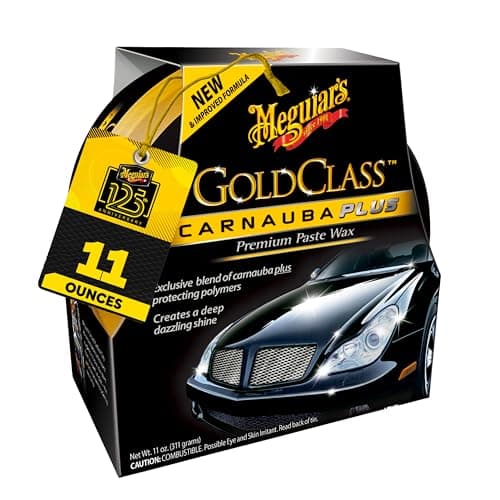
| Meguiar’s Gold Class Carnauba Plus | Paste | No | None stated |
| Mothers California Gold Pure Brazilian Carnauba | Paste | No — non-abrasive | None stated |
| Griot’s Garage Best of Show Wax | Liquid | No | None stated |
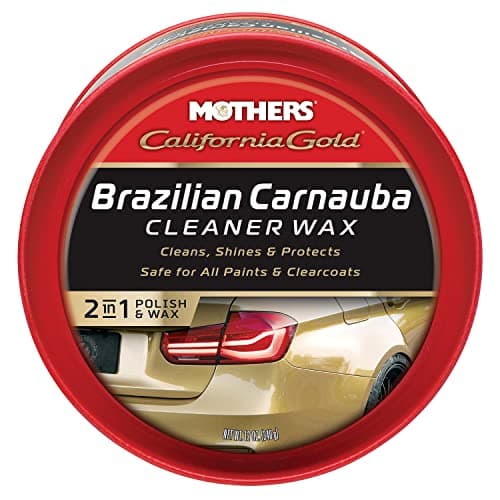
| Mothers California Gold Carnauba Cleaner Wax | Paste | Yes — light polishing action | None stated |
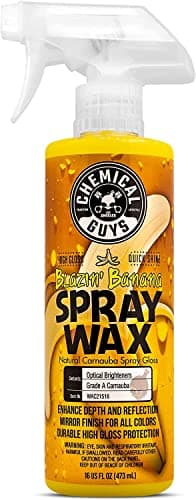
| Chemical Guys Blazin’ Banana | Spray | No | None stated |
“None stated” is not a criticism; it means the maker’s current product page and Amazon listing give no figure. Treat any carnauba without one as a weeks product until the water tells you otherwise — the test in how often to wax a car shows when it is actually gone, rather than guessing from the calendar.
Paste, liquid or spray?
Three of the four general-purpose picks are pastes, because paste is still the format most carnauba is sold in and the one most enthusiasts associate with a proper wax day. A paste goes on with more resistance and asks for a thin, deliberate coat. A liquid like Griot’s Best of Show spreads faster and is easier to keep thin, which matters in warm weather. A spray like Blazin’ Banana is not a replacement for either — it is a fast top-up that keeps the look alive between full applications, and the rest of that category is ranked in best spray wax. Format changes the effort far more than it changes the result; the chemistry underneath decides how long it lasts.
Paste carnauba is the format where application technique shows most, because a heavy film hazes unevenly and fights the removal towel. The wax applicator pad picks cover the foam that meters a thin coat and the towel that lifts it cleanly back off.
How to choose a carnauba wax
Start with the paint, not the tin
The most useful question is what the paint looks like right now. Freshly corrected or new paint wants a pure wax and nothing abrasive — picks one to four. Paint that is dull, slightly chalky and has never been polished wants a cleaner wax, which lifts road film and light oxidation while it waxes — pick five, with the rest of that category ranked in best car wax and polish. Paint with visible swirls wants neither yet. Carnauba is a transparent film: it will make swirled paint look glossier for an afternoon and then show every defect in the first hard sun. Correct first — how to remove swirl marks covers it — and the same wax will look like a different product.
Decide how often you will really reapply
Be honest here, because it decides the whole purchase. If you will wax every month or two because you enjoy it, the lifespan argument barely matters and you should buy for look and feel. If you will wax twice a year and want the car protected in between, a traditional carnauba is the wrong tool on its own. Either buy the 476S, which Collinite rates for months, or lay a synthetic sealant down as the base and use carnauba on top purely for the look — the layering approach explained in carnauba vs synthetic wax.
Match it to the color
Carnauba’s advantage is almost entirely visual, and it is most visible on black, deep blue and dark metallics — which is why the black-paint picks lean on it. On white and silver most of the warmth is invisible and a synthetic’s longer life usually wins; the white-paint picks explain why. If the car lives in strong sun, heat shortens every carnauba’s life, and the UV protection picks are the better list.
Plan for the trim before you open the tin
Paste carnauba dries to a haze, and on textured black plastic that residue works into the grain and is tedious to get out. The fix is cheap: run painter’s tape along trim edges before you start, or keep the applicator an inch away and finish the edge by hand. The harder and longer-lasting the paste, the harder it is to remove from trim — an owner review on Collinite’s own 476S product page says exactly that.
Work in the shade, on a cool panel
Carnauba applied to a hot panel flashes before you can spread it evenly, then streaks at buff-off. Wax in the shade or in a garage, on paint that is cool to the touch. Collinite’s instructions for the 476S are specific: a thin layer, one section of about two feet by two at a time, removed as soon as it hazes — which it says typically takes one to three minutes. Griot’s explicitly rates Best of Show for warm as well as cool panels, which is part of why it ranks as the easiest general-purpose pick here.
Over a ceramic coating, use something else
If the car already carries a ceramic coating, carnauba is the wrong topper: it can mask the coating’s own water behavior, which is the main signal you have for when the coating needs attention. An SiO2 spray is the better maintenance layer, as covered in how to maintain a ceramic coating. Carnauba over a synthetic sealant, on the other hand, is a well-established technique — just let the sealant cure fully first.
Application, in order
- Wash and dry the car properly — two buckets, a clean mitt, a plush drying towel.
- Decontaminate if the paint still feels rough after washing; a clay bar takes a few minutes a panel.
- Correct anything you do not want sealed in for the next few weeks.
- Apply thin, one section at a time, in the shade. A coat you can clearly see is usually a coat that is too thick.
- Let it haze, then buff with a clean, plush, edgeless microfiber — our towel picks cost less than most of these waxes.
- Finish with a second clean towel, and check the panel under a single bright light before moving on.
The full hand method, including how to work a paste without streaking, is in how to wax a car by hand.
The common mistake
Applying more wax on the theory that a thicker coat lasts longer. It does not — only what bonds to the paint contributes, and the excess simply becomes a harder, streakier buff-off, which is how people end up scrubbing freshly waxed paint and putting fine marring into it. With a hard paste like the 476S that matters twice over. Thin, even, and a fresh towel face often.