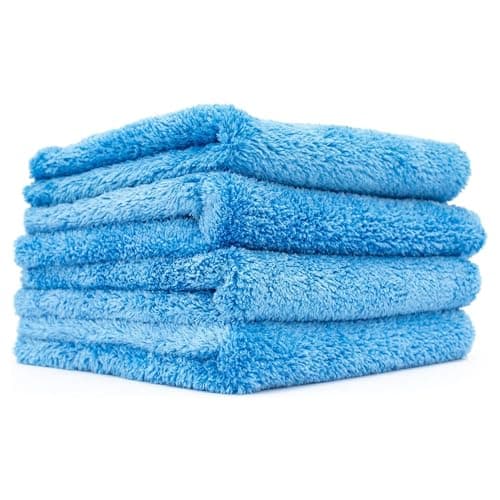
Here is the uncomfortable truth about swirl marks: most of them were put there by the person who owns the car. Not by road debris, not by the automatic wash six months ago — by a towel, during a wash or a wax buff-off, dragging trapped grit across clear coat. It is the cheapest problem in detailing to fix and the one most people never think about, because a towel costs a couple of dollars and a polisher costs two hundred.
The fix is not one perfect towel. It is having the right towel for each job and never crossing them over, because the towel that is ideal for wheel arches is exactly the one that will ruin a freshly corrected hood. That is why this roundup is organized by job rather than by a single ranking. Drying is the job with the most at stake and the biggest towels, and it is ranked on its own in best car drying towel.
The specs that actually mean something
GSM — grams per square meter, the density of the pile. Roughly 300 is general purpose, 500 and above is plush enough for paint, and the very highest figures are drying towels. Higher GSM means more pile to trap and hold particles away from the surface instead of dragging them along it.
Edgeless — a towel with no stitched border. This matters more than almost anything else on delicate paint, because a stitched or tagged edge is a hard, non-absorbent strip that is dragged across clear coat at exactly the moment you are being careful. Edgeless towels remove that risk entirely.
Blend — the ratio of polyester to polyamide, commonly quoted as 70/30 or 80/20. Polyamide is the softer, more absorbent fiber, so a higher polyamide share generally means a plusher, thirstier towel.
Weave — plush pile for paint work and buff-off; waffle weave for drying and glass; twisted loop for maximum water capacity. The weave tells you the job.
The four jobs, and the towel each one needs
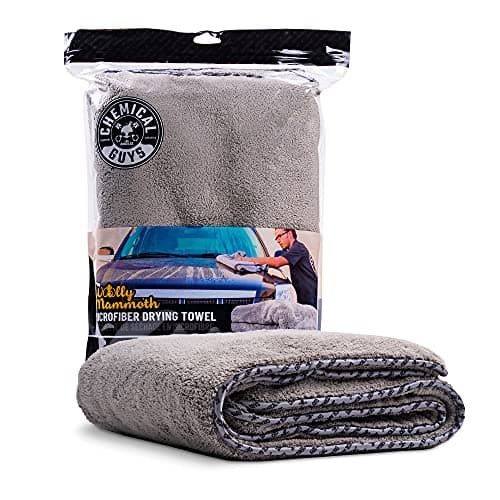
Drying is where the most damage happens, because you are touching every panel while the surface still has whatever the wash left behind. One large, deep-pile drying towel is the right answer here — big enough to sheet water off a panel in a single pull rather than repeatedly wiping. The step before it has the same logic and its own media: the wash mitt is the first thing to touch the paint, and the one that puts most of the swirls there.
Buffing wax, sealant or coating demands the plushest, safest towel you own. This is the job for a high-GSM edgeless towel, and it is where a cheap towel costs you the correction you just spent hours on. On dark paint it is not optional — see best car wax for black cars.
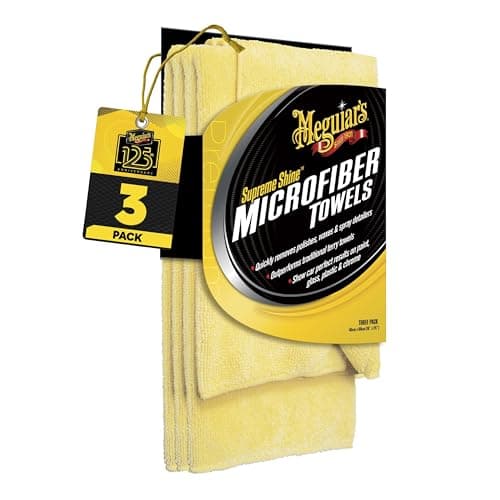
Glass wants a low-pile waffle or a dedicated glass towel. Plush pile leaves lint and streaks on glass, which is the reverse of what it does on paint.
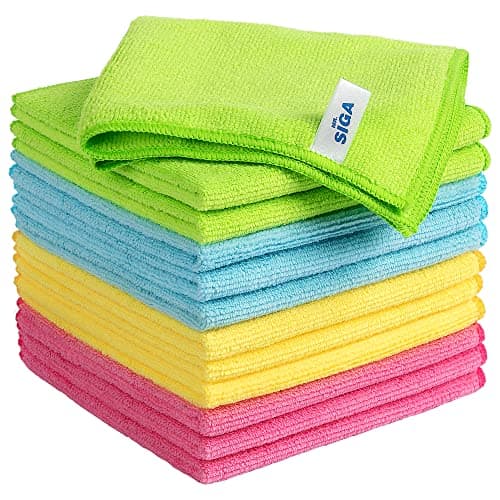
Wheels, arches, jambs and engine bays want the cheapest towels you can buy, in quantity, kept permanently separate from the paint towels. Once a towel has touched brake dust, it never touches paint again.
Washing them is part of the product
A good towel washed badly becomes a bad towel. Wash microfiber separately from cotton — cotton lint embeds in the pile and never leaves — use a detergent without fabric softener or bleach, and never use dryer sheets. Fabric softener coats the fibers with a waxy residue that destroys absorbency, which is the entire reason you bought them.
Dry on low heat or air dry. High heat melts the synthetic fibers, and a melted pile is both less absorbent and more abrasive. Keep the paint towels in their own bag, separate from the wheel towels, permanently.
How to build a towel set
Buy in tiers, not in bulk
A sensible set for one car is roughly: one large drying towel, four to six plush edgeless towels for paint and buff-off, a couple of low-pile towels for glass, and a big cheap multi-pack for everything dirty. That covers every job without spending premium prices on towels that will be used on wheel arches.
Color-code and mean it
Buy each tier in a different color and treat the boundary as absolute. A towel that has been used on wheels carries brake dust particles that survive washing, and one pass with it across a hood undoes an afternoon of correction. Color-coding is the only system that survives a busy Saturday afternoon.
Quantity beats quality for the dirty jobs
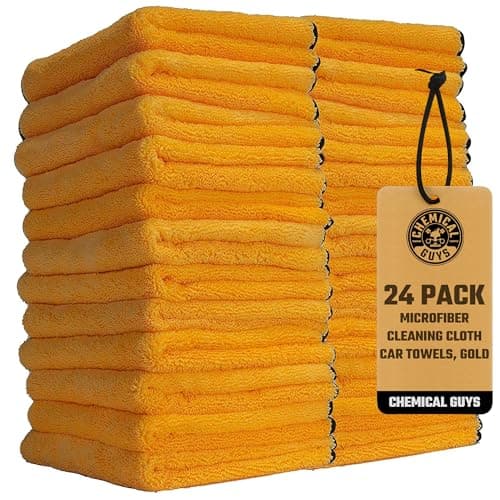
For paint, buy fewer and better. For everything else, buy more and cheaper. Running out of clean towels mid-job is what causes people to reach for a used one, which is where the damage happens — so the twelve-pack is not an indulgence, it is what stops you improvising.
Fold into quarters, and use all eight faces
A towel folded in quarters gives eight clean working surfaces. Turning to a fresh face as soon as one loads up is the single biggest technique improvement available in this category, and it costs nothing. A saturated face stops absorbing and starts pushing residue and grit around.
Inspect and retire them
Retire a paint towel when the pile has flattened and gone stiff, when it stops absorbing properly, or when it has picked up anything you cannot wash out. A stiff towel is an abrasive one. They are consumables, and by some distance the cheapest consumable in this hobby.
The common mistake
Using one stack of towels for everything, washed together, stored together. It feels practical and it is the reason a lot of carefully maintained cars have swirl marks. The separation between paint towels and dirty-job towels is the whole point — a five-dollar multi-pack for the dirty work protects a five-hundred-dollar correction.