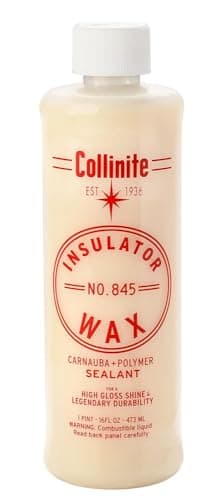
Collinite 845 has one of the strangest origin stories in car care. Collinite is an old American chemical company whose products were developed for industrial and marine use — 845 is called Insulator Wax because it was formulated to protect high-voltage electrical insulators from weather. Somewhere along the way boat owners noticed how long it lasted, then car people noticed the boat people, and a cult formed. Collinite's harder, longer-rated paste is the obvious next question, and the two are compared in Collinite 845 vs 476S.
The disclosure: we have not aged panels side by side or run this against a gloss meter, because we do not operate a lab and will not imply otherwise. What follows is drawn from Collinite's published information, the chemistry it implies, and the unusually consistent pattern in long-term owner reporting. Our method is on how we research.
What it actually is
A liquid wax combining carnauba with synthetic polymers — which is why it sits awkwardly in the neat two-family split in carnauba vs synthetic wax. It has some of carnauba's warmth in the look and much of a synthetic's tenacity in the durability, and that combination is the entire reason for its reputation.
Durability is the whole argument
This is the product's claim to fame and the reason it wins our general wax roundup. Owner reporting on 845's longevity is remarkably consistent across climates, and it substantially outlasts ordinary consumer carnaubas — which is exactly what you would expect from a formulation designed to survive outdoors on industrial hardware rather than to photograph well on a show stand.
For a daily driver that lives outside, that durability is worth more than a marginally prettier finish, because a wax that is still present in August protects paint that a prettier wax stopped protecting in June.
The two things people dislike
1. It is fussy about application
845 wants to be applied thin, and it genuinely punishes a heavy hand. Applied too thickly it becomes stubborn to remove and can streak. It also prefers a warm bottle — many long-term users stand it in warm water before use to thin it, which sounds like folklore and is in fact the manufacturer's own guidance.
Get those two things right — thin coat, warmed product — and application is straightforward. Get them wrong and you will spend an unpleasant hour buffing.
2. It is not a show wax
The look is good rather than spectacular. On dark paint, a dedicated show carnauba gives more depth and more warmth. If you are preparing a car for an event, 845 is not the product; it is what goes on the car you actually drive. The dark-paint alternatives are in best car wax for black cars.
Where it fits in a real routine
Two or three applications a year on a daily driver is a realistic rhythm — far fewer than a pure carnauba needs. It also makes an excellent base layer: apply 845, let it cure, then top with a show carnauba before an event, or maintain with a spray wax between washes. The base survives; the top layer is cosmetic.
As always, it protects whatever surface it goes onto. Wash and decontaminate first — clay if the paint feels rough — or you are sealing grime under a very durable layer, which is worse than sealing it under a wax that fades in six weeks.
Who should buy something else
Buy a show carnauba instead if appearance is the point and the car is garaged and dark. Buy a modern synthetic sealant instead if you want easier application and a cooler, glassier look with comparable durability — and if you want that in a spray you can apply at every wash, look at our sealant picks. Buy a ceramic coating instead if you are ready to correct the paint and commit to a cure window, because that moves durability from months to years.
The verdict
845 is the wax to buy when you want protection that is still there months later and are happy for the finish to be very good rather than exceptional. Its reputation is earned, its quirks are real and manageable, and it is remarkably cheap for what it does. Apply it thin, warm the bottle, and it will comfortably outlast most of what sits beside it on the shelf.