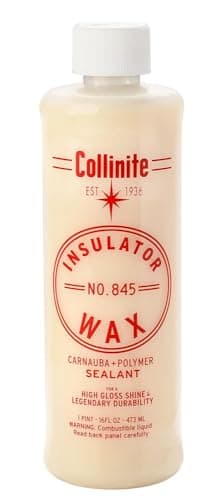
Buy the 845 liquid. For almost everyone asking this question — one car, a driveway, a couple of wax days a year — Insulator Wax is the right Collinite: it spreads and buffs off like a normal liquid wax, it still outlasts the paste waxes most people are comparing it against, and Collinite rates it at 4–7 months. Buy 476S Super Doublecoat instead only if you want the single most durable thing Collinite makes, rated 7–10 months, and you are willing to pay for it in effort rather than money.
Both products come from the same unusual place in the market. Collinite is a small industrial-coatings company whose car waxes were originally built for marine and fleet use, which is why the whole line is organized around durability rather than the warm, deep glow that drives most carnauba sales. Buy either of these expecting a show-car look and you will be mildly underwhelmed. Buy either expecting protection that is still beading water next spring and you will understand the cult.
The real difference: format, not formula
Both waxes are carnauba blended with synthetic polymers. That blend is the entire reason they are on this site: pure carnauba looks superb and lasts weeks, synthetic sealants last months and look clinical, and Collinite's answer is to put polymer into a carnauba so the look survives longer than the usual handful of washes. The two products take that idea to different places.
845 Insulator Wax is a liquid. It goes on thin, hazes quickly, and comes off with ordinary effort. It is the Collinite that behaves like the waxes you already know how to use, and it is the one that collects recommendations for winter and salt-belt daily drivers. It gets a full write-up in our Collinite 845 review.
476S Super Doublecoat is a hard paste in a 9 fl oz tin, and "hard" is doing real work in that sentence. Collinite itself describes it as the most labor-intensive wax in its range, and an owner review on Collinite's own product page advises taping off black trim before you start, because getting it back off trim is genuinely difficult. In exchange it is Collinite's most durable product, and Collinite also claims it bonds without requiring a surgically clean multi-step decontamination first — which is a meaningful convenience on a car that is not getting a full clay and decontamination session.
Side by side
| 845 Insulator Wax | 476S Super Doublecoat |
|---|
| Format | Liquid | Hard paste, 9 fl oz tin |
| Chemistry | Carnauba + polymer | Carnauba + polymer, polymer-heavy |
| Durability (Collinite's own figures) | 4–7 months | 7–10 months |
| Application | Thin coats, easy spread | Thin coats, and thin is not optional |
| Removal effort | Normal liquid-wax wipe-off | The hardest in Collinite's range, by Collinite's own account |
| Trim risk | Low | Tape off black trim first |
| Prep demanded | Clean, decontaminated paint | Collinite says it bonds without full decon |
| Look | Clean and slick, not the warmest glow | Similar, slightly harder-edged from the polymer load |
| Best for | Anyone who waxes their own car twice a year | One application meant to carry a whole salt season |
How to choose, in one question
Ask yourself when you will realistically next wax this car. If the honest answer is "in the spring, maybe," the 476S is worth its difficulty, because the extra three months of Collinite's rated range is the difference between protection that lasts the winter and protection that quietly ends in February. If the honest answer is "whenever it looks dull," the 845 is the better buy, because a wax you will actually reapply beats a wax you dread.
That is not a soft answer. Wax durability only matters at the moment it runs out, and the failure mode for both of these products is identical: water stops beading, the panel feels grabby rather than slick, and road film starts to stick. Checking for that is the whole maintenance routine, and it is covered in how often to wax a car.
Two situations where neither is the answer
You want the deepest possible gloss. Collinite is a durability brand. Both of these waxes are polymer-loaded on purpose, and polymer is what costs you the warm, wet carnauba depth that show paste waxes are bought for. If the look is the point, the heavy-carnauba picks in best carnauba wax are the honest direction, and one of them is ranked below.
You want maximum durability, full stop. Then you are not really shopping for wax. A synthetic sealant bonds to the clear coat rather than sitting on it and carries a season on one application, and a ceramic coating goes considerably further than that. 476S is the most durable wax here; it is not the most durable protection here, and Collinite does not claim it is.
What about applying 476S over 845?
This comes up constantly, and the reasoning behind it is sound even if the execution rarely is. Collinite's own naming invites it — "Doublecoat" refers to layering the product on itself, not to stacking it on a different wax. Two thin coats of 476S, with the second going on after the first has fully cured, is the use the name describes and the one Collinite supports.
Layering 476S on top of 845 is a different proposition, and the problem is not chemistry but adhesion. Any wax bonds best to clean paint, and the slicker the surface underneath, the less there is for the next layer to key into. In practice you get the durability of the top layer, not the sum of both, which means you did the hardest wax job in the range for no additional months. If you want layers, layer the same product. If you want a different kind of layering that genuinely works, the pattern is a synthetic sealant for durability with a carnauba topper for warmth — the reasoning is in wax vs sealant vs coating.
Both reward the same prep
Neither of these waxes corrects anything, and both are completely transparent about what is underneath them. Wax on swirled paint is swirled paint with a shine. If the car has never been polished, the order that actually pays is correct first, protect second — how to remove swirl marks covers the correction half, and do you wax after polishing covers what to put down afterwards and why the gap between the two matters.
One practical note that applies to both and gets ignored on the paste: thin coats. Both products are formulated to be applied in a film thin enough that you can still see the paint through it. A thick application of 845 wastes product and streaks; a thick application of 476S will have you out there with a towel in both hands wondering what you have done. The tin will outlast several cars if you use it the way Collinite describes.
Getting either one right
Cool panels, shade, dry paint
Both waxes want a cool surface. A hot hood flashes the solvent off before the wax has spread, which on 476S turns a manageable job into a hard one. Work in shade, early or late, one panel at a time — the same rule that governs polishing in the sun applies to waxing, for the same reason.
Let it haze, then test one small area
Apply, wait for the haze, then wipe a six-inch square and look. If it comes off clean, do the panel. If it smears, wait longer. If it has gone past the point of wiping cleanly — a real possibility with the paste — a light mist of detail spray on the towel re-wets it enough to remove.
Tape the trim before the paste
This is Collinite's own advice via its product page, not ours, and it is worth following. Dried 476S on textured black plastic is far harder to remove than it is on paint. Low-tack masking tape along trim edges takes two minutes and saves you an evening.
Two thin coats beat one thick one
If you want the Doublecoat the name refers to, apply one thin coat, let it cure for several hours or overnight, then apply a second. That is the layering Collinite describes, and it is a different thing from piling product on in one pass.
Use an applicator, not a towel
A foam or microfiber applicator pad lays down a far more even film than a folded towel, and evenness is what both of these waxes are sensitive to. The options are ranked in best wax applicator pads.