Skip to content
Pad & Polish

HUB 06 · Paint Prep & Decontamination

Best Rinseless Wash

One bucket, two gallons of water, no hose and no rinse. Six concentrates ranked on the only thing that decides whether this is safe for your paint: how much lubrication they put between the dirt and the clear coat.

By Stephen V.Updated How we research
#ad

We earn a commission when you buy through our Amazon links, at no extra cost to you. It never affects our rankings, and we say so when the cheaper product is the better buy. How this works.

A rinseless wash is the answer to a very specific problem: you want the car clean, and you cannot use a hose. Maybe there is no tap in the parking garage. Maybe it is February and the hose is frozen. Maybe the city is in a drought and the HOA has opinions. A rinseless concentrate turns two gallons of water in one bucket into a wash that leaves no soap to rinse off, so the whole job is wipe-on and dry.

The category is frequently confused with waterless washing, and the two are genuinely different products with different limits. A waterless wash is a ready-to-use spray with no water involved at all, and it is for a dusty car. A rinseless wash is a diluted concentrate in a bucket, and it handles a genuinely dirty daily driver — road film, winter salt haze, a week of commuting — because there is water doing work and a mitt or towel carrying lubricant with it.

That lubricant is the entire safety story. Ordinary car shampoo relies on the rinse to carry away the dirt it lifted; a rinseless wash has no rinse, so the dirt has to be held away from the paint by polymers in the solution until the towel takes it off the car. Every product on this page sells itself on that chemistry, and the differences between them are mostly differences in how they claim to handle the suspended dirt and the water it is mixed into.

How a rinseless wash actually works

The mechanism is encapsulation. The polymers in the concentrate surround each dirt particle and hold a slick film between it and the clear coat, so when the towel drags across the panel the particle slides rather than cuts. The two things that break the mechanism are running out of lubricant — a dry towel on a dirty panel — and reusing a loaded towel face, which puts the particle you just removed back onto the paint with no film around it.

Optimum makes the one claim here that goes a step further: that its polymers drop the encapsulated dirt to the bottom of the bucket rather than keeping it circulating in the solution. Whether that difference is visible on a panel is not something we can measure, but it is a specific, falsifiable statement about the chemistry rather than an adjective, and it is the reason the ONR formula has been the reference point in this category for years.

The second mechanism worth understanding is water hardness. A rinseless wash leaves its solution on the paint to be dried off, which means every mineral in your tap water is sitting there when you start drying. In a hard-water region that is the difference between a clean car and a car covered in spots, and it is why P&S building water-softening chemistry into the formula is a real feature rather than a marketing line.

How we ranked them

Lubricity — how much slip the maker claims the diluted solution provides, judged from the polymer chemistry each one publishes. This is the criterion with permanent consequences, because a rinseless wash that runs short of lubrication puts fine marring into clear coat you then have to polish out. It carries the most weight.

Cleaning power — how much road film each is built to shift at its published dilution. A rinseless wash is a maintenance wash by design, so the question is not whether it strips a mud-caked truck but whether it handles a week of commuting without needing a second pass.

Versatility — how many jobs the same bottle does. Most of these publish dilutions for use as a clay lubricant and a quick detailer as well as a wash, and a concentrate that replaces three bottles is worth more than its shelf price suggests.

Value — cost per wash at the published dilution, not cost per bottle. At one ounce per two gallons, a 32 oz bottle is thirty-two washes, which changes the arithmetic completely. We have run no controlled comparison of these products; how we research sets out exactly what our scores are built from.

The method matters more than the bottle

This is the uncomfortable truth about the category. The gap between the best and worst concentrate here is small. The gap between good and bad rinseless technique is the difference between a clean car and a car that needs polishing.

The method that works is the multi-towel method, and it is simple. Mix the concentrate at the published ratio in one bucket. Soak several plush microfiber towels in it. Take one towel, fold it into quarters, and wipe one panel with one face — then flip to a fresh face for the next section, and when all four faces are used, that towel goes into a separate bag and a clean one comes out of the bucket. You never put a loaded towel back into the wash solution, which is the single rule that separates this from dragging grit around.

Work top down, because gravity has not been repealed: roof, glass, upper panels, doors, then the lower third of the car last, where the real filth lives. Dry each panel as you go rather than washing the whole car and then drying it, because solution left to dry on its own is a water spot with extra steps. A plush drying towel and the same one-face-per-panel discipline apply to the drying pass too.

When a rinseless wash is the wrong tool

It is not a replacement for a hose wash on a filthy car. If the lower panels are caked, if there is visible grit, if the car has been down a gravel road or through a salted winter week without a wash in between, there is more solid material on the paint than any amount of polymer can hold away from it. That car wants a pre-rinse, and the two-bucket method with a real car wash soap.

It is also not a decontamination step. A rinseless wash removes what is loose; it does nothing about the bonded contamination that makes paint feel gritty through a sandwich bag, which needs chemical iron removal and clay. The useful overlap is that most of these concentrates double as the clay lubricant for that job at a stronger dilution.

And it is not protection. None of these publishes a durability figure, and only the wash-and-wax variant claims to leave anything behind at all. A rinseless wash keeps a protected car clean; it does not protect an unprotected one. What goes on top is a separate decision, covered in best spray wax and best ceramic coating spray.

Dilution is where the money is

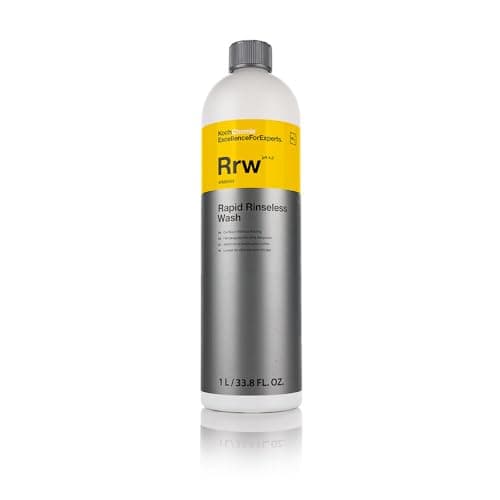
Four of these six publish a ratio around one ounce per two gallons. Koch-Chemie publishes 256:1, which is roughly a 10 ml capful in the same two gallons — a liter bottle therefore makes far more wash solution than a 32 oz bottle of anything else here, and that is the whole value argument for it.

The flip side is accuracy. A concentrate that strong is unforgiving in both directions: over-dose it and you are wiping residue off dry paint, under-dose it and the lubricity drops exactly when you need it. A cheap kitchen measuring jug costs almost nothing and removes the problem. Guessing by eye is how people conclude that rinseless washing marks paint.

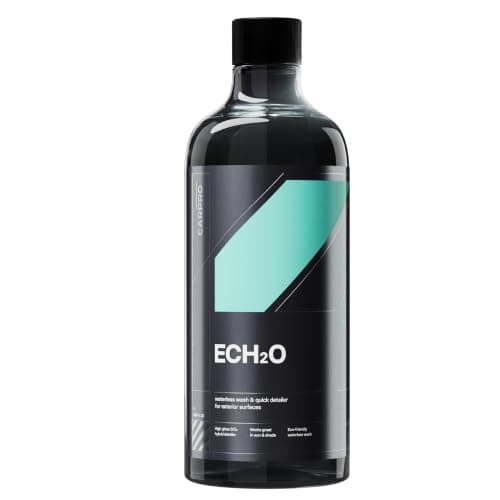
CarPro ECH2O is the exception to the whole ratio conversation: it publishes a range from 1:15 to 1:40 depending on whether you want a wash, a clay lube or a detail spray, which is more flexible and also more homework. If you want one bottle that becomes three products, that range is the feature. If you want to mix a bucket without thinking, it is not.

Coatings, wraps and PPF

This is the category where coating owners should be paying attention, because a rinseless wash is the ideal maintenance wash for a coated car: minimal water, no aggressive surfactants, no mechanical scrubbing. Four of the six here name ceramic coatings explicitly in their safety list, and P&S and Koch-Chemie add PPF and vinyl wrap.

The one product built specifically around that use case is CarPro's ECH2O, which is an SiO2 hybrid designed to work with a coating rather than merely avoid harming it. The honest caveat is the same one that applies to every SiO2 maintenance product: the silica in a cleaning spray is a gloss and slickness aid, not a coating, and nobody publishes a durability figure for it. If the coating itself has stopped beading, a spray will not revive it — how to maintain a ceramic coating covers what will.

The short answer

Quick picks

#ProductBest forScorePrice
01
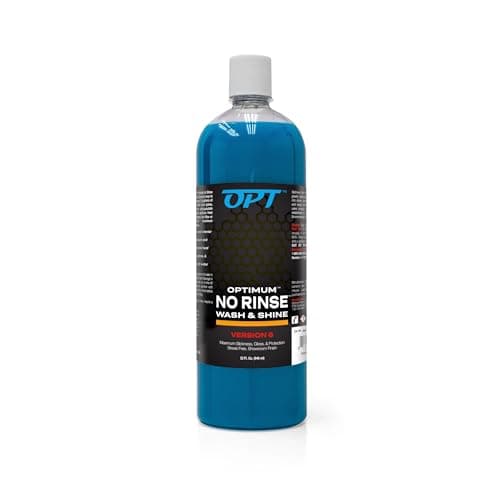
Optimum Optimum No Rinse Wash & Shine (ONR) Version 6
Optimum No Rinse Wash & Shine (ONR) Version 6

The product that made the category, now on its sixth formula: one ounce in two gallons washes a whole car with no hose, and Optimum is the only maker here that claims its polymers drop the encapsulated dirt to the bottom of the bucket rather than keeping it in suspension.

The rinseless standard, and the safest dirt handling
9.0
$29.98Amazon
02
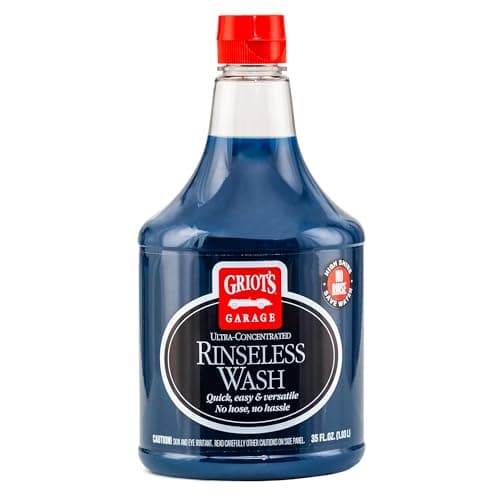
Griot's Garage Griot's Garage Rinseless Wash (35 oz)
Griot's Garage Rinseless Wash (35 oz)

The best-value way into rinseless washing: the same one-ounce-per-two-gallons dilution as the category standard, in a larger bottle at a lower price, and Griot's publishes the detailer and clay-lube dilutions too.

A first rinseless wash without the premium price
8.8
$19.75Amazon
03
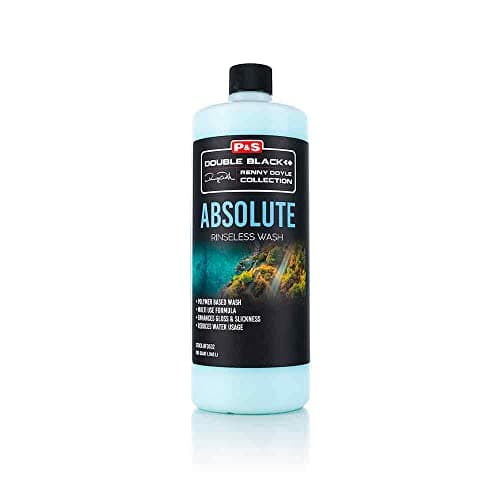
P&S Professional Detail Products P&S Absolute Rinseless Wash (1 Quart)
P&S Absolute Rinseless Wash (1 Quart)

The one that addresses hard water head-on: P&S builds water-softening chemistry into the formula so the solution itself is less likely to leave spots, which is the failure mode that ruins a rinseless wash in a hard-water region.

Hard water, where spotting is the real risk
8.7
Check price →
04
CarPro CarPro ECH2O Waterless Wash & Quick Detailer (1 Liter)
CarPro ECH2O Waterless Wash & Quick Detailer (1 Liter)

The SiO2 one: a concentrate CarPro built to work with ceramic coatings rather than merely tolerate them, diluted anywhere from 1:15 to 1:40 depending on whether you want a rinseless wash, a clay lube or a gloss-boosting detail spray.

A coated car, and the widest dilution range
8.6
$30.49Amazon
05
Koch-Chemie Koch-Chemie Rapid Rinseless Wash (1 Liter)
Koch-Chemie Rapid Rinseless Wash (1 Liter)

The most dilute formula here by a wide margin — Koch-Chemie publishes 256:1, roughly a capful per two gallons — which makes a one-liter bottle the cheapest per wash on the page despite being priced like a premium import.

The lowest cost per wash, if you measure carefully
8.6
$26.99Amazon
06
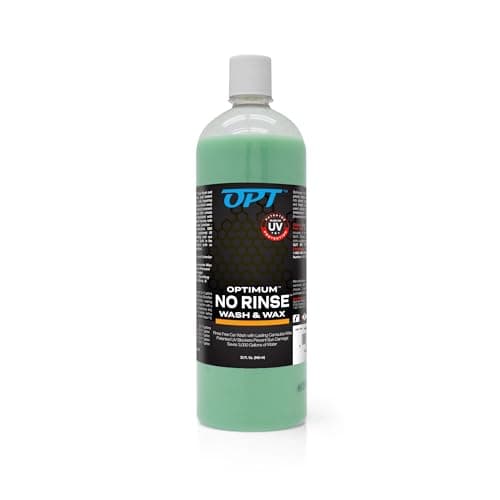
Optimum Optimum No Rinse Wash & Wax
Optimum No Rinse Wash & Wax

The same ONR chemistry with carnauba added, so the maintenance wash leaves a little protection behind instead of just gloss — the sensible pick if a rinseless wash is the only wash your car ever gets.

A rinseless wash that also tops up protection
8.6
$32.19Amazon

#ad · Live prices from the Amazon Product API, as of November 23, 2026. Where we have no verified live price, we show none — we would rather leave a gap than print a number that has rotted.

In detail

The picks, in full

01
Optimum Optimum No Rinse Wash & Shine (ONR) Version 6

The rinseless standard, and the safest dirt handling

Optimum No Rinse Wash & Shine (ONR) Version 6

1 oz per 2 gallonsAlso a clay lubricant32 oz concentrateCoating and matte safe
9.0/10

The product that made the category, now on its sixth formula: one ounce in two gallons washes a whole car with no hose, and Optimum is the only maker here that claims its polymers drop the encapsulated dirt to the bottom of the bucket rather than keeping it in suspension.

Cleaning power
8.8
Lubricity
9.2
Versatility
9.4
Value
8.4

Pros

  • Optimum's claim is specific and unique here — dirt is encapsulated and dropped to the bottom of the bucket, not carried back to the paint
  • Rated by Optimum for paint, ceramic coatings, matte paint, glass and interior surfaces, so one bottle covers the whole car
  • Doubles as a clay lubricant at a stronger dilution, which removes a separate product from the shelf

Cons

  • The most expensive 32 oz on this page, and the dilution means you are buying mostly water-free concentrate you then have to measure
  • Version 6 is the current formula, so the cheaper Version 5 bottles still on Amazon are the previous chemistry — check which one you are adding to the cart
  • No published durability figure: it cleans and leaves gloss, it is not a protection step

Don't buy this if…

…your car is genuinely filthy — a rinseless wash is a maintenance wash, and heavy grit still wants a pre-rinse you cannot do without water.

$29.98View on Amazon

Price as of November 23, 2026. Prices change — Amazon's is the one that counts.

#ad · we may earn a commission from this link to Optimum No Rinse Wash & Shine (ONR) Version 6

02
Griot's Garage Griot's Garage Rinseless Wash (35 oz)

A first rinseless wash without the premium price

Griot's Garage Rinseless Wash (35 oz)

1 oz per 2 gallons35 oz bottleDilutes into detailerClay bar lubricant
8.8/10

The best-value way into rinseless washing: the same one-ounce-per-two-gallons dilution as the category standard, in a larger bottle at a lower price, and Griot's publishes the detailer and clay-lube dilutions too.

Cleaning power
8.2
Lubricity
8.6
Versatility
8.8
Value
9.4

Pros

  • Largest bottle in the group at the lowest price, on the same dilution ratio as the premium concentrates
  • Griot's publishes three uses for it — rinseless wash, quick detailer and clay lubricant — so the dilution chart does real work
  • Griot's specifically positions it for collector cars, ceramic coatings and pre-correction prep, which is exactly where minimizing water matters

Cons

  • Griot's calls it a “waterless car wash” in its own listing copy, which muddles the two categories — it is a rinseless concentrate and needs a bucket
  • No water-softening claim, so on genuinely hard water you are more exposed to spotting than with the formulas that make one
  • Nothing here is a protection step — gloss, not durability

Don't buy this if…

…you want a one-bottle spray-and-wipe with no bucket at all — that is a waterless wash, a different product class.

$19.75View on Amazon

Price as of November 23, 2026. Prices change — Amazon's is the one that counts.

#ad · we may earn a commission from this link to Griot's Garage Rinseless Wash (35 oz)

03
P&S Professional Detail Products P&S Absolute Rinseless Wash (1 Quart)

Hard water, where spotting is the real risk

P&S Absolute Rinseless Wash (1 Quart)

1 oz per 2 gallonsWater-softening32 oz concentratePPF and wrap safe
8.7/10

The one that addresses hard water head-on: P&S builds water-softening chemistry into the formula so the solution itself is less likely to leave spots, which is the failure mode that ruins a rinseless wash in a hard-water region.

Cleaning power
8.8
Lubricity
8.8
Versatility
8.6
Value
8.6

Pros

  • The only pick here that claims water-softening technology — a direct answer to the spotting problem a no-rinse wash cannot rinse away
  • P&S rates it safe on paint, coatings, wraps, PPF, trim, plastics, leather and upholstery
  • Same pre-treat trick the pros use: the identical dilution in a spray bottle handles the dirtier panels before the mitt touches them

Cons

  • Sold by P&S rather than Amazon, so delivery and returns run through the brand's own storefront
  • The listing leans on marketing language more than published numbers — the dilution ratio is the only hard figure on it
  • A pro-line product in a 32 oz bottle: the gallon is where the price per wash actually drops

Don't buy this if…

…you have soft water and want the cheapest route in — the water-softening chemistry is the reason to pay for this one.

Check price on Amazon →

No buyable offer at the last price check (November 23, 2026). We show nothing rather than a stale number.

#ad · we may earn a commission from this link to P&S Absolute Rinseless Wash (1 Quart)

04
CarPro CarPro ECH2O Waterless Wash & Quick Detailer (1 Liter)

A coated car, and the widest dilution range

CarPro ECH2O Waterless Wash & Quick Detailer (1 Liter)

SiO2 hybridDilutes 1:15 to 1:4034 oz concentrateSafe on trim and chrome
8.6/10

The SiO2 one: a concentrate CarPro built to work with ceramic coatings rather than merely tolerate them, diluted anywhere from 1:15 to 1:40 depending on whether you want a rinseless wash, a clay lube or a gloss-boosting detail spray.

Cleaning power
8.4
Lubricity
9
Versatility
9.2
Value
8

Pros

  • Built around SiO2 to work in harmony with a ceramic coating, which is the one thing a plain polymer concentrate does not claim
  • CarPro states it can be used in direct sun without leaving swirl marks — useful on the washes you did not plan
  • One bottle covers three jobs at three dilutions, and CarPro says it will not stain or discolor rubber or plastic trim

Cons

  • The dilution range is wide and the listing gives no per-job chart, so the first few mixes are guesswork
  • Sold by a third-party seller rather than Amazon or CarPro directly
  • A gloss and cleaning product with SiO2 in it is not a coating — do not read the chemistry as months of protection

Don't buy this if…

…your car is not coated and you want the simplest possible bucket mix — a plain rinseless concentrate is cheaper and asks less of you.

$30.49View on Amazon

$35.0013% off

Price as of November 23, 2026. Prices change — Amazon's is the one that counts.

#ad · we may earn a commission from this link to CarPro ECH2O Waterless Wash & Quick Detailer (1 Liter)

05
Koch-Chemie Koch-Chemie Rapid Rinseless Wash (1 Liter)

The lowest cost per wash, if you measure carefully

Koch-Chemie Rapid Rinseless Wash (1 Liter)

256:1 dilution1 liter bottleBucket or spray-onPPF and wrap safe
8.6/10

The most dilute formula here by a wide margin — Koch-Chemie publishes 256:1, roughly a capful per two gallons — which makes a one-liter bottle the cheapest per wash on the page despite being priced like a premium import.

Cleaning power
8.6
Lubricity
8.4
Versatility
8
Value
9.2

Pros

  • At Koch-Chemie's published 256:1, a liter makes far more wash solution than any other bottle here
  • Rated safe on paint, ceramic coatings, PPF, wrap and existing polishes and waxes
  • Koch-Chemie publishes both methods — sponge from a bucket, or spray on and wipe off with microfiber

Cons

  • A 10 ml capful into two gallons is an unforgiving ratio: over-dose it and you are wiping residue off, under-dose it and the lubricity drops
  • Sold by a third-party retailer, and the listing's own copy has typos and calls a rinseless wash a “waterless car wash”
  • No water-softening or SiO2 claim — this is a clean, plain rinseless chemistry and nothing more

Don't buy this if…

…you would rather not measure in milliliters — the whole value case here rests on getting the ratio right.

$26.99View on Amazon

Price as of November 23, 2026. Prices change — Amazon's is the one that counts.

#ad · we may earn a commission from this link to Koch-Chemie Rapid Rinseless Wash (1 Liter)

06
Optimum Optimum No Rinse Wash & Wax

A rinseless wash that also tops up protection

Optimum No Rinse Wash & Wax

1 oz per 2 gallonsCarnauba + UV32 oz concentrateWash and wax in one
8.6/10

The same ONR chemistry with carnauba added, so the maintenance wash leaves a little protection behind instead of just gloss — the sensible pick if a rinseless wash is the only wash your car ever gets.

Cleaning power
8.6
Lubricity
9
Versatility
8.8
Value
8

Pros

  • Carnauba and UV protection in the wash step, which is the one thing the plain concentrates deliberately leave out
  • Optimum publishes three dilutions on the bottle — 1 oz per 2 gallons to wash, 2 oz per gallon as clay lube, 8 oz per gallon as a quick detailer
  • Explicitly pitched at indoor and off-season washing, which is when a no-rinse wash earns its keep

Cons

  • The priciest bottle on this page, and you are paying for wax in a product whose job is cleaning
  • Carnauba in a wash leaves a film, so it is the wrong choice immediately before applying a coating or sealant
  • Optimum publishes no durability figure for the wax it leaves — treat it as a top-up, not a wax day

Don't buy this if…

…you already wax or coat the car properly — the plain Wash & Shine cleans the same and leaves nothing to interfere with what goes on next.

$32.19View on Amazon

Price as of November 23, 2026. Prices change — Amazon's is the one that counts.

#ad · we may earn a commission from this link to Optimum No Rinse Wash & Wax

Washing a car with one bucket

Buy the towels before you buy the concentrate

Rinseless washing is a towel-dependent method, and six to eight plush microfiber towels do more for your results than upgrading the chemistry. You need enough clean faces to get around the car without reusing one, which on a mid-size sedan is realistically four to six towels plus two for drying. Grades and weaves are in best microfiber towels for detailing.

Measure the concentrate, do not pour it

One ounce in two gallons is a shot glass, not a glug. The strong formulas are stronger still. Under-diluted solution dries to a film you then have to remove; over-diluted solution is just water with ambitions, and water with ambitions is what marks paint.

One face per panel, then the towel is done

Fold the towel in quarters. Each face cleans one section — half a door, a quarter of a hood — and then you turn it. When all four faces are loaded, the towel goes into a dirty bag, not back into the bucket. This is the rule the whole method rests on, and it is the one people skip.

Pre-treat the filthy bits with a spray bottle

The lower third of a car, the rockers and the area behind the wheels carry several times the dirt of the roof. Mix the same solution in a pump sprayer, soak those areas first and let them sit for a minute before any towel touches them. P&S publishes this exact technique; it works with any of these concentrates and it removes most of the marring risk.

Work top down, dry panel by panel

Roof, glass, upper panels, doors, lower panels, and dry each one before the solution can dry itself. On a warm day in a parking lot this matters a lot — a rinseless wash left to air-dry is a hard-water spotting exercise, and it is the most common complaint about the method from people who have only tried it once in the sun.

Hard water needs a plan

If your tap water leaves spots on glass, it will leave them on paint in a no-rinse wash. Three options, in order of cost: use the formula with water-softening chemistry in it, use distilled water for the bucket on dark paint, or dry much more aggressively and accept doing a spot removal pass occasionally. How to remove water spots from car paint covers what to do when it happens anyway.

Use the same bottle as a clay lubricant

At a stronger dilution — Optimum publishes 2 oz per gallon — these concentrates are clay lubricants, which is a genuine saving because a dedicated clay lube is another bottle doing one job. How to clay bar a car covers the technique and why the lubricant is the whole safety margin in that job too.

Do not rinseless-wash before a coating

Anything a wash leaves behind is contamination for a coating, and that includes the gloss polymers in a plain rinseless concentrate as well as the wax in a wash-and-wax. The sequence before a coating is wash, decontaminate, correct, then a dedicated panel wipe and nothing else.

Know the honest limit

A rinseless wash handles road film, light dust, winter haze and a couple of weeks of commuting. It does not handle mud, gravel dust, sand, or a car that has been ignored for two months. Trying to make it do that job is how the method gets its bad reputation — the product is fine, it was simply the wrong tool for the state the paint was in.
How we picked

We do not run a testing lab

We compiled published specifications, manufacturer data sheets and aggregated owner reviews, computed the cost of ownership from real sizes and coverage, then scored each product against a published rubric. The scores are judgments from documented research — they are not measurements we took, because we do not own a lab and we are not going to pretend we do. Where a number came from someone else, we name them and link them in Sources.

Questions

Frequently asked

What is a rinseless wash?
A concentrated wash solution you dilute into a single bucket - typically one ounce per two gallons - then wipe onto the car with plush microfiber towels and dry off, with no rinse step and no hose. The concentrate's polymers encapsulate dirt and hold a lubricating film between it and the clear coat, which is what makes wiping a dirty panel safe. It is a maintenance wash for road film and light dirt, not a replacement for a hose wash on a filthy car.
Rinseless vs waterless wash - what is the difference?
A rinseless wash is a concentrate diluted into a bucket of water and applied with soaked towels; it handles a genuinely dirty daily driver. A waterless wash is a ready-to-use spray applied directly to the panel with no water at all; it is for a dusty or lightly filmed car. The rinseless method carries more lubricant to the paint, so it tolerates more dirt. Both exist for the same reason - no hose - and many people own one of each.
Can you use a rinseless wash on a ceramic coated car?
Yes, and it is arguably the ideal maintenance wash for one: minimal water, no aggressive surfactants and no scrubbing. Most of the concentrates here name ceramic coatings in their own safety list, and CarPro's ECH2O is built as an SiO2 hybrid specifically to work alongside a coating. The caveat is that silica in a cleaning product is a gloss aid, not a coating, and none of them publishes a durability figure for what it leaves behind.
Does rinseless washing scratch paint?
It can, and almost always because of technique rather than chemistry. The two failure modes are running out of lubrication - a towel that has dried out, or a solution mixed too weak - and reusing a loaded towel face, which puts the grit you just removed back onto the paint with nothing around it. Fold towels in quarters, use one face per section, never return a dirty towel to the bucket, and pre-treat the lower panels with the same solution in a spray bottle.
How much water does a rinseless wash use?
Two gallons for the wash bucket is the usual published figure, against roughly 40 to 140 gallons for a hose wash depending on nozzle and habit. That is the practical appeal alongside the lack of a hose: it works in a garage, an apartment lot or a region under water restrictions, and there is no soapy runoff into a storm drain.
Can a rinseless wash be used as a clay lubricant?
Most of them, yes, at a stronger dilution - Optimum publishes two ounces per gallon for clay use against one ounce per two gallons for washing. That saves buying a dedicated clay lube, and it is a genuine reason to prefer a concentrate that publishes a dilution chart over one that only lists a wash ratio.

Keep reading

Receipts

Sources

We do not run a testing lab, and we do not pretend to. Where a measured number came from someone else's lab, we name them and link them. Where we could not verify something, we say so on the page rather than quietly leaving it out. Read our full method.