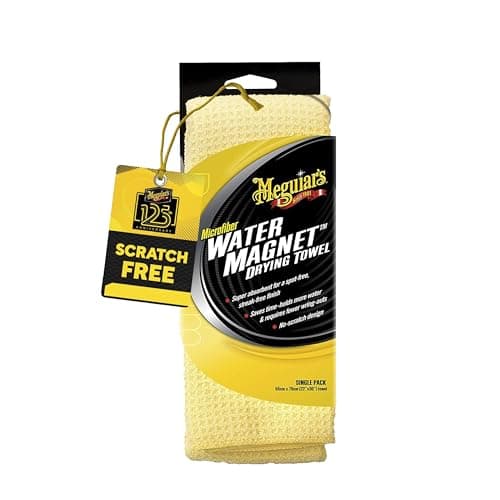
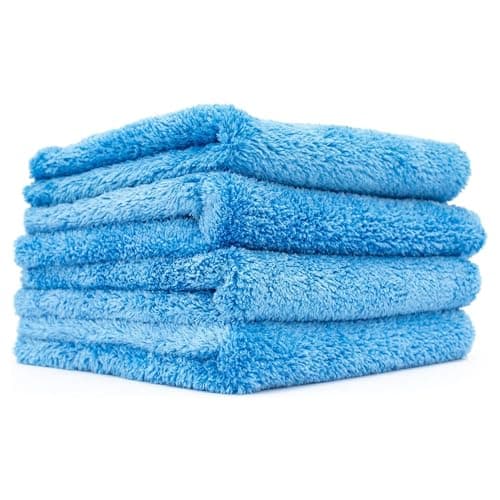
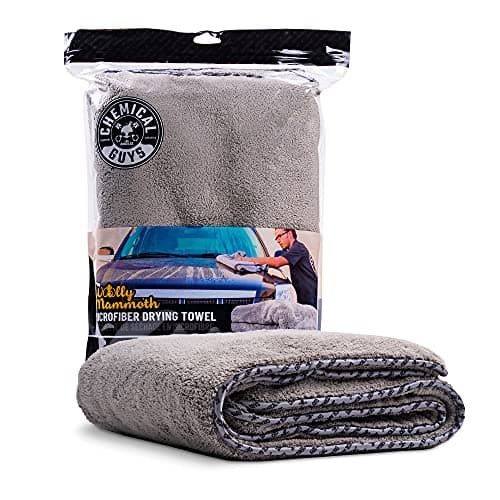
The Chemical Guys Woolly Mammoth is the drying towel to buy — a single 36 x 25 in dual-sided sheet with enough capacity to pull the water off most of a car without re-wringing, which is the property that decides whether drying scratches your paint. It is for anyone who has just corrected a car and wants to keep it corrected. If you want two thirds of that for a third of the money, Meguiar's Water Magnet is the waffle-weave answer, and if your paint is freshly polished black, the edgeless 500 GSM towels below are the ones you should be finishing with.
Drying is the step nobody ranks and everybody does badly. The wash gets the attention, because that is the step with a product and a technique attached to it, and a good wash mitt genuinely does most of the work of keeping paint safe. But a mitt works submerged in soap: there is a lubricating film of suds between the fibers and the clear coat the entire time. A drying towel is deliberately removing that film. It is the only step in a wash where dry fiber is dragged across dry paint under hand pressure, and every particle of grit the wash left behind gets exactly one more chance to cut.
The criterion: water carried per pull
A drying towel has one job, and the measure that matters is how much water it holds before it stops absorbing. The reason is mechanical rather than aesthetic. A towel that is saturated after half a hood stops lifting water and starts pushing it — and pushing water means pressing down, wringing out, re-folding, and going back over panels you have already touched. Every one of those is another pass of fiber on dry paint.
A towel with real capacity lets you work the way you should: lay it flat on the panel, pull it toward you in one slow motion, lift, move on. No pressure, no circles, no second pass. A large, thirsty towel is not a luxury item, it is the thing that makes a safe technique physically possible.
That is why size and capacity are ranked together here, and it is the axis that separates this page from our general detailing towel rankings, where towels are judged across five different jobs including wax buff-off, glass and jambs. A superb buff-off towel can be a mediocre drying towel, and two of the picks below are exactly that.
Waffle weave, plush pile, or edgeless?
Waffle weave is the traditional drying construction: a gridded surface whose pockets hold a surprising volume of water for the weight of fabric, and which releases it quickly when wrung. It is the cheapest route to real capacity. The trade-off is contact — the raised grid is a relatively firm, shallow surface, so there is less depth for a stray particle to fall into than a deep pile offers.
Deep plush pile is the safer construction and the one to use on paint you care about. The long fibers stand proud of the backing, so grit that touches the towel drops between the fibers rather than being pinned against the clear coat, and the pile itself holds water in volume. It costs more, it is bulkier to wring out, and it takes longer to dry between uses. On dark or freshly corrected paint it is worth all three.
Edgeless is not a weave at all — it is the absence of a stitched border. A sewn hem or a brand tag is a strip of non-absorbent, comparatively hard material dragged across paint at the exact moment you are being careful, and it is the single most common cause of towel-inflicted marring. Edgeless towels tend to be smaller 16 x 16 sheets rather than full drying sheets, which makes them the finishing towel rather than the primary one. The same reasoning applies to applicator pads and buff-off towels.
The field, by the numbers on the listings
| Towel | Size | Construction | Pack | Job it is for |
|---|
| CG Woolly Mammoth | 36 x 25 in | Dual-sided drying pile | 1 sheet | Primary drying towel for the whole car |
| Meguiar's Water Magnet | 22 x 30 in | Waffle weave | 1 sheet | Budget primary drying towel |
| Rag Company Eagle Edgeless 500 | 16 x 16 in | 500 GSM, no border | 4-pack | Final touch-dry and buff-off on dark paint |
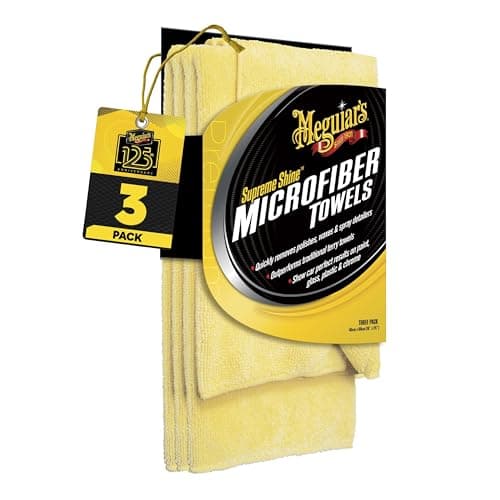
| Meguiar's Supreme Shine | 16 x 16 in | Plush, stitched border | 3-pack | Affordable backup towels, stocked locally |
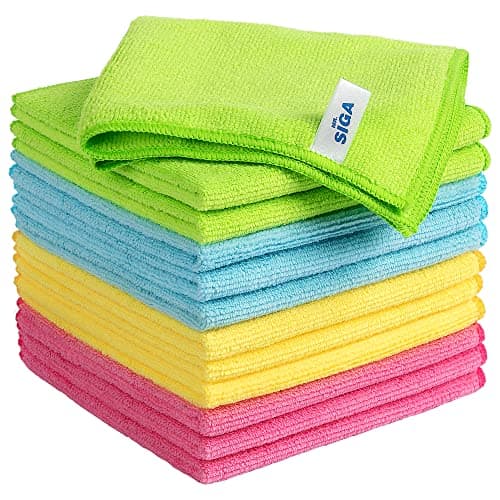
| MR.SIGA cleaning cloths | General purpose | Thin weave | 12-pack | Jambs, glass, wheels — never paint |
One absence is worth stating plainly rather than papering over. The format a lot of readers will be searching for is the twisted-loop drying towel — long, twisted fiber loops that hold enormous volumes of water and are the current enthusiast default. We do not have a verified live listing for one, so there is no twisted-loop pick on this page. Rather than promote a different weave into that slot and describe it as something it is not, the page ranks what the registry can honestly support: one large dual-sided plush sheet, one waffle weave, and the edgeless towels that finish the job.
The method matters as much as the towel
Sheet the water off first. Before any towel touches the car, flood each panel with a low-pressure, open-ended flow of water from the top down. Surface tension pulls the sheet off the panel and takes most of the standing water with it. On a waxed or coated car this can remove more than half of what you were about to towel off, and water you never have to dry is water that cannot drag anything.
Lay, pull, lift. Spread the towel flat, pull it toward you, lift it off. Do not scrub, do not circle, and do not press. If a panel needs a second pass, use a dry section of towel, not more pressure.
Top down, paint before everything else. The lower quarter of a car carries the hardest grit and the drying towel should reach it last, if at all — and the jambs, sills and wheels should get a different towel entirely. That is what the cheap twelve-pack on this page is for, and why its card says plainly that it is not a paint towel.
Use a drying aid on anything dark. A light mist of detail spray on the panel before the towel restores a slip layer and turns a dry drag into a lubricated one. It also adds a little gloss, which is why it has become standard practice on show cars. The field is ranked in best detail spray.
Never let a dropped towel back on paint. A towel that hits the driveway has embedded grit that a rinse will not reliably remove. Demote it to wheels. This is the strongest argument for buying towels in multipacks, and the same rule that governs the wash itself.
Why this step is worth the money
Paint correction is subtractive and permanent: every pass of a compound removes clear coat you do not get back, which is the whole argument of does polishing remove clear coat. Spending a weekend and a measurable fraction of your film thickness removing swirls, and then putting fresh ones in with a bath towel, is the most expensive mistake in this hobby by a wide margin. A good drying towel costs less than one bottle of compound and protects the correction indefinitely.
Buying and caring for drying towels
Buy one large towel plus a small finishing pack
The combination that works is one big sheet for the bulk of the water and two or three small edgeless towels for the last wet spots, mirror housings, grille slats and the water that creeps out of trim gaps for minutes after you think you are finished. One towel of each type is enough for a single car.
Wash them separately, and never with softener
Microfiber goes in the machine on its own — never with cotton, which sheds lint into the pile permanently — in a detergent with no fabric softener and no bleach, and dries on low or air dries. Softener leaves a waxy residue that destroys absorbency, which is the one property you paid for. A drying towel that has met softener once never dries properly again.
Keep paint towels and dirty-job towels physically separate
Different bins, different colors, no exceptions. Brake dust is hot metallic particulate that embeds in a pile and survives a wash cycle, so a towel that has been near a wheel is retired from paint duty permanently.
Retire them on feel, not on age
A drying towel is finished when it feels stiff or slick rather than soft and grabby, when it stops pulling water on the first pass, or when you find something in the pile you cannot flush out. Towels are the cheapest consumable in detailing and the one most people keep longest past their useful life.
Do not dry a car that has not been decontaminated
If the paint still feels rough after a wash, that roughness is bonded contamination, and a towel dragged across it will catch and marr no matter how plush it is. Fix the surface first: the baggie test and the two routes out of it are in best clay bar for car, and the cadence question in how often should you clay bar your car.