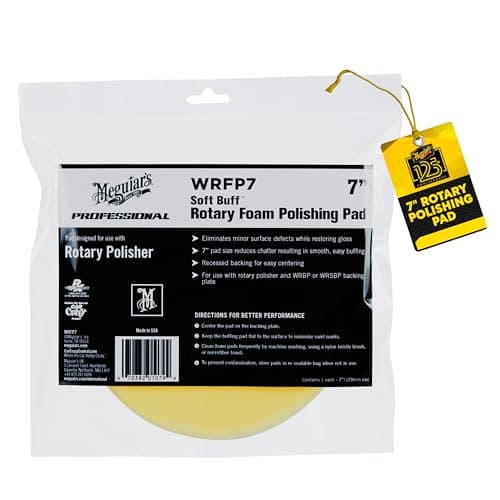
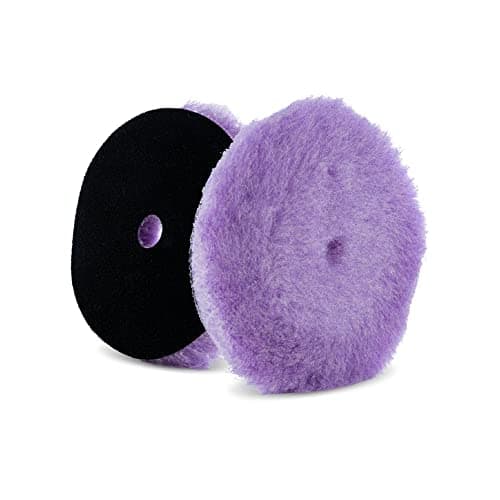
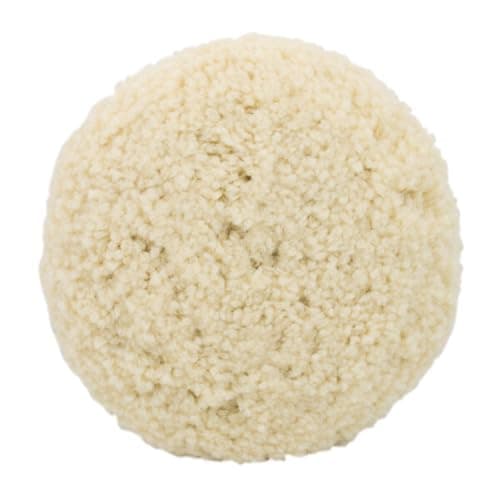
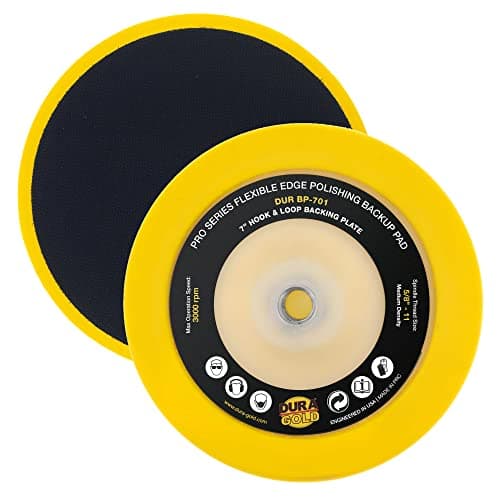
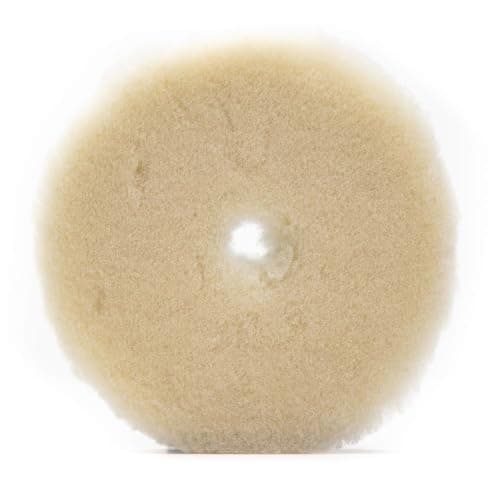
Pads sold for a dual-action and pads sold for a rotary are not the same product with a different label. A DA moves its pad in a wobbling orbit and lets it free-spin, so heat builds slowly and gets spread around. A rotary drives the pad in one direction at a constant speed, so every part of the pad face passes over the same paint at the same velocity, continuously, and the heat has nowhere to go but into the foam and the clear coat underneath it. The machines these pads belong on are ranked in best rotary polisher.
That single mechanical difference is why wool exists in this category and barely registers in the DA one. Wool fibers shed heat far better than closed-cell foam, and they cut hard enough to justify the risk of running a rotary in the first place. If you are still deciding whether you need a rotary at all, dual-action vs rotary polisher is the page to read first — most people correcting ordinary modern clear coat do not.
Wool, hybrid or foam
Three materials, three jobs, and the sequence usually runs through more than one of them.
Wool is the cutting material. Knitted lambswool or twisted wool fiber removes oxidation and sanding marks at a speed no foam matches, and it does it while running cooler than foam would at the same cut. The cost is haze: wool leaves fine circular marks of its own that a second pass has to clear. Nobody finishes on wool.
Wool-foam hybrids bind wool fiber into a foam matrix. They cut somewhere between the two and finish noticeably better than pure wool — the right choice when the paint needs real correction but not a full two-stage attack, and you would rather not swap pads mid-panel.
Foam is the refining material. On a rotary it is almost always the second pass: a polishing-grade foam with a finer polish, run slower and lighter, to remove the haze the wool left. The wider material comparison sits in foam vs microfiber pads, and the logic carries across.
Size, thread and the plate underneath
Rotary buffers use a 5/8"-11 threaded spindle and traditionally run 7-inch pads. That is a lot of pad — heavy on a vertical panel and awkward on anything curved — which is why 5- and 6-inch rotary setups have become common among people who correct cars rather than boats.
Whatever size you choose, the pad needs a proper hook-and-loop backing plate, not the old bonnet-and-spindle arrangement many older buffers ship with. That plate is a separate purchase and it is the thing that makes every pad on this page usable; the field is ranked in best backing plate for a polisher.
Heat is the whole game
On a dual-action, a badly chosen pad gives you a poor finish. On a rotary it gives you a burn. Everything that raises heat — a dense closed-cell pad, a high speed, heavy pressure, a dry pad, a saturated pad — stacks, and clear coat softens long before you smell anything. Pads with a foam interface layer, an open fiber structure or a vented plate underneath all buy you margin, and margin is what you are actually shopping for here.
A saturated pad is the sneakiest version of this. Spent compound fills the fiber, the pad stops releasing product and starts generating friction instead of cut, and the panel gets hot much faster than it did ten minutes earlier. Clean pads between panels rather than at the end — how to clean polishing pads covers the routine, and it matters more on a rotary than anywhere else.
Buy pads in pairs, minimum
One wool pad and one foam pad is the absolute floor for a car, and it will have you washing and drying mid-job. Two of each is the realistic number, and wool especially benefits from a rotation because a wet, washed wool pad takes hours to dry properly. Pads are consumables and cheap relative to the time they save; how often to replace polishing pads covers when a tired one starts costing you results.
Everything on this page assumes you have already settled the material question. If you have not — if you are still weighing whether wool is worth the extra foam pass it forces — foam vs wool pads compares the two on cut, finish, heat and the backing plate each one needs.
How to choose rotary pads
Start from the defect, not the pad
Heavy oxidation, chalky single-stage paint or sanding marks from a repair justify wool. Ordinary swirls in modern clear coat do not — those are dual-action work, and reaching for wool on them removes far more clear coat than the job needs. If you are unsure what you are looking at, inspect under a tight-beamed light first; the detailing light picks exist for exactly that.
Match the pad diameter to the plate, not the machine
- 7-inch pads — the rotary standard. Fastest coverage, heaviest to hold, hardest to keep flat on curves.
- 5 to 6-inch pads — far more controllable on car bodywork, and what most people correcting cars rather than boats end up running.
- Pad overhang — about a half-inch beyond the plate, so the rigid plate rim never contacts paint when you tilt the machine.
Plan the second pass before you buy the first pad
Wool always needs foam afterwards. Buying a wool pad without a foam polishing pad in the same order is planning to look at haze in daylight and wonder what went wrong. Pair the foam pass with a finer product too — the picks in best polishing compound for cars are formulated for it.
Low-lint matters more than it sounds
Cheap wool sheds. Loose fibers end up in your compound, get dragged across the panel and put in marks that look exactly like the ones you are trying to remove. Knitted, low-lint constructions cost more and shed dramatically less, and on a dark car that difference is visible.
Speed and technique
These pads are all designed for roughly 1,000 to 1,500 rpm, flat, moving continuously. Anything faster is generating heat rather than cut. The full technique is in how to use a rotary polisher.