For a full-size car, plan on four to six cutting pads and three to four finishing pads per correction — call it eight to ten pads total for a two-stage job on a sedan. If you are doing a single-stage polish on a well-kept car, four to five pads of one type is enough. If you have two or three pads and a car full of swirls, pad count is very likely the reason the correction is not working, and it is the cheapest problem on this site to fix.
Why a pad stops cutting
A foam polishing pad is a sponge, and the abrasive in a compound works by being held between that sponge and the paint. As you work, three things happen to the pad: it fills with spent product, it fills with removed clear coat and dried polish residue, and it heats up and stiffens. Past a certain point the open cells are full, the face is glazed, and the pad is no longer presenting fresh abrasive to the surface — it is smearing a slurry around.
That failure is almost completely invisible. The machine still sounds right, the pad still looks like a pad, and the panel still looks wet and glossy under the oils. You only find out when you wipe the section down and nothing has changed. Nine times out of ten, when someone says a compound "did nothing", the compound was fine and the pad was full.
The second failure mode is worse. A saturated pad with dried residue on its face is a hard surface, and a hard surface being spun against paint is an abrasive you did not choose. That is how a correction ends up adding marring instead of removing it. Our pad cleaning guide covers the on-the-fly routine that extends a pad's working life, and how often to replace polishing pads covers the end of it.
The arithmetic, per car
The working rule most detailers converge on is one pad per two to three panels, per stage. A panel here means a door, a fender, a quarter, half a hood, half a roof — the two-foot-square working sections you actually polish in.
| Vehicle | Panels, roughly | Cutting pads | Finishing pads | Total for a two-stage job |
|---|
| Coupe or small hatch | 10 to 12 | 3 to 4 | 2 to 3 | 5 to 7 |
| Sedan | 14 to 16 | 4 to 6 | 3 to 4 | 7 to 10 |
| SUV or crossover | 18 to 20 | 6 to 7 | 4 to 5 | 10 to 12 |
| Full-size truck or van | 22 or more | 7 to 9 | 5 to 6 | 12 to 15 |
Three adjustments to those numbers, all of which push upward rather than down.
- Heavily swirled or neglected paint: add 30 to 50 percent to the cutting column. More material coming off means the pad fills faster, and you will also be working each section longer.
- Single-stage paint: add at least 50 percent. The pad is absorbing pigment as well as residue, and a pigment-loaded pad glazes over quickly — our single-stage page explains why.
- Microfiber cutting pads: they clog faster than foam, not slower. Budget one per one to two panels if you are using them — the microfiber page has the detail.
If you are wondering where the panel count comes from and how long all this takes, how long paint correction takes runs the same arithmetic against the clock.
Rotation beats quantity — up to a point
You do not need a fresh pad per panel if you clean on the fly. The method is simple and it roughly doubles how far a pad goes: after every section, with the machine running at low speed, press the pad face against a stiff brush or a microfiber towel to pull the spent product out, then snap the machine on and off at speed to centrifuge the rest. Thirty seconds a panel.
What on-the-fly cleaning cannot fix is wetness. Once a pad is genuinely saturated — damp through the foam rather than just loaded on the face — it will not cut properly no matter how clean the surface looks, and it needs to come off and dry. That is the real reason to own more pads than the arithmetic strictly requires: not because each one wears out, but because you need dry ones available while the wet ones recover. Three pads rotated through a whole car means you are always working with the dampest of the three.
A practical minimum for one car, then: buy double the number the table says you will use for your main stage. Pads are inexpensive relative to a polisher or a compound, they last years with proper washing, and running out mid-correction means either stopping or doing damage.
Which types, not just how many
Quantity is the common mistake; buying all of one grade is the second. A correction needs at least two grades to work the way it is supposed to.
- A cutting or polishing grade for the correction stage — firmer foam, more mechanical bite. This is where most of your pads should be.
- A soft finishing grade for the refinement stage and for applying wax or sealant by machine. These last much longer because they see less material.
- Two or three small pads, 3 inch or 4 inch, for mirrors, pillars, bumper returns and the places a 5 inch pad cannot reach flat. Nothing else does this job.
Polishing vs finishing pads maps the grades against each other, and the pad color guide decodes the manufacturer color conventions so you can tell what you are actually buying. Standardize on one face size before you order — 5 inch vs 6 inch explains why mixing them means owning two backing plates.
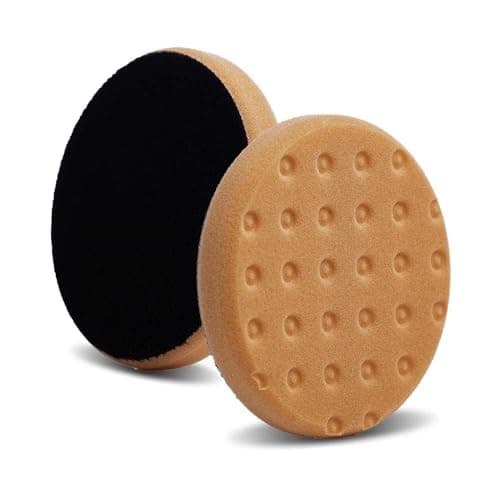
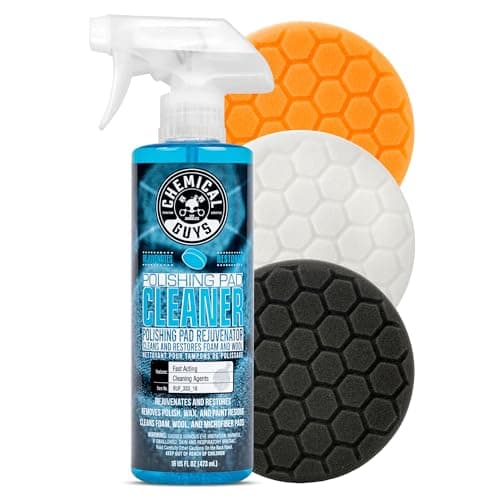
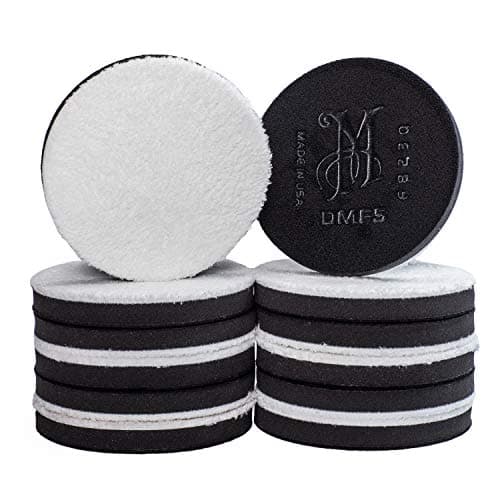
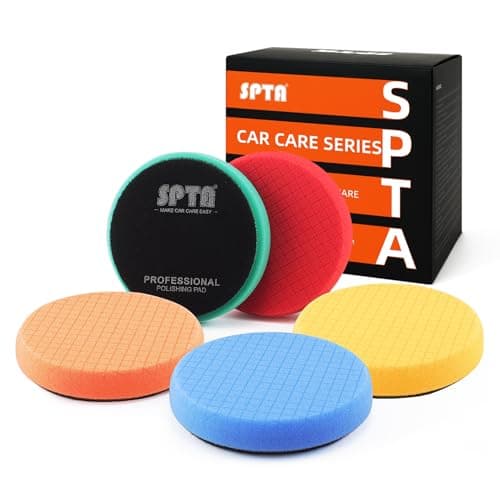
The picks below are chosen on cost per pad and pack size rather than on peak performance, because this page is about having enough of them: a large budget multi-pack, two mid-range multi-packs in different grades, and a finishing pack. Prices are read live from the retailer and stamped with the date we verified them.