Skip to content
Pad & Polish

HUB 01 · Machine Polishers

Best Rotary Polisher for Cars

A rotary removes defects faster than anything else you can hold, and burns clear coat faster than anything else you can hold. Here is what is actually worth buying, and who should not buy one at all.

By Stephen V.Updated How we research
#ad

We earn a commission when you buy through our Amazon links, at no extra cost to you. It never affects our rankings, and we say so when the cheaper product is the better buy. How this works.

The DEWALT DCM849B is the rotary to buy — a 20V MAX XR cordless machine with jobsite-grade trigger and speed control, running a 7-inch pad, and it is for one person: someone who has already run a rotary and wants defects gone faster than any dual-action can manage. If the price is the obstacle, the AVID POWER 1200 W corded rotary does the same job for well under a hundred dollars and comes with four pads. If you have never run a rotary, the honest recommendation on this page is the third pick, which is not a rotary at all.

That shape of answer is unusual for a roundup, and it reflects what has actually happened to this category. A decade ago a rotary was the only machine that would correct neglected paint in a reasonable number of hours. Then long-throw dual-action polishers arrived with orbits big enough to do most of that work while keeping the stall protection that stops a beginner from burning a panel, and the consumer rotary market thinned out accordingly. We could not honestly fill six slots on this page with rotary machines, because there are not six rotary machines in the registry worth recommending. There are two. The other three picks are the consumables a rotary needs to work at all, plus the machine most readers should buy instead.

What a rotary actually is, and why it cuts

A rotary spins the pad on a single fixed axis, like a grinder. Every point on the pad travels in a circle at a known, constant speed, and that speed is entirely yours to choose. Nothing interrupts it. Put a wool pad on a rotary at 1,500 rpm against a swirled hood and the abrasive gets dragged across the same patch of clear coat continuously, which is why correction that takes four dual-action passes takes one rotary pass.

A dual-action, by contrast, spins the pad and orbits it, and the spin is driven by friction rather than by the motor. Press too hard, hold an edge, or hit a curve and the pad stops rotating and just orbits — it stalls. That stall is the safety net the entire beginner recommendation rests on, and the comparison in full is in dual-action vs rotary polisher.

A rotary has no such net. Heat builds where the pad dwells, the clear coat softens, and if you keep the pad there the paint burns through to primer. That is not a rare horror story; it is the normal consequence of a few seconds of inattention on a body line or a panel edge where the clear coat is thinnest. It is also the single reason this page ranks the way it does.

How we ranked these

Correction rate on neglected paint. The only reason to own a rotary. Measured by motor power, pad size, and whether the speed range goes low enough to spread a compound without slinging it across the garage.

Speed control at the bottom of the range. A rotary that only knows how to go fast is a liability. Spreading product, working a compound and finishing with foam all happen at the low end, and a machine with a single fixed speed cannot do the first or the third.

Whether it takes modern pads. Many older rotary buffers ship with a spindle and a bonnet, which is a wax-application design, not a correction design. Hook-and- loop pads need a threaded backing plate, which is why one is on this list.

What it does to your arms. A 7-inch pad on a corded rotary held against a vertical door for an hour is genuine physical work, and fatigue is a safety factor on a machine with no stall protection.

The field, side by side

MachineActionPower / platformPadWho it is for
DEWALT DCM849BRotary20V MAX XR cordless, tool only7 in / 180 mmExperienced correctors already on the DEWALT platform
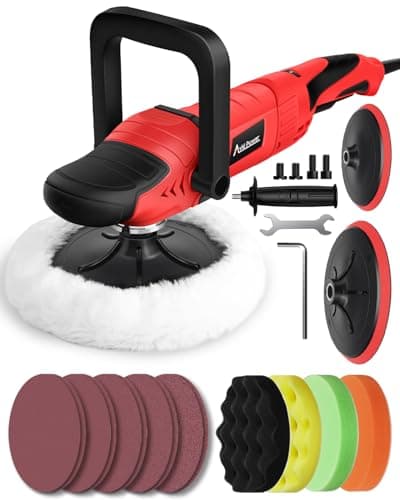
AVID POWER 1200 WRotary1,200 W corded, 6 speeds6 in, four pads includedCheap cutting power for heavily oxidized paint
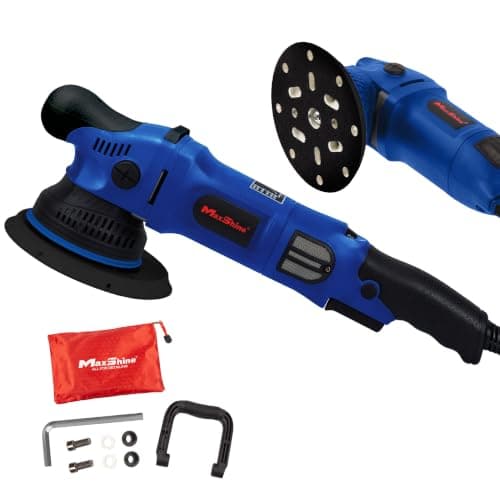
Maxshine M21 ProDual action, 21 mm throw1,000 W corded, 2,200–5,000 OPM6 inMost people: near-rotary pace with stall protection

The cordless-versus-corded split here is not a minor convenience question. A cordless rotary lets you work around a whole car without dragging a cable across fresh paint, and the DEWALT is sold bare, so anyone with 20V MAX batteries in the garage skips paying for them twice. A corded machine never runs out mid-panel, which on a rotary is a real advantage: stopping halfway through a section because the battery died is how you end up with a visible seam. The wider cordless field, almost all of it dual-action, is in best cordless polisher.

The pads are not optional, and they are not DA pads

A rotary with the wrong pad is a slower, more dangerous dual-action. The classic rotary combination is knitted wool for cutting, followed by rotary-grade foam to clear the haze the wool leaves — two passes, two pads, and the second one is what makes the finish presentable. Wool cuts faster than any foam at the same speed, and it always leaves something behind for the foam to fix. The full field is ranked in best polishing pads for rotary, and the trade-off itself in foam vs wool pads.

Sizing matters more than it does on a dual-action. Rotary plates thread on at 5/8"-11, a completely different fitting from the 5/16"-24 that dual-action machines use, so DA plates and rotary plates are not interchangeable in either direction. If you have inherited an old rotary buffer that came with a spindle and wool bonnets, a threaded 7-inch plate is the upgrade that brings it into the modern pad ecosystem — and it is cheaper than any other part of this page.

Who should not buy a rotary

If this is your first machine, do not buy a rotary. Not because the technique is unlearnable, but because the cost of the learning curve is paid in clear coat you cannot put back. The sequence that works is to learn pad pressure, panel speed and section size on a dual-action, where a mistake means a dull patch rather than a trip to a body shop, and then add a rotary later if the work you are doing genuinely needs one. Start with best car polisher for beginners.

If what you want is one machine that corrects a whole car in an afternoon without the burn risk, buy a long-throw dual-action. A 21 mm orbit does not match a rotary on badly oxidized single-stage paint, and it comes close enough on the swirled modern clear coat that most of us are actually working on — with the stall protection intact. The comparison is in long-throw vs short-throw polisher.

And if the job is wax rather than correction, a rotary is the wrong tool twice over: too fast, too hot, and no faster at spreading a liquid than a cheap orbital waxer. That job has its own page in how to wax a car with a polisher.

What the rotary is still genuinely best at

Three jobs, and they are real. Heavily oxidized single-stage paint on an older car, where the chalky layer is thick and uniform and the fastest removal wins. Sanding-mark removal after wet sanding, where you are levelling a known pattern of scratches and a dual-action will take all day. And production work, where correcting several cars a week makes the time saved per panel add up to something that matters. For the first of those, the sequence is in best compound for single-stage paint; for the second, in best sandpaper for wet sanding a car.

Outside those three, a rotary is a faster way to do a job you could have done safely. That is a legitimate thing to want — it is just worth being honest that it is what you are buying.

The short answer

Quick picks

#ProductBest forScorePrice
01
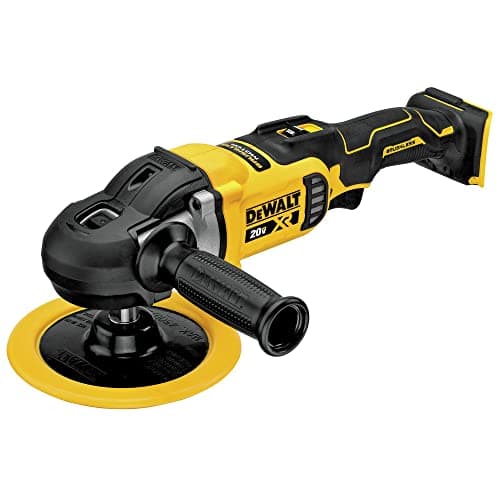
DEWALT DEWALT DCM849B 20V MAX XR Cordless Rotary Polisher
DEWALT DCM849B 20V MAX XR Cordless Rotary Polisher

A professional-grade cordless rotary — the fastest correction here by a wide margin, and the only tool on this page with no dual-action safety net, so it earns its place only in trained hands.

Experienced correctors already on the DEWALT 20V platform
7.2
$222.30Amazon
02
AVID POWER AVID POWER 1200 W Rotary Buffer/Polisher
AVID POWER 1200 W Rotary Buffer/Polisher

A budget corded rotary with real motor power and four pads in the box — genuinely capable on neglected single-stage paint, and genuinely capable of burning through clear coat if you dwell.

Cheap cutting power on heavily oxidized paint
7.0
$49.99Amazon
03
Maxshine Maxshine M21 Pro Long-Throw Dual-Action Polisher
Maxshine M21 Pro Long-Throw Dual-Action Polisher

The long-throw end of the dual-action range: the same stall-protected action a beginner tool has, wrapped around an orbit big enough to take a whole car's moderate defects out in a fraction of the passes.

Correcting whole cars in the fewest passes
8.1
$258.99Amazon
04
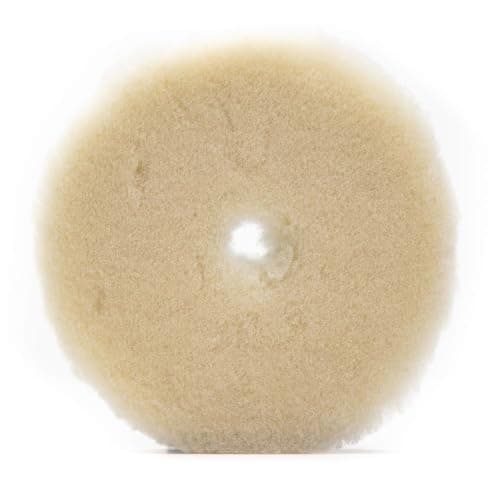
Lake Country Lake Country 6" Low-Lint Wool Buffing Pad
Lake Country 6" Low-Lint Wool Buffing Pad

Half-inch knitted lambswool over a 3/8-inch foam interface — the combination that gives you wool's cutting speed without wool's usual habit of shedding fibers into your compound.

Fast cutting on a rotary without the shedding mess
8.1
$26.76Amazon
05
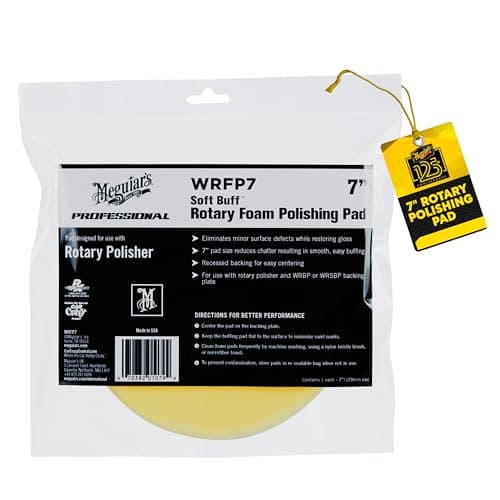
Meguiar's Meguiar's 7" Soft Buff Rotary Foam Polishing Pad (WRFP7)
Meguiar's 7" Soft Buff Rotary Foam Polishing Pad (WRFP7)

The foam pass that has to follow wool: a polishing-grade foam sized for a rotary's 7-inch plate, built to take out the haze a wool cutting pad leaves and put the gloss back.

Refining the finish after a wool cutting pass
7.6
$23.77Amazon
06
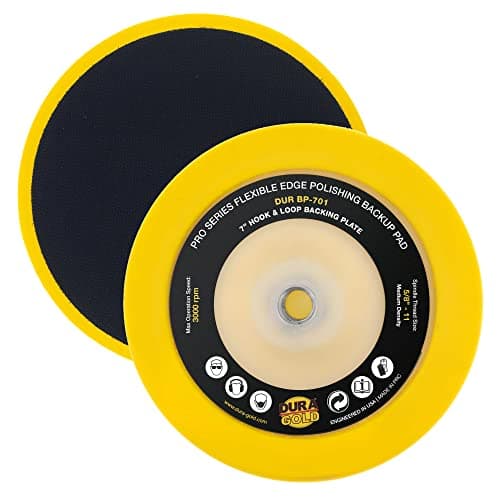
Dura-Gold Dura-Gold Pro Series 7" Rotary Backing Plate
Dura-Gold Pro Series 7" Rotary Backing Plate

The plate a rotary actually needs: a 5/8"-11 threaded, flexible-edge 7-inch backer that lets an old rotary buffer take modern hook-and-loop wool and foam pads instead of spindle bonnets.

Converting a rotary buffer to hook-and-loop pads
8.3
$17.99Amazon

#ad · Live prices from the Amazon Product API, as of October 17, 2026. Where we have no verified live price, we show none — we would rather leave a gap than print a number that has rotted.

In detail

The picks, in full

01
DEWALT DEWALT DCM849B 20V MAX XR Cordless Rotary Polisher

Experienced correctors already on the DEWALT 20V platform

DEWALT DCM849B 20V MAX XR Cordless Rotary Polisher

20V MAX XR platformRotary (not DA)7-inch / 180 mm padTool only
7.2/10

A professional-grade cordless rotary — the fastest correction here by a wide margin, and the only tool on this page with no dual-action safety net, so it earns its place only in trained hands.

Ergonomics
8
Correction power
9.2
Beginner-safe
4.5
Value
7

Pros

  • Clears heavy defects far faster than any dual-action on this list
  • Sold bare, so 20V MAX owners skip paying for batteries again
  • Trigger and speed control are genuinely jobsite-grade

Cons

  • Rotary action has no stall protection — it can burn clear coat
  • No battery or charger in the box

Don't buy this if…

…you have not run a rotary before — buy a dual-action and learn on that first.

$222.30View on Amazon

$349.0036% off

Price as of October 17, 2026. Prices change — Amazon's is the one that counts.

#ad · we may earn a commission from this link to DEWALT DCM849B 20V MAX XR Cordless Rotary Polisher

02
AVID POWER AVID POWER 1200 W Rotary Buffer/Polisher

Cheap cutting power on heavily oxidized paint

AVID POWER 1200 W Rotary Buffer/Polisher

1200 W motorRotary6 speedsFour 6-inch pads included
7.0/10

A budget corded rotary with real motor power and four pads in the box — genuinely capable on neglected single-stage paint, and genuinely capable of burning through clear coat if you dwell.

Ergonomics
6.8
Correction power
8.6
Beginner-safe
4.2
Value
8.6

Pros

  • Serious cutting power for well under a hundred dollars
  • Pads included, so it works out of the box
  • Six-speed dial rather than a single fixed speed

Cons

  • Rotary action offers no stall protection on thin modern clear coat
  • Heavier and more tiring to hold flat than a DA

Don't buy this if…

…this is your first machine — the price is tempting and the burn risk is real.

$49.99View on Amazon

$69.9929% off

Price as of October 17, 2026. Prices change — Amazon's is the one that counts.

#ad · we may earn a commission from this link to AVID POWER 1200 W Rotary Buffer/Polisher

03
Maxshine Maxshine M21 Pro Long-Throw Dual-Action Polisher

Correcting whole cars in the fewest passes

Maxshine M21 Pro Long-Throw Dual-Action Polisher

21 mm throw1,000 W motor2,200–5,000 OPM6 in backing plate
8.1/10

The long-throw end of the dual-action range: the same stall-protected action a beginner tool has, wrapped around an orbit big enough to take a whole car's moderate defects out in a fraction of the passes.

Ergonomics
7.6
Correction power
9.2
Beginner-safe
7.2
Value
8.4

Pros

  • The largest orbit in the consumer field — a hood or door skin takes noticeably fewer passes
  • A six-speed controller and a locking progressive trigger, so the bottom of the range is slow enough to spread a compound without slinging it
  • Maxshine specifies a CNC-machined steel counterweight and an adjustable D-handle mount, which is what keeps a 21 mm orbit's vibration manageable over a full car

Cons

  • Big and nose-heavy on bumpers, mirror caps and tightly curved panels
  • Needs pads built for a long throw — thin short-throw foam flexes and overheats on it
  • Maxshine is a detailing-specialist brand, so dealer support and spare plates are thinner on the ground than Griot's or Adam's

Don't buy this if…

…this is your first polisher — a shorter orbit is far easier to keep flat while you learn.

$258.99View on Amazon

Price as of October 17, 2026. Prices change — Amazon's is the one that counts.

#ad · we may earn a commission from this link to Maxshine M21 Pro Long-Throw Dual-Action Polisher

04
Lake Country Lake Country 6" Low-Lint Wool Buffing Pad

Fast cutting on a rotary without the shedding mess

Lake Country 6" Low-Lint Wool Buffing Pad

6-inch1/2" knitted lambswool3/8" foam interfaceLow-lint build
8.1/10

Half-inch knitted lambswool over a 3/8-inch foam interface — the combination that gives you wool's cutting speed without wool's usual habit of shedding fibers into your compound.

Cut
9.2
Finish
6.4
Heat control
8.6
Value
8

Pros

  • Knitted lambswool cuts faster than any foam at the same speed
  • Foam interface spreads pressure and helps dissipate heat
  • Low-lint construction means far less fiber left in the finish

Cons

  • Leaves wool haze that a foam finishing pass has to clear
  • Needs washing after almost every heavy job

Don't buy this if…

…you own only a dual-action — wool on a DA mostly just stalls the machine.

$26.76View on Amazon

Price as of October 17, 2026. Prices change — Amazon's is the one that counts.

#ad · we may earn a commission from this link to Lake Country 6" Low-Lint Wool Buffing Pad

05
Meguiar's Meguiar's 7" Soft Buff Rotary Foam Polishing Pad (WRFP7)

Refining the finish after a wool cutting pass

Meguiar's 7" Soft Buff Rotary Foam Polishing Pad (WRFP7)

7-inchRotary-specific foamPolishing cut levelHook-and-loop
7.6/10

The foam pass that has to follow wool: a polishing-grade foam sized for a rotary's 7-inch plate, built to take out the haze a wool cutting pad leaves and put the gloss back.

Cut
5.6
Finish
8.8
Heat control
8
Value
7.8

Pros

  • Sized and rated for rotary use rather than adapted from a DA pad
  • Removes wool haze without needing a third pad
  • Meguiar's foam is widely stocked and consistent between batches

Cons

  • One pad is nowhere near enough for a whole car
  • Too large to work tight panels and mirror surrounds

Don't buy this if…

…your rotary plate is 5 inches — buy the matching size, not this one.

$23.77View on Amazon

Price as of October 17, 2026. Prices change — Amazon's is the one that counts.

#ad · we may earn a commission from this link to Meguiar's 7" Soft Buff Rotary Foam Polishing Pad (WRFP7)

06
Dura-Gold Dura-Gold Pro Series 7" Rotary Backing Plate

Converting a rotary buffer to hook-and-loop pads

Dura-Gold Pro Series 7" Rotary Backing Plate

7-inch face5/8"-11 threadFlexible edgeRotary polishers
8.3/10

The plate a rotary actually needs: a 5/8"-11 threaded, flexible-edge 7-inch backer that lets an old rotary buffer take modern hook-and-loop wool and foam pads instead of spindle bonnets.

Build quality
8
Flex & conformity
7.8
Fitment breadth
8.6
Value
8.8

Pros

  • Standard rotary thread, so it fits nearly every corded rotary buffer
  • Flexible edge reduces the chance of the plate rim contacting paint
  • Opens up the whole modern wool and foam pad range

Cons

  • 7-inch pads are heavy and tiring on vertical panels
  • Not usable on a dual-action machine — different thread entirely

Don't buy this if…

…you own a DA — this thread will not fit it, and the 5/16"-24 plates are what you want.

$17.99View on Amazon

Price as of October 17, 2026. Prices change — Amazon's is the one that counts.

#ad · we may earn a commission from this link to Dura-Gold Pro Series 7" Rotary Backing Plate

Running a rotary without burning anything

Never let the pad stop moving

The one rule that prevents almost every rotary disaster. Keep the machine traversing at a steady walking-slow pace and never pause with the pad spinning on paint, not even for a second to adjust your grip. Heat is cumulative and local; a stationary pad concentrates all of it in one spot.

Keep the pad flat and stay off edges

Clear coat is thinnest on body lines, panel edges and sharp curves — exactly the places a tilted pad concentrates pressure. Work the flat middle of a panel and treat anything within an inch of an edge as hand-polish territory. Tape off badges and trim before you start.

Start at the lowest speed that works

Spread the product at the bottom of the dial with the machine off the trigger stop, then bring the speed up only as far as the correction requires. Most correction on modern clear coat happens well below a rotary's top speed, and the top of the range exists for jobs most home users will never do.

Have a light in your hand before you have a machine

A rotary makes its own defects — holograms, that faint curved pattern you only see in direct light — and you cannot correct what you cannot see. An inspection light is not optional on a rotary; the field is ranked in best detailing light for paint correction. If you already have holograms, how to remove buffer trails covers getting them out.

Finish with foam, on a dual-action if you have one

The honest professional workflow is rotary to cut, dual-action to finish. Wool haze and rotary holograms both clear far more reliably on a DA with a soft finishing pad and a fine polish than on the machine that made them. If the rotary is your only machine, the rotary-grade foam pad above is the minimum.

Know how much clear coat you are working with

Every rotary pass removes more film than a dual-action pass does. On a car with unknown history — a repaint, a previous correction, a used purchase — a paint thickness reading before you start is the difference between informed and lucky. See best paint thickness gauge.
How we picked

We do not run a testing lab

We compiled published specifications, manufacturer data sheets and aggregated owner reviews, computed the cost of ownership from real sizes and coverage, then scored each product against a published rubric. The scores are judgments from documented research — they are not measurements we took, because we do not own a lab and we are not going to pretend we do. Where a number came from someone else, we name them and link them in Sources.

Questions

Frequently asked

Is a rotary polisher better than a dual-action?
Faster, not better. A rotary removes defects in fewer passes because the pad spins continuously under motor power with nothing to interrupt it. That same property is why it can burn through clear coat in seconds. For most home users a long-throw dual-action gets close enough on modern clear coat with a stall-protection safety net.
Can a beginner use a rotary polisher?
You can learn on one, but the cost of the learning curve is paid in clear coat. The standard advice, and ours, is to learn pad pressure and panel speed on a dual-action first, where a mistake leaves a dull patch rather than burnt-through paint, then add a rotary if your work genuinely needs the speed.
What speed should I run a rotary polisher at?
Spread product at the lowest speed the machine offers, then raise it only as far as the correction requires. Most correction on modern clear coat happens well below a rotary's top speed. A machine with a single fixed speed cannot spread product or finish properly, which is why a multi-speed dial is a requirement, not a feature.
Do rotary polishers use different pads?
Yes, and different backing plates. Rotary plates thread on at 5/8"-11 while dual-action plates use 5/16"-24, so they are not interchangeable. Rotary work also runs larger pads, typically 6 or 7 inches, and the classic combination is a knitted wool cutting pad followed by rotary-grade foam to clear the wool haze.
Will a rotary polisher burn my paint?
It will if you let the pad dwell. Heat builds where the pad stops moving, the clear coat softens, and a few seconds of inattention on a body line is enough to go through to primer. Keep the machine traversing constantly, keep the pad flat, and stay an inch away from every edge.
Can I use a rotary polisher to wax a car?
You can, and there is no reason to. Wax application needs a slow, even spread and no heat, which a cheap orbital waxer does perfectly for a fraction of the price and none of the risk. A rotary brings speed you do not need to a job where speed is the problem.

Keep reading

Receipts

Sources

We do not run a testing lab, and we do not pretend to. Where a measured number came from someone else's lab, we name them and link them. Where we could not verify something, we say so on the page rather than quietly leaving it out. Read our full method.