Cordless polishers occupy an awkward middle ground that the marketing photos never admit to. A cord is genuinely annoying: it drags across paint you just corrected, it catches on mirrors, and it decides where in the driveway you are allowed to work. But the cord is also what lets a corded machine hold pad speed under real pressure for three hours straight, and every battery tool on this page trades some of that away. The question is not whether cordless is worse — it is which kind of worse you can live with.
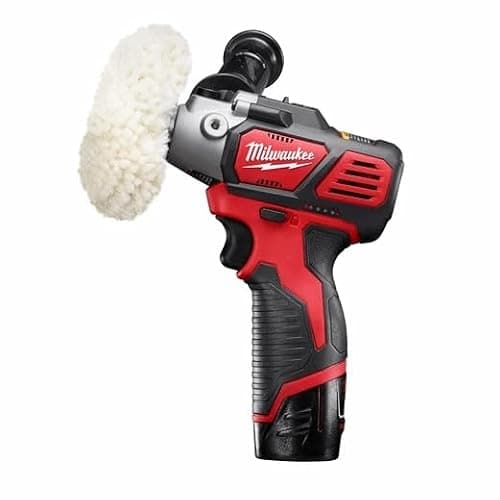
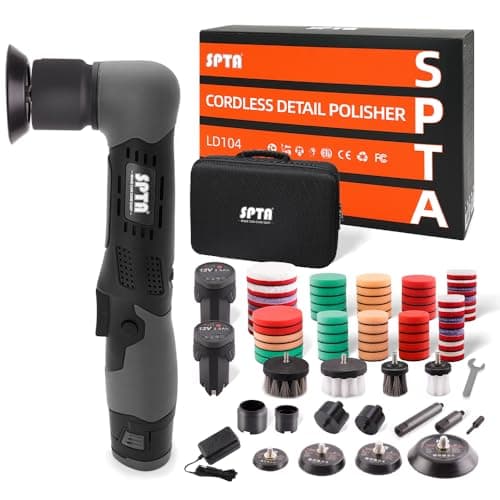
There are really two products being sold under the word "cordless" here. One is a genuine correcting dual-action with a real orbit, built to remove swirls without a wall socket. The other is a small spot tool designed for mirrors, badges, headlights and coating application, where a full-size machine simply does not fit. Both are useful. Buying the second when you wanted the first is the most common disappointment in this whole category, and the specification that separates them is orbit size, not voltage.
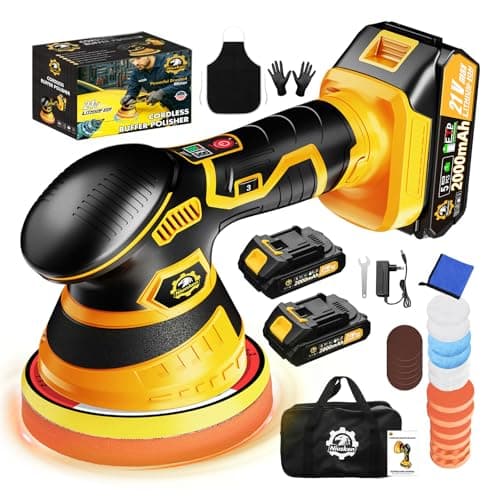
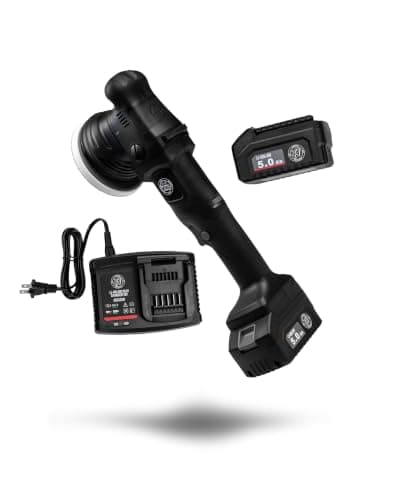
Worth being blunt about before you read the picks: only one of the machines below is a full-size cordless correcting DA. Our top pick pairs a real 15 mm long throw with a 5-inch plate, so it corrects whole panels the way a corded machine does — and it costs more than any corded polisher we recommend. Below it the field drops away to small-pad spot tools, plus one professional rotary. If the whole car needs correcting and there is an outlet within reach, the cheaper machine is still corded, and it is in our dual-action polisher roundup.
Orbit is the spec that matters, not volts
Battery listings lead with voltage — 12 V, 20 V, 21 V — because it is a big number that sounds like power. It is not the number that predicts correction. A tool's orbit (or throw) is the diameter of the circle the pad traces as it spins, and it is what determines whether the machine levels defects or just polishes the wax you put on it. A 12 mm orbit corrects. A 3 mm wobble on a mini tool does not, no matter what battery is behind it. We explain the mechanism in full in our dual-action vs rotary comparison, and it applies identically whether the tool has a cord or not.
What you are actually paying for
Cordless carries a real price premium — roughly the cost of the battery pack and the electronics that manage it, which on a premium machine is most of the difference between it and an equivalent corded DA. If you work in a garage with an outlet, that premium buys you convenience and nothing else. If you detail at a customer's house, in a parking lot, or in a driveway where the nearest socket is through a window, it buys you the ability to do the job at all.
The picks below run from a mini spot polisher up to a professional cordless rotary, so the sensible way to read them is by job rather than by rank. If you are correcting a whole car and have power available, honestly, buy a corded machine from our dual-action polisher roundup and put the difference toward decent pads and compound. That is not the answer this page is supposed to give, and it is still the right one for most garages.
How to choose a cordless polisher
The decision tree here is shorter than the spec sheets suggest, because most of what gets printed on a cordless polisher box has no bearing on the result you get. Work through these four questions in order and the field narrows to one or two machines.
1. Are you correcting, or protecting?
Correcting means removing swirls, oxidation and light scratches by abrading clear coat. Protecting means applying a wax, sealant or ceramic coating and buffing it off. These are completely different mechanical demands. Correction needs a real orbit and a motor that holds speed under pressure; protection needs almost nothing beyond rotation, which is why the cheapest tools on this page are perfectly adequate for it and useless for the other job.
2. How much of the car at a time?
Battery runtime is the constraint nobody plans for. A full correction on a mid-size sedan is several hours of continuous pad-on-paint work, and no single battery covers that. Two batteries and a fast charger turn it into a non-issue; one battery turns it into a stop-and-wait job. If the tool ships with a single pack, budget for a second one in the purchase price rather than discovering the problem halfway across the hood.
3. Do you already own a battery platform?
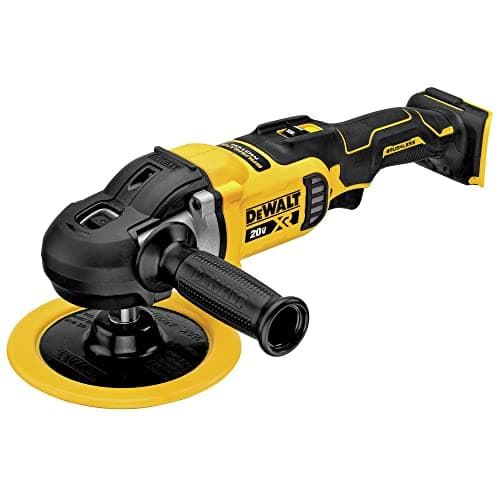
This is the biggest swing in real cost on the whole page. A bare tool on a platform you already own can cost half what the same capability costs as a kit, because you are not buying batteries and a charger a second time. If you have DEWALT 20V MAX or Milwaukee M12 packs on the shelf already, the arithmetic changes completely and the bare-tool options become the obvious value.
4. Dual-action or rotary?
One machine on this page is a rotary, and it is included deliberately because it is the right tool for a specific, experienced buyer. A rotary's pad never stalls, which is why it corrects fastest and why it burns through clear coat when held too long in one place. Every other pick is a dual-action with the built-in stall that makes learning safe. If you have not run a rotary on a panel you did not care about, buy a DA.
The mistake that wastes the money
The pattern we see repeatedly is someone buying a cheap cordless mini polisher because the listing photo shows it on a car hood, then concluding that machine polishing does not work. A one-inch pad on a hood is like mowing a lawn with scissors: it is not that the tool is bad, it is that it was built for badges and headlights and you pointed it at twenty square feet of paint. Match the pad size to the panel size, and pair whichever machine you buy with pads rated for its orbit and a suitable compound — the machine is only ever a third of the system.