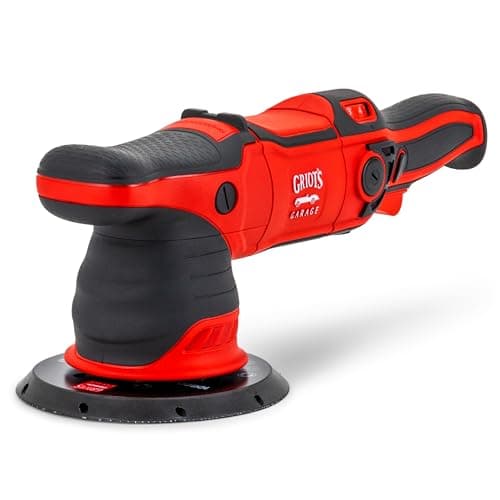
Every dual-action polisher leads its spec sheet with an orbit: 8 mm, 12 mm, 15 mm, 21 mm. That number is the diameter of the small circle the pad wanders through while it spins, and it tells you more about how the machine will feel and how long a job will take than the wattage printed next to it. Two polishers with identical motors and identical pads behave like different tools if their orbits are different. The throw is the machine.
The confusing part is that neither end of the range is the "better" one. A short 8 mm throw and a long 21 mm throw are not budget and premium versions of the same idea — they are two different trade-offs between control and coverage, and which one you want depends almost entirely on whether you are learning to correct a panel or trying to finish a whole car before it gets dark.
What the orbit number actually measures
A dual-action polisher does two things at once. The backing plate spins on a free bearing, and the whole assembly is also carried around a small offset circle by the motor. The orbit — also called the throw — is the diameter of that second circle. It is not the pad size, it is not the speed, and it is not the power.
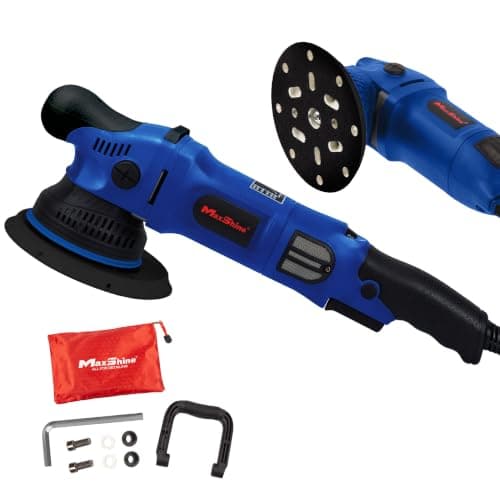
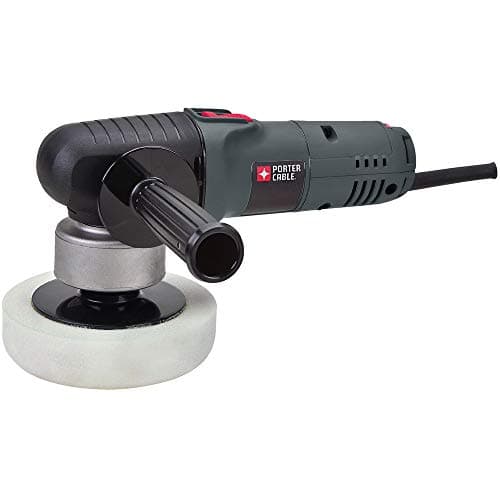
Speed is a separate spec, quoted in OPM, oscillations per minute, and the two numbers pull in opposite directions across the market. The PORTER-CABLE 7424XP, an 8 mm machine, is published at 2,500–6,800 OPM. Maxshine publishes 2,200–5,000 OPM for the 21 mm M21 Pro. The long-throw machine has the lower top speed on paper — and still drags the pad through far more paint per minute, because each of its oscillations travels around a circle roughly two and a half times the diameter. That is arithmetic off two published spec sheets, not a measurement we made; we do not run a lab, and how we research says exactly what we do instead.
Throw is coverage, not cut
The single most useful thing to understand before you spend the money: a bigger orbit does not cut deeper. It covers more ground.
How much defect comes out of a given square foot of clear coat is set by the pad, the abrasive in the compound, the pressure you apply and how long you work the section. A 21 mm machine and an 8 mm machine loaded with the same cutting pad and the same compound will both remove the same swirls from a door — the long-throw one just gets across the door in fewer passes. That is why the honest way to describe the difference is in square feet per hour, not in scratch depth. If your problem is that a defect will not come out at all, a longer throw is the wrong answer; a more aggressive pad and compound pairing is, and our cutting compound picks are where that starts.
The case for a short throw (8–9 mm)
It is easier to keep flat. A pad only corrects the paint it is actually touching. On a bumper, an arch, a mirror housing or the sculpted flank almost every modern car has, a small orbit lets the pad follow the shape; a large one is constantly trying to lift an edge off the panel. Keeping a pad flat is the entire skill of machine polishing, and a short throw is the setting that makes it easy.
It is more forgiving while you learn. The dual-action stall that protects your clear coat exists on every DA regardless of orbit, but a short-throw machine puts less energy into a given spot in a given second, so an unsteady first pass is less consequential. This is why the whole field of beginner polishers sits at 8 mm.
It is lighter, cheaper and quieter. Less mass swinging through a smaller circle means less vibration into your forearms over a three-hour session, a lighter tool to hold above shoulder height on a roof, and a lower price. The PORTER-CABLE 7424XP has been the cheapest honest way into machine polishing for two decades, and the entire library of tutorials built around it is worth something on your first attempt.
Its pads are the standard. The overwhelming majority of 5.5-inch foam pads, kits and multi-packs are engineered around short-throw consumer machines. Buy an 8 mm tool and everything on the shelf fits it.
The cost is time. On a neglected hood, an 8 mm machine will get there — in more passes, with more product, and with more of your afternoon spent on the same square foot.
The case for a long throw (15–21 mm)
It finishes cars, not panels. This is the whole argument. Correcting an entire vehicle is a repetitive job measured in sections, and a machine that clears each section in fewer passes compounds that saving across every panel on the car. People who correct a car once every couple of years rarely notice. People who correct a car every few months notice immediately.
It is still a dual-action. A long throw does not trade away the safety margin. The pad still stalls under too much pressure rather than grinding a hole in one spot, which is the mechanical difference that separates every DA from a rotary. A 21 mm machine is a faster tool, not a riskier class of tool.
It is steadier on big flat panels. A wide orbit spreads its work over a larger area of a hood or a roof, which makes it harder to leave the uneven, patchy coverage a small orbit produces when you rush it.
What a long throw costs you
Nimbleness. Everything that makes a long throw fast on a door skin works against it on a mirror cap. Long-throw machines are physically larger and nose-heavier, and the wider orbit means the pad edge is more likely to catch a body line or a trim edge. Most people who own one also own a small polisher for the areas it cannot sit flat on.
Vibration and fatigue. More mass through a wider circle is more energy into your hands. Modern long-throw machines counterweight and rubber-mount to manage it, and it is still more tiring than an 8 mm tool over the same hours.
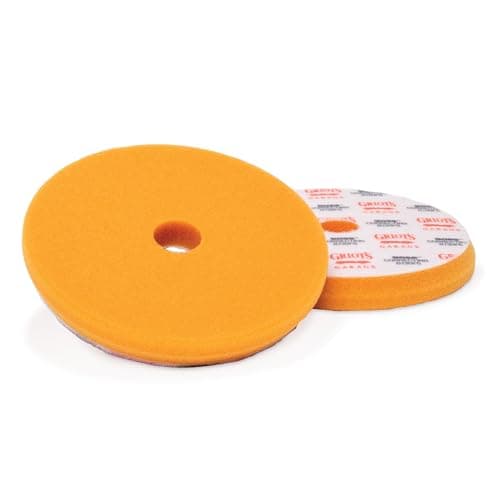
Your pad drawer. Pads for long-throw machines are built thicker and with more support in the foam, because thin foam engineered for a short orbit flexes and heats up when a 21 mm machine throws it around. Griot's BOSS foam is a good example of a pad line designed around long-throw tools — and equally, running those thick pads on an 8 mm machine wastes some of the small orbit it does have.
Money, for a result you could have had slower. A long-throw machine is usually a bracket above a comparable short-throw one, and it does not remove defects a short-throw machine cannot. You are buying hours back, which is a completely reasonable purchase — as long as you know that is what you are buying.
15 mm or 21 mm?
The long-throw category has its own internal split, and it matters more than most buying guides admit.
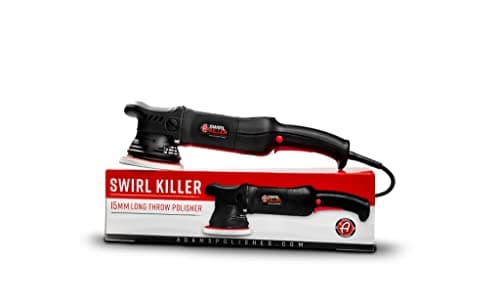
A 15 mm machine captures most of the coverage advantage while staying close to a normal polisher in size and manners. It is the sensible default for a second machine, or for a confident first-time buyer who already knows they are correcting whole cars — Adam's Swirl Killer 15 is the version of that tool we point at most often, and it is examined on its own in our Swirl Killer 15 review.
A 21 mm machine is the specialist. On a large, flat-paneled vehicle it is the fastest consumer tool available for taking swirls out of the whole thing; on a compact hatchback with almost no flat surface, a good chunk of that advantage is unusable and you are just holding a bigger, heavier polisher. Buy 21 mm if you correct cars regularly and the vehicles are big, and expect to reach for something smaller for the last ten percent of each job.
What throw does to the rest of your kit
Orbit is not an isolated decision — it sets the pads and the backing plate you will be buying for as long as you own the machine.
The plate has to match the machine's spindle thread, and the pad has to overhang the plate by roughly half an inch so the plate rim never touches paint when the machine tilts. Get the combination wrong and the symptom is a pad that hops or stops rotating under pressure, which nearly everyone misdiagnoses as a bad compound. The thread sizes and the flex trade-off are covered in best backing plate for a polisher, and the diameter question — where a long throw pushes you toward a slightly different answer — is worked through in 5-inch vs 6-inch polishing pads.
Budget for product, too. Covering more paint per minute means getting through more compound per session and cleaning the pad more often, because a saturated pad stops cutting and starts smearing no matter what it is bolted to.
The recommendation
Buying your first polisher: 8 mm. Every argument that matters at the start — control on curves, easy to keep flat, cheap, light, universal pad support — lands on the short-throw side, and it will still correct your car properly.
Correcting whole cars, already comfortable with a machine: 15 mm. The coverage gain is real and the tool still handles like a polisher.
Correcting cars often, on large vehicles: 21 mm, plus something small for the tight areas. That is a working setup, not a first purchase.
Only ever applying a coating or a sealant: throw barely matters. Any DA spreads product evenly; save the money for the coating.
Plenty of enthusiasts end up owning one of each, and that is not redundancy — it is the same reason a woodworker owns two sanders. If you are still deciding between machines rather than orbits, the full field is ranked in our dual-action polisher roundup.