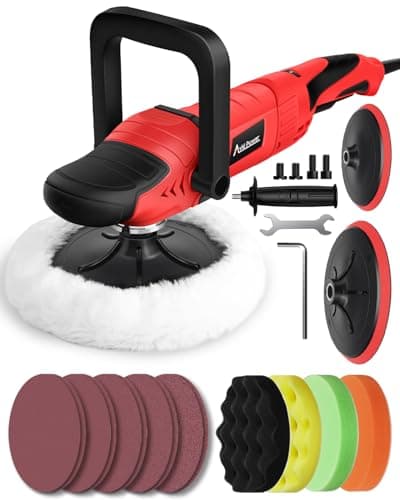
A rotary polisher spins its pad in one continuous direction, driven directly by the motor. There is no free-spinning bearing and no stall point — whatever you point it at, it keeps cutting. That is why a rotary clears sanding marks, deep oxidation and decades-old single-stage paint that a dual-action would still be arguing with an hour later, and it is why a rotary can go through a clear coat to primer in a few seconds of inattention.
If you have not read dual-action vs rotary polisher yet, read that first. The machines themselves are ranked in best rotary polisher. This page assumes you have decided a rotary is the right tool and want to use it without damaging anything.
Before you switch it on
Three things have to be true or the rest of this does not matter.
- The paint has to be clean and decontaminated. A single bonded particle under a wool pad at 1,500 rpm becomes a scratch you will spend the rest of the day removing. Wash, then clay — see how to clay bar a car.
- Every edge, badge and trim piece has to be taped. Paint is thinnest on ridges, body lines and panel edges, which is exactly where a spinning pad concentrates pressure. Tape them and you cannot burn them.
- You need somewhere to practice. A scrap panel from a breaker's yard is the cheapest insurance in detailing. Learn what a rotary feels like on paint that is not yours.
Pad and product, matched deliberately
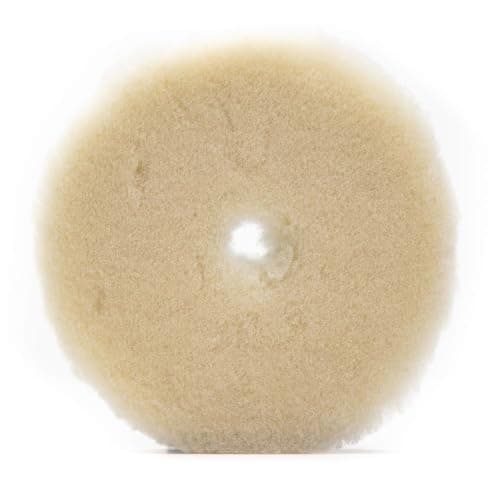
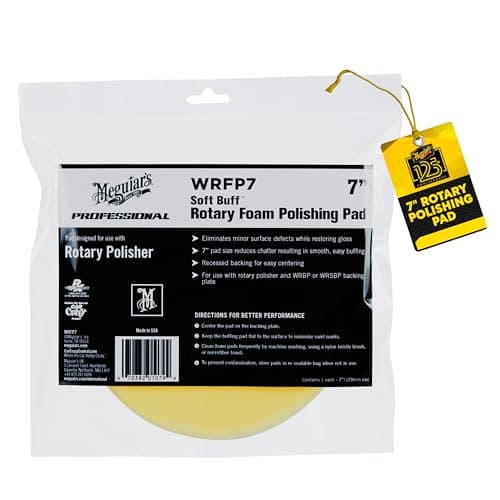
Rotaries take 7-inch pads on a 5/8"-11 threaded plate as standard, though 5-inch setups exist and are easier to control. Wool cuts hardest and fastest; foam cuts less and finishes better. The normal sequence is a wool cutting pad with a compound, then a foam polishing pad with a finer polish to clear the haze the wool left. Skipping the second pass is the most common reason a rotary job looks worse in sunlight than it did in the garage.
The full field is ranked in best polishing pads for a rotary, and the plate that lets an older buffer take modern pads at all is covered in best backing plate for a polisher.
Speed: lower than you think
Most correction on a rotary happens between roughly 1,000 and 1,500 rpm. Higher speeds do not cut proportionally faster; they generate heat, and heat is what softens clear coat and lets a pad dig in. Start at the low end of the machine's range to spread the product across the panel with the machine off the trigger or barely on it, bring it up to a working speed, then drop it back down for the final refining passes.
If you can smell hot paint or the panel is too warm to rest a palm on comfortably, you are already past the point where the machine is helping. Stop, let it cool, and come back at a lower speed.
Pressure and movement
Keep the pad flat. A rotary tilted onto its edge concentrates all its force into a fraction of the pad face, which is how burns happen even at sensible speeds. Let the weight of the machine supply most of the pressure and add only a little of your own — if you are pushing hard, the pad or the compound is wrong, not your arms.
Move continuously in overlapping passes, roughly a couple of inches per second, working a section about two feet square at a time. Never let the pad dwell. The rotary has no safety mechanism to catch you if it does, and dwelling for two or three seconds in one spot is genuinely enough to do damage on thin modern clear coat.
The places that burn first
Paint thickness is not uniform across a car. It is thinnest on the crown of a body line, the lip of a panel edge, the raised ridge of a bonnet swage and around badge surrounds. Those are the areas that go through first, and they go through while the flat middle of the panel is still perfectly fine. Tape them, or work them by hand, or come off the trigger as you approach them — but do not treat them like the middle of a door.
Finishing the job
Wool always leaves haze — very fine circular marks from the fibers themselves. A foam polishing pad with a finer polish, run slower and lighter, clears it. Wipe the panel down afterwards with a dedicated residue remover or panel wipe so you are judging the paint rather than a film of polish oils; our panel wipe picks cover that step. Then inspect under a strong, tight-beamed light rather than a fluorescent tube — see the detailing light picks.
Once the paint is where you want it, protect it. Bare corrected paint is the most vulnerable it will ever be, and the whole point of the work is to keep it looking that way — a sealant or a ceramic coating is how you do it.
When to put the rotary down
If the defects you are chasing are ordinary swirls in modern clear coat, a rotary is the wrong tool — a dual-action clears those with none of the risk, and the finish is better. Reach for the rotary when the paint is genuinely neglected: heavy oxidation, single-stage paint that has gone chalky, sanding marks from a repair. For everything else, our dual-action picks are the honest recommendation.
If you are reading this because a rotary is the machine you own rather than the one you chose, the gentler sibling of this page is how to use a dual-action polisher, where the orbit stalls under pressure instead of burning through — and where almost everyone should be learning.
The signature failure of this machine deserves naming here rather than in a footnote. Skip the finishing pass, finish on wool, or let the pad dry out, and a rotary leaves holograms — long directional streaks that appear to float above the paint as you walk past it. How to remove buffer trails covers the fix, which is a dual-action, a fine polish and a soft pad rather than another rotary pass. Our dual-action vs random orbital page explains why a non-repeating pad path cannot produce them in the first place.