Skip to content
Pad & Polish

HUB 01 · Machine Polishers

Best Backing Plate for a Polisher

The twelve-dollar part between your machine and your pad — and the reason a good polisher can still leave a hazy, hopping finish.

By Stephen V.Updated How we research
#ad

We earn a commission when you buy through our Amazon links, at no extra cost to you. It never affects our rankings, and we say so when the cheaper product is the better buy. How this works.

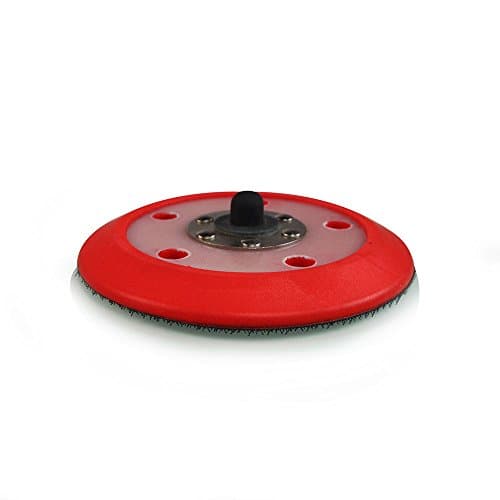
The backing plate is the disc that threads onto your polisher's spindle and gives the pad something to stick to. It is the cheapest component in the whole correction chain and the one nobody thinks about until something goes wrong — and when something does go wrong, the symptoms look exactly like a bad pad or a bad compound. A pad that hops, a finish that hazes at panel edges, a machine that suddenly feels unbalanced: all three are frequently the plate.

There are only three decisions here, and none of them is difficult once you know what you are choosing between: the thread has to match your machine, the diameter has to match your pads, and the amount of flex has to match the panels you work on. Get those right and a plate is a buy-once item. Get the thread wrong and it will not go on the tool at all.

Thread size is the part people get wrong

Consumer dual-action polishers overwhelmingly use a 5/16"-24 spindle. Rotary buffers overwhelmingly use 5/8"-11. Some European and cordless machines use M8 or M14. These are not interchangeable, no adapter is included, and a plate ordered for the wrong one is simply a plate you cannot use. Check the thread stamped on your machine's spindle or printed in its manual before you order anything on this page — it is thirty seconds of work that prevents the single most common return in this category.

Diameter: the plate is smaller than the pad, on purpose

A 5-inch plate takes a 5.5-inch pad. A 6-inch plate takes a 6.5-inch pad. That half-inch of overhang exists so the rigid rim of the plate never contacts paint even when you tip the machine slightly on a curve — the soft foam edge takes that contact instead. Run a pad the same size as the plate and every slight tilt puts a hard plastic edge onto your clear coat.

The reverse error is worse in a different way. A pad much larger than its plate has an unsupported outer ring that folds under load, flaps at speed and generates heat where nothing is holding it flat. If you are unsure what size pads you own, the sizing logic is worked through in 5-inch vs 6-inch polishing pads.

Flex, and why more is not better

Plates are sold on a spectrum from nearly rigid to genuinely floppy, and the right answer depends entirely on what you polish. A flexible plate follows a curved bumper or a rounded fender and keeps the whole pad face in contact. A stiffer plate holds a pad dead flat across a big hood, which is what produces even correction over a large area. A very flexible plate on a flat panel lets the pad rock slightly under pressure, so your cut varies from one part of the pass to the next.

Most people should buy a mid-flex plate with an inner steel or reinforced core: it conforms enough for real bodywork without going soft on a hood. Buy the extremes only if your work genuinely is one extreme.

Heat is the failure mode

Backing plates fail in one of two ways. The hook-and-loop face wears smooth, at which point pads start spinning free of the plate mid-pass — dangerous as well as useless. Or the adhesive bonding that face to the plate body softens from heat and the whole face peels. Both are heat problems, and heat comes from long sessions, heavy pressure, and long-throw machines. That is the entire argument for a vented plate: it moves air through the foam and the plate body while it spins, and everything downstream lasts longer.

The short answer

Quick picks

#ProductBest forScorePrice
01
Lake Country Lake Country 5" Dual-Action Backing Plate
Lake Country 5" Dual-Action Backing Plate

The plate most enthusiasts end up on: a flexible face over an inner steel core, so it follows a curved panel without developing the wobble a cheap all-plastic plate gets once the foam heats up.

A 5.5-inch pad on almost any consumer DA
8.4
$25.50Amazon
02
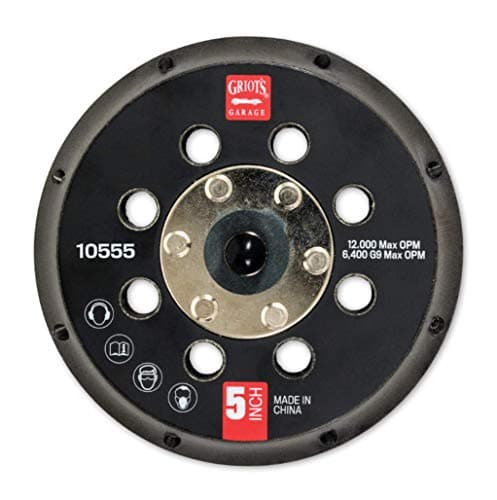
Griot's Garage Griot's Garage 5" Vented Orbital Backing Plate
Griot's Garage 5" Vented Orbital Backing Plate

A vented plate that pulls air through the foam while it spins, which is the cheapest way to stop a long-throw machine cooking its own pad on a hot panel.

Long-throw machines that run pads hot
8.1
$33.97Amazon
03
Chemical Guys Chemical Guys TORQ R5 5" Dual-Action Backing Plate
Chemical Guys TORQ R5 5" Dual-Action Backing Plate

The hyper-flex plate built for Chemical Guys' own machines and hex pads — soft enough to wrap a bumper corner, and the obvious replacement if your TORQX plate has torn.

TORQ/TORQX owners and heavily contoured panels
8.5
$21.99Amazon
04
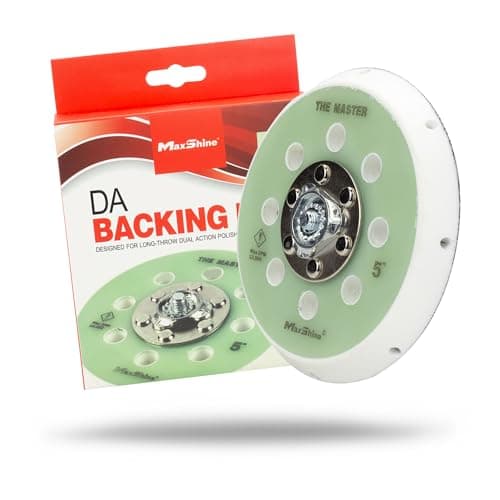
Maxshine Maxshine 5" Universal DA Backing Plate (Pro Series)
Maxshine 5" Universal DA Backing Plate (Pro Series)

The value pick: a 5/16"-24 universal plate rated to 12,000 OPM that fits the overwhelming majority of consumer dual-action polishers for roughly half what the name-brand plates cost.

A spare plate, or a cheap fix for a torn one
8.5
$17.99Amazon
05
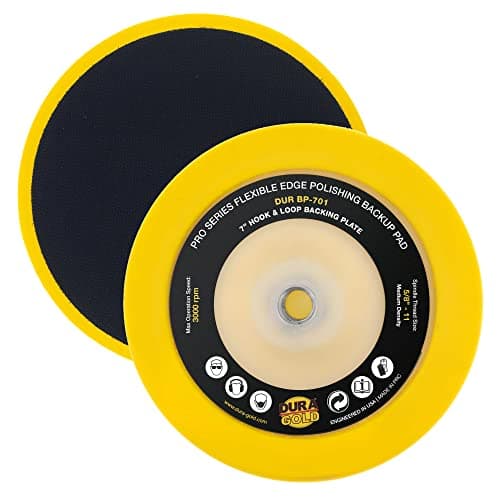
Dura-Gold Dura-Gold Pro Series 7" Rotary Backing Plate
Dura-Gold Pro Series 7" Rotary Backing Plate

The plate a rotary actually needs: a 5/8"-11 threaded, flexible-edge 7-inch backer that lets an old rotary buffer take modern hook-and-loop wool and foam pads instead of spindle bonnets.

Converting a rotary buffer to hook-and-loop pads
8.3
$17.99Amazon

#ad · Live prices from the Amazon Product API, as of Sep 4, 2026. Where we have no verified live price, we show none — we would rather leave a gap than print a number that has rotted.

In detail

The picks, in full

01
Lake Country Lake Country 5" Dual-Action Backing Plate

A 5.5-inch pad on almost any consumer DA

Lake Country 5" Dual-Action Backing Plate

5-inch faceHook-and-loopInner steel constructionFlexible edge
8.4/10

The plate most enthusiasts end up on: a flexible face over an inner steel core, so it follows a curved panel without developing the wobble a cheap all-plastic plate gets once the foam heats up.

Build quality
9
Flex & conformity
8.8
Fitment breadth
8
Value
7.6

Pros

  • Steel core keeps the plate true under pad pressure
  • Flexible face follows body lines instead of fighting them
  • Correct size for the 5.5-inch pads most roundups recommend

Cons

  • Costs more than the two-pack generics
  • Thread pitch still has to be checked against your machine

Don't buy this if…

your polisher already came with a good plate — this is a replacement, not an upgrade path.

$25.50View on Amazon

$26.765% off

Price as of Sep 4, 2026. Prices change — Amazon's is the one that counts.

#ad · we may earn a commission from this link to Lake Country 5" Dual-Action Backing Plate

02
Griot's Garage Griot's Garage 5" Vented Orbital Backing Plate

Long-throw machines that run pads hot

Griot's Garage 5" Vented Orbital Backing Plate

5-inch faceVented bodyHook-and-loopGriot's pad sizing
8.1/10

A vented plate that pulls air through the foam while it spins, which is the cheapest way to stop a long-throw machine cooking its own pad on a hot panel.

Build quality
9
Flex & conformity
8.4
Fitment breadth
7.6
Value
7.2

Pros

  • Venting keeps a pad cooler over a long session
  • Matches Griot's own 5.5-inch pad sizing exactly
  • Built to the same standard as the rest of the Griot's tool line

Cons

  • One of the pricier plates in the category
  • Vent holes need clearing when they pack with dried compound

Don't buy this if…

you only polish one panel at a time — heat never becomes the limiting factor.

$33.97View on Amazon

Price as of Sep 4, 2026. Prices change — Amazon's is the one that counts.

#ad · we may earn a commission from this link to Griot's Garage 5" Vented Orbital Backing Plate

03
Chemical Guys Chemical Guys TORQ R5 5" Dual-Action Backing Plate

TORQ/TORQX owners and heavily contoured panels

Chemical Guys TORQ R5 5" Dual-Action Backing Plate

5-inch faceHyper Flex bodyHook-and-loopFits TORQ DA polishers
8.5/10

The hyper-flex plate built for Chemical Guys' own machines and hex pads — soft enough to wrap a bumper corner, and the obvious replacement if your TORQX plate has torn.

Build quality
8
Flex & conformity
9.2
Fitment breadth
8.2
Value
8.4

Pros

  • The most compliant plate here on curved and edged panels
  • Drop-in replacement for the plate TORQX kits ship with
  • Widely stocked, so a mid-project failure is easy to fix

Cons

  • That much flex costs you flatness on a big, flat hood
  • Softer material shows wear sooner than a steel-cored plate

Don't buy this if…

you mainly polish large flat panels — a stiffer plate holds the pad flatter there.

$21.99View on Amazon

Price as of Sep 4, 2026. Prices change — Amazon's is the one that counts.

#ad · we may earn a commission from this link to Chemical Guys TORQ R5 5" Dual-Action Backing Plate

04
Maxshine Maxshine 5" Universal DA Backing Plate (Pro Series)

A spare plate, or a cheap fix for a torn one

Maxshine 5" Universal DA Backing Plate (Pro Series)

5-inch face5/16"-24 threadRated to 12,000 OPMUniversal DA fit
8.5/10

The value pick: a 5/16"-24 universal plate rated to 12,000 OPM that fits the overwhelming majority of consumer dual-action polishers for roughly half what the name-brand plates cost.

Build quality
7.6
Flex & conformity
8
Fitment breadth
9
Value
9.2

Pros

  • Universal thread covers most consumer DAs without research
  • Cheap enough to keep a spare in the drawer
  • OPM rating is published rather than left vague

Cons

  • No steel core, so it flexes more under heavy pad pressure
  • Hook-and-loop is not as aggressive as the premium plates

Don't buy this if…

your machine uses an M8, M14 or 5/8"-11 spindle — check the thread before ordering.

$17.99View on Amazon

Price as of Sep 4, 2026. Prices change — Amazon's is the one that counts.

#ad · we may earn a commission from this link to Maxshine 5" Universal DA Backing Plate (Pro Series)

05
Dura-Gold Dura-Gold Pro Series 7" Rotary Backing Plate

Converting a rotary buffer to hook-and-loop pads

Dura-Gold Pro Series 7" Rotary Backing Plate

7-inch face5/8"-11 threadFlexible edgeRotary polishers
8.3/10

The plate a rotary actually needs: a 5/8"-11 threaded, flexible-edge 7-inch backer that lets an old rotary buffer take modern hook-and-loop wool and foam pads instead of spindle bonnets.

Build quality
8
Flex & conformity
7.8
Fitment breadth
8.6
Value
8.8

Pros

  • Standard rotary thread, so it fits nearly every corded rotary buffer
  • Flexible edge reduces the chance of the plate rim contacting paint
  • Opens up the whole modern wool and foam pad range

Cons

  • 7-inch pads are heavy and tiring on vertical panels
  • Not usable on a dual-action machine — different thread entirely

Don't buy this if…

you own a DA — this thread will not fit it, and the 5/16"-24 plates are what you want.

$17.99View on Amazon

Price as of Sep 4, 2026. Prices change — Amazon's is the one that counts.

#ad · we may earn a commission from this link to Dura-Gold Pro Series 7" Rotary Backing Plate

How to choose a backing plate

Start with the thread, not the price

5/16"-24 for nearly all consumer dual-actions. 5/8"-11 for nearly all rotary buffers. M8 or M14 on a minority of cordless and European machines. Confirm yours before you compare anything else — a plate that will not thread on is not a compromise, it is a return.

Then the diameter your pads need

  • 5-inch plate — 5.5-inch pads. The standard for consumer DA polishers and the size most pad multi-packs are sold in.
  • 6-inch plate — 6.5-inch pads. Faster coverage on flat panels, more strain on the motor, harder to keep flat on curves.
  • 3-inch plate — 3.5-inch pads, for a mini polisher working pillars, mirrors and bumper corners.
  • 7-inch plate — the rotary standard, and the only way to run modern hook-and-loop wool and foam on an older buffer.

Match flex to the panels you actually polish

Flat hoods, roofs and boot lids reward a stiffer plate. Bumpers, arches and sculpted modern bodywork reward a flexible one. If your car is a typical modern hatchback or crossover with very little genuinely flat panel, err toward flexible.

Look after the hook-and-loop

The face is the part that wears out. Pull pads off straight rather than peeling them from one edge, keep dried compound out of the loops, and never leave a wet pad compressed onto a plate overnight. The same care routine that keeps pads alive is in how to clean polishing pads.

When the plate is not your problem

If the finish is hazing rather than hopping, the plate is almost certainly innocent — look at pad choice and compound pairing instead, which is where hazing nearly always originates. Our finishing pad picks cover the pass that clears it.
How we picked

We do not run a testing lab

We compiled published specifications, manufacturer data sheets and aggregated owner reviews, computed the cost of ownership from real sizes and coverage, then scored each product against a published rubric. The scores are judgments from documented research — they are not measurements we took, because we do not own a lab and we are not going to pretend we do. Where a number came from someone else, we name them and link them in Sources.

Questions

Frequently asked

What size backing plate do I need for 5.5-inch pads?
A 5-inch plate. The pad should overhang the plate by roughly a quarter inch all round so the plate's rigid rim never touches paint when you tilt the machine on a curve.
What thread do car polisher backing plates use?
Most consumer dual-action polishers use 5/16"-24. Most rotary buffers use 5/8"-11. A minority of cordless and European machines use M8 or M14. Check the spindle or the manual before ordering — the sizes are not interchangeable.
Do I need a vented backing plate?
Only if heat is a real limit for you — long sessions, heavy correction, or a long-throw machine. Venting pulls air through the pad and plate while they spin, which extends the life of both. On short jobs it changes very little.
How do I know when a backing plate is worn out?
When pads no longer grip firmly and shift or spin free under load, when the hook-and-loop face looks matted flat, or when any part of that face has lifted from the plate body. All three are safety problems, not just performance ones.
Can I use a DA backing plate on a rotary polisher?
No. The threads are different — 5/16"-24 on a DA versus 5/8"-11 on a rotary — and a plate designed for dual-action speeds is not built for a rotary's direct drive. Buy the plate that matches the machine.

Keep reading

Receipts

Sources

We do not run a testing lab, and we do not pretend to. Where a measured number came from someone else's lab, we name them and link them. Where we could not verify something, we say so on the page rather than quietly leaving it out. Read our full method.