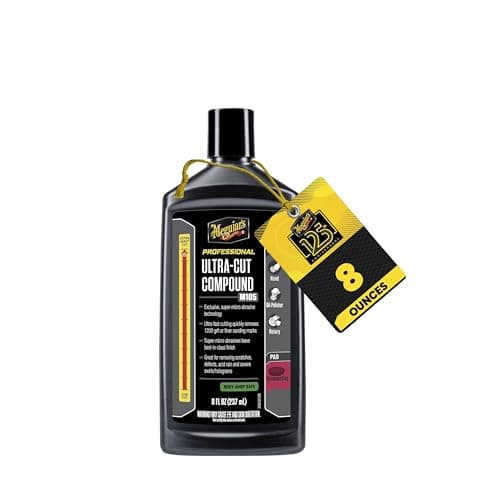
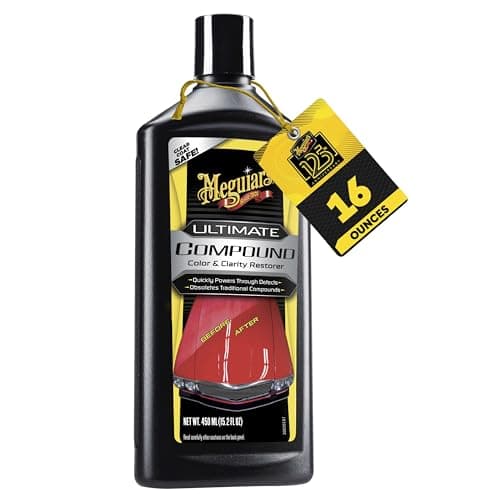
For almost every home user the answer is Ultimate Compound. It is clear-coat safe, it works by hand or machine, it removes moderate swirls and oxidation, and — the part that decides this comparison — it finishes glossy enough that many people never run a follow-up polish at all. M105 is the other thing entirely: a body-shop grade ultra-cut compound that removes serious defects and sanding marks fast, and then hands you a hazed panel that needs a finishing polish to clear. Buy M105 when you have damage Ultimate Compound has already failed to remove, and buy the polish in the same order.
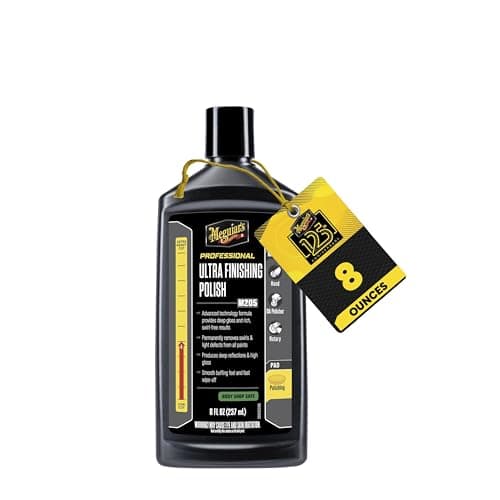
The two sit in different Meguiar's lines, which is why the naming confuses people. Ultimate Compound is from the consumer range sold in auto-parts stores. M105 is Mirror Glaze, the professional line, where the M-numbers are a sequence rather than a brand — M105 cuts and M205 finishes, and they are designed to be used as a pair.
Side by side
| | Ultimate Compound | Mirror Glaze M105 |
|---|
| Line | Consumer | Mirror Glaze (professional) |
| Cut | Moderate | Aggressive — ultra-cut |
| Abrasive type | Micro-abrasive, clear-coat safe | SMAT (super micro abrasive technology) |
| Finish straight off the pad | Glossy — often needs no polish after | Hazed — expects a finishing polish |
| Fillers | None | None |
| Hand use | Yes, genuinely works by hand | Machine only, in practice |
| Working time | Forgiving | Short — it dusts if you over-work it |
| Size | 15.2 oz | Professional bottle sizes |
| Who it is for | Most swirl and oxidation removal, by hand or machine | Heavy correction and sanding-mark removal |
Why M105 is harder to use, specifically
Two reasons, and neither is about danger. The first is working time. M105 is formulated to cut fast, which means the abrasives do their work in a short window and then the product starts to dust if you keep going. Ultimate Compound stays workable for far longer, which forgives a slow arm and a distracted pass. The second is that M105 is designed around a correction sequence rather than as a standalone product. It is the first half of a job, and the pass that follows it is not optional on paint anyone will look at closely.
That is the whole case for M205 appearing in the pick list above. Meguiar's built it as the finishing half of this exact pair — it removes the haze a cutting compound leaves and finishes clear, with no fillers hiding what is still underneath. If you buy M105, buy M205. The reasoning behind the two-stage approach generally is in what is a cut and polish.
Which one your paint needs
- Light to moderate wash swirls on a daily driver. Ultimate Compound, alone. There is no defect here that justifies the harder product.
- Oxidation on older paint. Ultimate Compound first. It handles more than people expect, and escalating before you have tried it wastes clear coat.
- Deep swirls in hard clear that Ultimate Compound has not cleared. M105, and only after you have also tried a more aggressive pad — the pad is usually the cheaper variable, which is the argument in best compound for hard paint.
- Sanding marks after wet sanding. M105. This is the job it exists for, and nothing in the consumer line replaces it.
- No machine at all. Ultimate Compound. M105 by hand is a waste of an expensive bottle.
The third option people forget
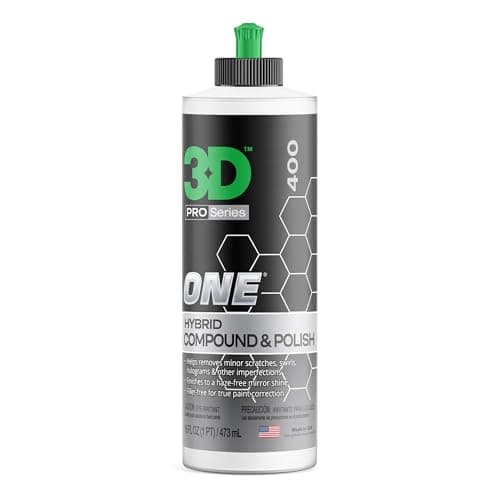
Neither of these is the only shape a compound comes in. A hybrid with adaptive abrasives spans cut to finish in one bottle, which is a genuinely different answer to the same question: instead of buying a cutter plus a finisher, you buy one product and change the pad to change the aggressiveness. It will not match M105 at the heavy end or M205 at the fine end, and for a home garage that owns two pads and no third bottle, that is often an acceptable trade. Where it ranks against the whole field is in best rubbing compound for cars.
Buying the right one for your setup
Match it to the machine you own
M105 on a short-throw dual-action is slower than its reputation suggests, because a DA needs time on the panel and M105's working window is short. It is at its best on a rotary or a long-throw machine. Ultimate Compound is indifferent to the machine, which is part of why it is the default recommendation.
Match it to the pad, too
An aggressive compound on a soft finishing pad hazes without correcting, because the foam cannot generate the friction the abrasives need. If you step up to M105, step up the pad as well — a cutting foam or a microfiber cutting pad, not the pad you finish with. The pairing logic is in best foam cutting pad.
Buy the finishing polish in the same order
The most common M105 complaint — "it left the paint hazy" — is not a fault. It is the product behaving exactly as designed, with the second half of the job missing. Budget for both bottles or do not buy the first one.
Do not escalate on price alone
A professional compound is not a better version of a consumer compound; it is a more aggressive one, and aggression costs clear coat. Start mild, test a section, and escalate only when a section test proves the milder product is not clearing the defect. Where to stop is covered in will rubbing compound damage clear coat.
Shelf life and storage
Both are water-based and both dislike freezing. A compound that has frozen and thawed can separate, and a separated compound does not re-mix into the product it was. Keep them indoors over winter rather than on a garage shelf.