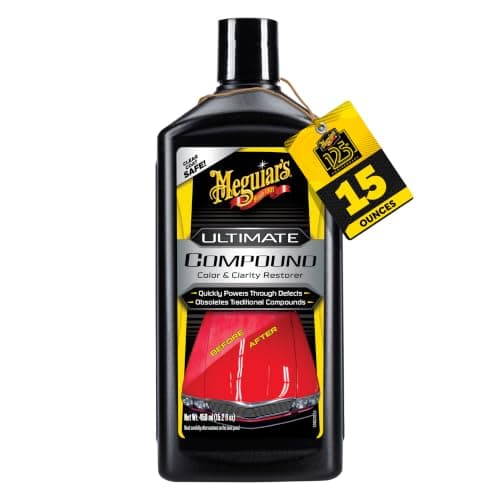
Rubbing compound removes clear coat. That is not a side effect or a risk — it is the mechanism. Abrasives in the compound level the surface by cutting the high points down until they meet the bottom of whatever defect you are removing. Nothing is filled in, nothing is repaired. The panel simply ends up slightly thinner and perfectly flat, which is why it reflects light cleanly again.
So the honest answer to the question is yes, and the useful conversation is about quantity. A single careful pass with a moderate compound removes a very small fraction of the clear on a modern car. Repeated aggressive passes in the same place, on a panel that has already been corrected twice before, are how people end up with a matt patch that has to be repainted.
How much clear coat there is to spend
A modern factory clear coat is measured in microns, and it is thin. It is also not uniform: it is thinner over ridges, panel edges, body-line crowns and areas that were repaired before you owned the car. Total paint thickness readings on a used vehicle can also be misleading, because a respray adds material that is not necessarily clear coat.
We are not going to publish a specific micron figure and a number of "safe" corrections, because those numbers vary by manufacturer, model year, panel and paint system, and inventing a universal one would be exactly the kind of confident nonsense this site exists to avoid. What is reliably true is directional: heavy compounding spends noticeably more clear than a light polish, edges have less to give than flat panels, and a car that has already been corrected several times has less margin than one that has not.
The four things that actually cause damage
- Dwelling in one spot. On a rotary especially, holding a spinning pad still concentrates heat and cut into a small area. Modern clear softens with heat, and softened clear cuts far faster than you expect. Keep the pad moving, always.
- Working an edge or a ridge like a flat panel. Paint is thinnest exactly where the pad concentrates pressure. Body lines, panel lips and badge surrounds are where burn-through happens first, and they are the reason experienced people tape them off.
- Escalating instead of diagnosing. A scratch that will not come out with a moderate compound is usually a scratch that has gone through the clear — reaching for a heavier compound cannot fix that, it only thins the surrounding paint.
- A dry or saturated pad. Both stop carrying product properly and start generating friction instead of cut. The panel heats up, and the compound is no longer doing the work — the pad is.
How to keep a comfortable margin
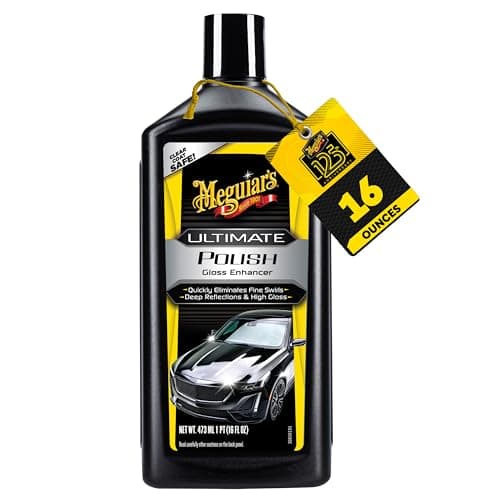
Start with the least aggressive thing that could work. A finishing polish first, then a one-step, then a cutting compound, and only if each in turn is not enough. Most swirls in a daily driver come out with far less than people reach for. The gradations are laid out in polish vs compound.
Test one small section before you commit. Paint hardness varies enormously between manufacturers. Do a two-foot square, inspect it under a strong light, and let that tell you how many passes the rest of the panel needs.
Measure before you cut, on a car you did not buy new. A previous respray, hidden filler or a panel a previous detailer already cut thin are all invisible and all change how much margin you have. Five minutes with a gauge finds every one of them — best paint thickness gauge ranks the ones worth buying and is explicit about the readings they cannot give you.
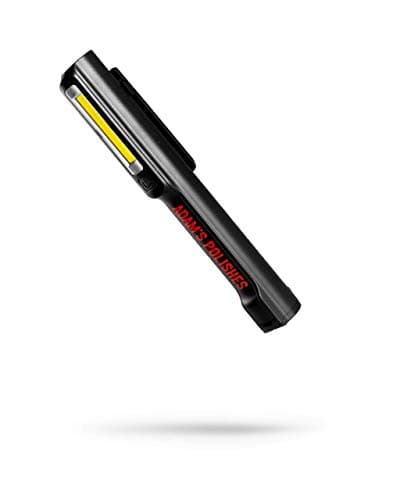
Inspect properly. Overhead garage fluorescents hide almost everything. A tight-beamed handheld light shows you both the defect and whether it is actually gone, which is what stops you doing a fourth pass you did not need. The field is ranked in best detailing light for paint correction.
Decontaminate first. Compounding over bonded contamination drags grit across the panel and puts in new scratches, which then need more compounding. A clay bar step removes it — see do you need to clay bar before polishing.
Use a dual-action, not a rotary, unless you have a reason. A DA's pad free-spins and stalls under pressure rather than continuing to grind, which is a genuine mechanical safety net. A rotary has none — dual-action vs rotary polisher covers when the extra risk is justified.
Treat sandpaper as a different risk class entirely. Everything above concerns a compound, which spends clear coat slowly enough that a mistake is usually recoverable. Wet sanding spends it quickly and much less selectively, which is why it belongs only to defects no compound can reach — orange peel, runs, nibs. Best sandpaper for wet sanding a car applies the same honesty to that stage, including the edges and body lines where clear coat is thinnest and a burn-through comes without warning.
Signs you are going too far
Stop immediately if the panel becomes hot to the touch, if the residue coming off the pad starts showing color rather than the neutral gray of spent compound and clear, or if a matt, cloudy area appears that does not improve with a finishing polish. Color on the pad means you are into base coat. That is not recoverable at home.
The part everyone forgets afterwards
Compounding strips whatever protection was on the paint. Corrected clear coat is bare — more exposed to UV and contamination than it was before you started, right up until you put something back on it. A sealant or a ceramic coating both do that job, and the coating route has the useful side effect that a well-protected car needs correcting far less often — which is the real way to preserve clear coat over a decade.
If what you actually want is the arithmetic — how thick a clear coat is, how much a single pass costs you, and how many corrections a car can take before thickness becomes the limit — does polishing remove clear coat answers it directly, without the hedging this question usually attracts.