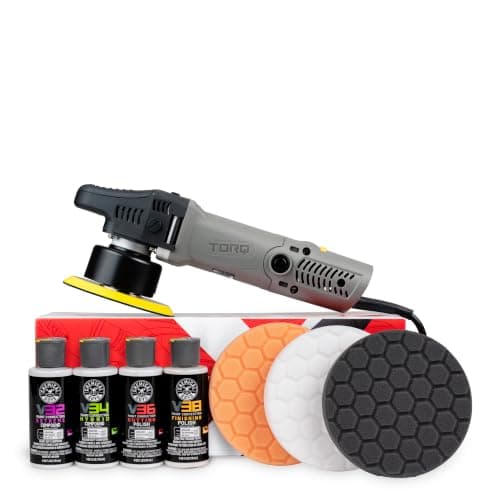
The Chemical Guys TORQX is one of the two or three machines a first-time buyer is most likely to end up looking at, and it gets there by a different route than the rest of the field. Most polishers are sold as tools. The TORQX is overwhelmingly sold as a kit — the machine, a backing plate, three pads and four liquids, in one box, with nothing else to buy before the first pass. That packaging decision is the actual product, and it is what this review is mostly about.
The disclosure first, because it matters more on a review page than anywhere else on this site: we have not owned, stripped or instrumented a TORQX. We do not run a testing lab and will not imply otherwise. What follows is built from Chemical Guys' own published specifications, the mechanical behavior those specifications imply, the itemized kit contents on Chemical Guys' product page, and the consistent pattern of owner reporting around a tool that has been sold in volume for years. The full method is on how we research.
What the TORQX actually is
Chemical Guys publishes two numbers for this machine and they are the two that matter: an 800-watt motor and a 9 mm dual-action orbital throw. It is a corded random orbital with variable speed control, and Chemical Guys lists it as compatible with 3-inch, 5-inch and 6-inch backing plates, which is a wider range than most machines in this class advertise.
Mechanically it is a free-spinning dual action, the same architecture as every beginner machine on this site. The head carries the pad through a small circle while the pad itself rotates on a bearing, driven only by friction against the paint. Nothing forces that rotation, so when resistance rises — an edge, a curve, too much pressure — the pad slows or stops turning instead of concentrating heat in one place. That is the entire reason a dual-action is the right first machine, and the alternative that lacks the safety net is laid out in dual-action vs rotary polisher.
What 9 mm buys, and what it does not
Throw length is how far the pad travels per orbit, and it is the spec that separates generations of dual-action polishers. The old entry-level machines ran 5 to 8 mm. The current enthusiast standard sits at 8 to 9 mm, and the long-throw machines run 15 mm and up.
At 9 mm the TORQX sits at the top of the short-throw bracket. In practice that means it covers ground meaningfully faster than a 5 mm machine, it does not fight you on contoured panels the way a long-throw tool can, and it will correct real defects rather than just apply wax. What it will not do is match a 15 mm machine on a large, flat panel — that is simple arithmetic, since pad travel per minute is throw multiplied by orbits per minute, and the full version of that calculation is in long throw vs short throw polisher.
For a first machine, the short throw is a feature rather than a compromise. A 9 mm tool is easier to control on a door handle recess, a mirror cap or a bumper curve, and the smaller backing plates Chemical Guys supports make it genuinely usable in tight areas instead of forcing a second purchase.
What Chemical Guys does not publish
Three figures are missing from the published specification, and a buyer deserves to know they are missing rather than find an invented number here.
There is no published OPM range. The page describes variable speed control for cutting, polishing and finishing but gives neither the speed range nor the number of detents on the dial. That is a real gap, because the usable low end of a speed dial is what lets you spread product without flinging it, and the high end is what does the cutting.
There is no published weight and no published cord length. Weight matters on a tool you hold at arm's length over a roof for an hour, and cord length decides whether you need an extension to get around a car.
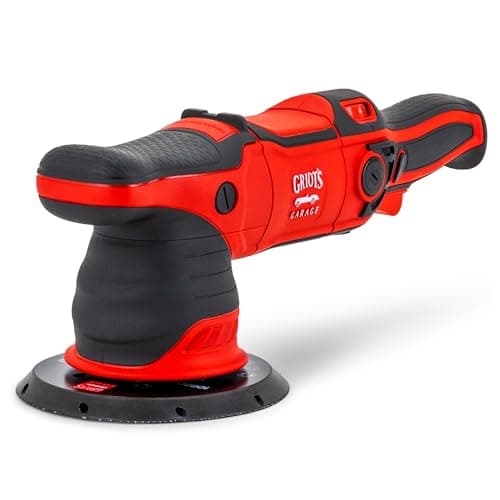
And there is no warranty term published on the product page. This is the clearest point of difference against the Griot's machine it is most often cross-shopped with, which carries a lifetime warranty stated plainly — and that warranty is a large part of why the G9 costs what it does. If long-term support is what you are buying, that asymmetry is the whole decision.
The kit is the product
Chemical Guys itemizes nine pieces, and unusually for this category the list is specific enough to evaluate. Alongside the polisher and a backing plate, the kit includes a four-step abrasive ladder — V32 heavy cut, V34 medium cut, V36 light cutting polish and V38 finishing polish — plus three Hex-Logic pads matched to those steps: an orange medium-heavy cutting pad, a white light-medium polishing pad and a black finishing pad.
Chemical Guys states on its own page that accessory colors and packaging may differ from the images and that accessories or chemicals may be substituted based on stock. That is worth repeating rather than glossing over: the contents of this box are not a fixed guarantee, and anyone buying for a specific liquid should check what actually ships.
What the bundle genuinely solves is the cold-start problem. The most common reason a first polisher sits in a box for three months is that the owner does not know which compound, which pad and which combination to start with, and the research is more intimidating than the work. A four-liquid, three-pad ladder with the pairings implied by the packaging removes that decision entirely. For a first weekend, that is worth real money.
Four liquids is more ladder than most people need
Here is the honest counterpoint. Almost nobody needs four abrasive steps on a daily driver. The overwhelming majority of paint comes right with a medium compound followed by a finishing polish — two steps — and on softer paint a single one-step product gets most of the way there on its own. The relationship between those grades, and how to tell which one your paint actually wants, is in polish vs compound and hard paint vs soft paint.
So two of the four bottles will probably sit unopened for a year, and some buyers will read the four-step ladder as four mandatory passes and spend a whole weekend doing work the paint did not need. Abrasive steps are not free — every pass removes clear coat, and that budget does not refill, which is the argument made at length in does polishing remove clear coat. Use the ladder as a range to pick from, not an itinerary.
Three pads is also a starting allocation rather than a working one. A pad loaded with spent compound stops cutting, and a full car needs several of each grade rotated through as they clog — the counting exercise is in how many polishing pads do I need. Plan on a pad order alongside the kit, not instead of one.
Bundle or shopping list — the actual arithmetic
The TORQX kit competes with two different things, and which one wins depends entirely on what you already own.
If you own nothing, the kit is hard to beat on effort. A bare machine plus a backing plate plus three pad grades plus two liquids is four or five separate purchases, each with its own decision, and the assembled total is rarely cheaper than the box by enough to matter. Buying the box and spending the saved research time actually polishing is a defensible trade.
If you already own pads and compounds, the kit is the wrong purchase and you should buy a bare tool. You will be paying for duplicate liquids and starter foam you will not use, which is exactly the situation the bare-tool market exists for.
If what you want is longevity, the comparison is not with a shopping list at all — it is with the G9, which costs more as a bare tool and carries a published lifetime warranty. Someone who expects to polish two cars a year for a decade is buying a different thing than someone correcting one car once. The whole field, priced and ranked against each other, is in best dual action polisher.
Who it is right for
The TORQX kit suits a buyer who has never machine polished, wants one box and one decision, and intends to correct their own car and perhaps a family member's. The 9 mm throw is enough machine to remove genuine swirls rather than hide them, the free-spinning dual action makes burning paint very difficult, and the bundled ladder means the first pass happens the weekend the box arrives instead of after a month of forum reading.
It is the wrong purchase for three people. Anyone who already has a pad and compound collection should buy a bare machine. Anyone correcting large flat panels regularly — a truck, a van, several cars — should look at a long-throw machine and accept the handling trade. And anyone who weights warranty and resale heavily should price the G9 against it and decide whether a published lifetime term is worth the difference, because on that one axis the TORQX has nothing published to compare.
Getting a good first result with a TORQX
Do a test spot before you touch the car
Pick one two-foot square on a door, start with the least aggressive combination in the box — the finishing polish on the white pad — and see whether it clears the defects. If it does, you have just saved yourself three steps and a measurable amount of clear coat. Only step up when the gentler combination has demonstrably failed. The full sequence is in how to polish a car step by step.
Prime the pad, then use far less product than you expect
A dry foam pad soaks up the first application and cuts unevenly. Spread a thin layer across the face once, then work with three or four pea-sized drops per section after that. Too much liquid lubricates the abrasive instead of letting it work, which produces the classic beginner complaint of a machine that polishes forever and changes nothing — how to prime a polishing pad covers it properly.
Let the 800 watts do the work, not your arms
A dual action needs enough pressure to keep the pad flat and rotating, and no more. Leaning on it stalls the pad rotation, which is the single most common reason a short-throw machine appears to under-perform. Watch the pad: if the mark you drew on its face has stopped turning, you are pressing too hard or working too steep a curve.
Buy more pads than the box contains
Three pads will not finish a car. A clogged pad stops cutting and starts smearing, and cleaning one mid-panel is slower than swapping it. Four to six of your working grade is a realistic number for a full car, and the Hex-Logic pattern the kit uses has direct equivalents across the market — the grades and colors are decoded in polishing pad color guide.
Use the small backing plates the machine supports
Chemical Guys lists 3-inch compatibility, and that is genuinely useful: pillars, mirror caps, bumper returns and the strip below a door handle are where swirls are most visible and a 6-inch pad simply cannot sit flat. A 3-inch plate and a few small pads are the cheapest capability upgrade available for this tool, and the reasoning on sizes is in 5 inch vs 6 inch polishing pads.
Decontaminate before you polish, or you will install the swirls yourself
Polishing over bonded contamination drags grit across the paint under a spinning pad. Wash, chemically decontaminate and clay first — every one of those steps exists to stop you grinding something hard into the clear coat. The order and the products are in do you need to clay bar before polishing.
Protect the paint afterwards
Freshly polished clear coat is bare and unprotected, and leaving it that way wastes the weekend. A wax, a sealant or a coating all work; what matters is that something goes on within a day or two, and the trade-offs are in car wax vs sealant vs coating.
Check what actually shipped
Chemical Guys states that kit accessories and chemicals may be substituted based on stock. Open the box and confirm you have a cutting grade, a polishing grade and a finishing grade in both liquids and pads. If one rung of the ladder is missing, buy that one rung rather than improvising with the wrong pairing.