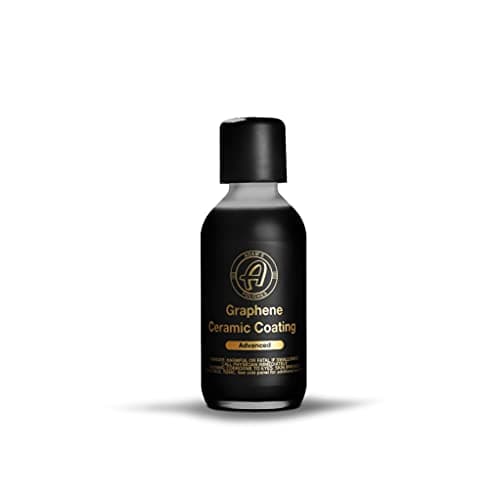
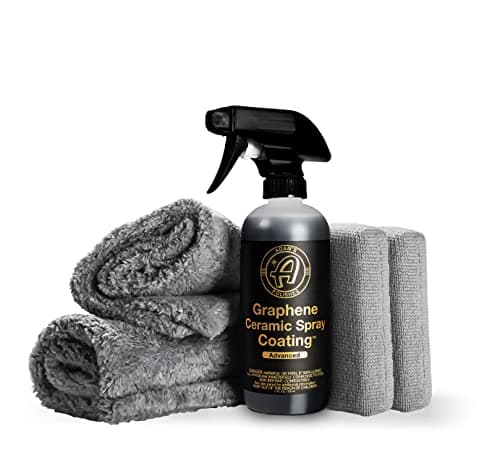
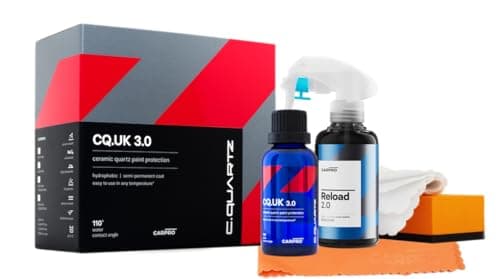
If you want the most protection and you are willing to do the prep, buy a real coating — CarPro CQuartz UK 3.0 is the prosumer benchmark, reformulated to cure in cooler, humid conditions, which is exactly the failure mode DIYers worry about. If you want most of the water behavior with none of the cure anxiety, Adam's Advanced Graphene Ceramic Spray is the strongest of the easy sprays. The decision is not really about which product is better. It is about whether you are prepared to correct and strip the paint first, because a coating locks in whatever is underneath it for years and a spray does not.
Both families use silica chemistry, and both will make water bead and sheet off a panel in a way that looks identical in a parking lot. What differs is what happens to the chemistry after you wipe it on.
The honest comparison
| | Ceramic spray | Ceramic coating |
|---|
| What it does on the paint | Sits on the surface and bonds loosely | Cures into a hard semi-permanent layer |
| Typical maker claim | Weeks to 18+ months, formula dependent | 18-24 months to multi-year |
| Prep needed | Clean, decontaminated paint | Corrected, clayed and panel-wiped paint |
| Application window | Wipe on, buff off, forgiving | Level within a stated window or it high-spots |
| Cure time before rain | Minutes to an hour | Hours, with a longer full cure |
| Cost of getting it wrong | Wash it off and redo it | Machine polish the panel to remove it |
| Time for a whole car | 20-40 minutes | A day, counting correction |
| Top-ups | Expected, after most washes or monthly | Optional, with a spray on top |
Durability figures in that table are manufacturers' own claims, not our measurements — we do not run a durability lab and how we research says so plainly. What is verifiable is the structural difference: a coating cures, a spray does not.
Why the prep requirement is the real decision
A ceramic coating is clear and it is hard. Anything under it — swirls, water spots, a patch of bonded iron — is now under a layer you cannot wipe off. Removing a coating means machine-polishing it off, which is a real afternoon and a real amount of clear coat; the process is in how to remove a ceramic coating. So the sequence before a coating is not optional: decontaminate, correct, then strip the polishing oils with a panel wipe, which is the step most first-timers skip and the one that causes most coating failures.
A spray asks for none of that. Clean paint is enough. If the finish underneath is average, the spray makes an average finish bead water — and in three months you can make a different decision. That reversibility is the feature, not a limitation.
Which one fits which car
- New car, paint still perfect, you keep cars for years. Coating. This is the best-case scenario for one: nothing to correct, and years of return.
- Daily driver with swirls you are not going to correct. Spray. A coating would lock the swirls in and cost more for the privilege.
- Lease, or a car you are selling within a year. Spray. The maths never favors a coating over that horizon.
- You already own a polisher and enjoy the work. Coating. You are halfway through the hard part already.
- No garage, no shade, unpredictable weather. Spray. Coatings want a controlled cure, and a rain shower two hours in is a genuine problem.
The middle ground nobody mentions
Spray over coating is a legitimate combination and it is what most coated cars end up running anyway. A real coating does the structural work, and a ceramic spray applied after washes tops up the surface behavior as the coating ages — which is the maintenance routine in how to maintain a ceramic coating. Buying a cheap spray alongside a coating is not hedging; it is the normal way the combination is run.
What to check before you buy either
Price per year, not price on the shelf
A coating costs several times a spray and lasts several times as long, so on paper the per-year cost is close. What the paper misses is the day of prep a coating needs, and the fact that a spray has no prep cost at all. If your time is the scarce resource rather than your money, the spray wins an argument the price tags lose.
Check the wipe-off window, not the durability claim
The number that decides whether a first coating succeeds is the leveling window — how long you have between applying and buffing before the product flashes. A forgiving window is worth more to a first-timer than twelve extra months of claimed durability, and it is the criterion the picks above are ordered on.
Sprays are not all the same strength
There is a real spread inside the spray family: an apply-on-wet-paint rinse-off formula is the easiest thing in detailing and the shortest-lived, a graphene spray sits at the durable end, and a cheap maintenance spray is designed to be reapplied constantly. The field is ranked on exactly that in best ceramic coating spray.
Budget for the panel wipe if you go the coating route
Polishing oils left on the paint stop a coating bonding, and that is the most common reason a coating "only lasted four months." A dedicated panel wipe is a cheap product that protects an expensive one — the panel wipe picks cover that step.
Where professional-grade sits
Above both of these is a tier of coatings with professional lineage that a DIYer can still buy, ranked on wipe-off window and recoverability rather than breadth, in best professional ceramic coating. It is the right next step only once the prep above is something you do comfortably.