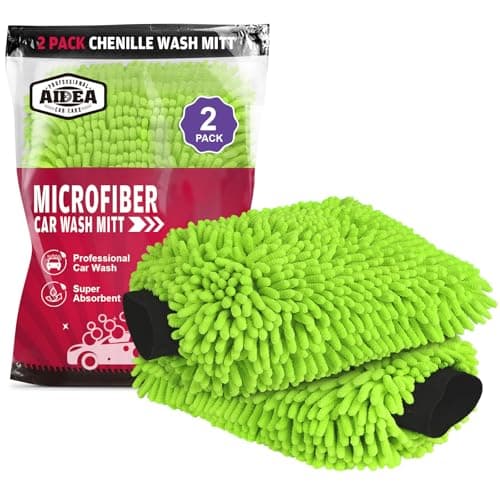
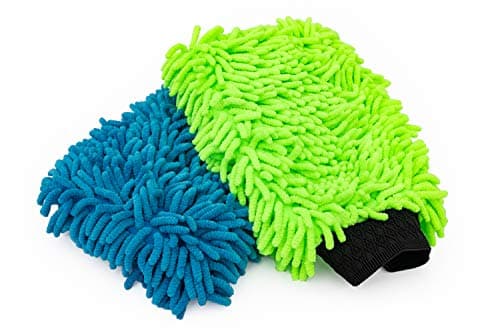
This whole site exists because of swirl marks, and the uncomfortable thing about swirl marks is where they come from. Not the automatic wash six months ago, not road debris, not the dealer. The overwhelming majority of the fine circular scratching on a daily-driven car was installed by the owner, during a wash, with whatever they were holding at the time. A polisher, a compound and a weekend will take those marks out. A twelve-dollar mitt decides whether you have to.
That makes the wash mitt the highest-leverage purchase in detailing, and almost nobody treats it that way. A mitt is sold on how soft it feels in the store, which is the wrong test entirely — softness is necessary and nowhere near sufficient. The question that matters is what the mitt does with a hard particle the moment it picks one up.
The criterion: grit release, not softness
Wash a dirty car and your mitt will collect grit. That is not a failure of technique; it is the job. Sand, brake dust, road grime and the hard mineral crust that builds up behind a wheel arch all end up in whatever you are wiping with. What separates a safe mitt from a scratching one is whether those particles get carried away from the paint — up into the pile, suspended in suds, and then released into the rinse bucket — or whether they sit on the contact face and get dragged along the panel for the next three feet.
A flat sponge is the worst case, and it is worth understanding exactly why, because the same logic ranks every product on this page. A sponge has a smooth, closed face and no depth. Grit cannot go anywhere except between the sponge and the clear coat, where the pressure of your hand turns each particle into a cutting tool with a lever arm. One pass across a hood with a loaded sponge produces a tight cluster of arcs that will be visible under a detailing light for as long as you own the car.
A mitt with deep, open pile does the opposite. The fibers stand proud of the backing, so a particle that touches the mitt falls between the noodles rather than resting on top of them, and the suds held in that pile keep it floating rather than pinned. Depth is the mechanism. Everything below is an argument about how to get depth without losing control of the mitt.
What to look for, in order
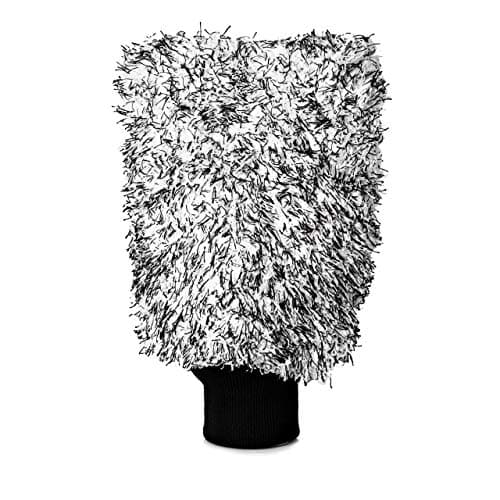
Pile depth and openness. The single most predictive feature. Long chenille noodles or deep natural wool both give you somewhere for grit to go; short, dense microfiber does not. If you can only judge one thing by eye, judge whether you can see the backing through the fibers when you spread them — you should be able to.
Suds capacity. Soap is not there to dissolve dirt so much as to keep it lubricated and suspended. A mitt that holds a lot of solution carries a liquid layer between fiber and paint; a mitt that holds little starts dry-wiping halfway down a door. This is also why the mitt and the shampoo are one decision rather than two, and why a high-foaming, pH-neutral soap earns its place — the field is ranked in best car wash soap for detailing.
No hard edge. A stitched border, a sewn-in brand tag or a plastic cuff stiffener is a non-absorbent strip that gets dragged across paint at exactly the moment you are being careful. The same reasoning applies to detailing towels, where edgeless construction is the standard, and it is under-applied to mitts.
Rinse-out behavior. A mitt you cannot flush clean is a mitt that holds last week's grit. Chenille noodles and natural wool both release well under running water or a vigorous agitation against a grit guard. Dense foam cores hold water longer and need squeezing out deliberately.
Size and control. Bigger is not better past a point. A soaked long-noodle mitt is heavy, and a heavy mitt on a vertical panel invites you to press, which is the opposite of what you want. Several of the picks below trade a little suds capacity for a mitt that stays controllable when wet.
Chenille, wool, or foam core?
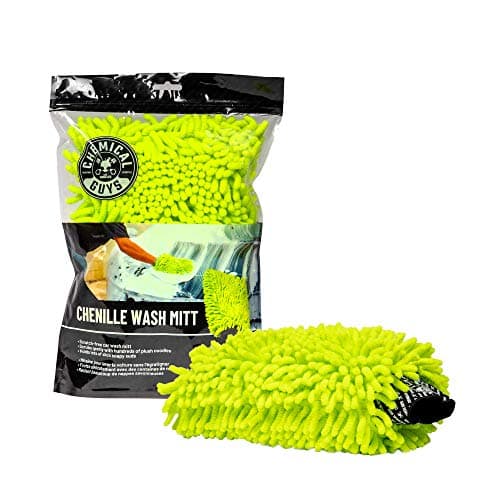
Chenille microfiber is the default for good reason. The long synthetic noodles give enormous depth per dollar, survive machine washing, dry fast and cost little enough that replacing one every season is a non-decision. The trade-off is weight when saturated and a tendency for the noodles to mat down if they are tumble-dried hot.
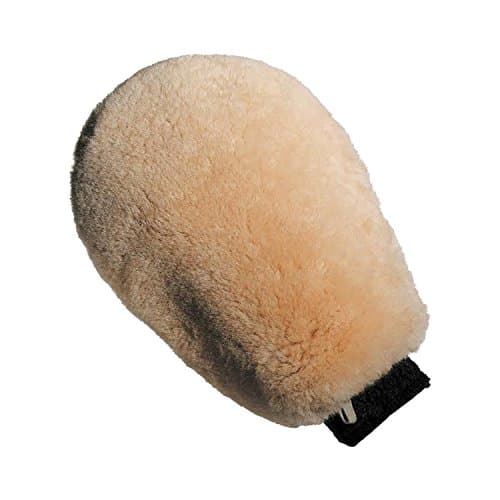
Natural lambswool is the traditional answer for show paint, and the reason is structural rather than romantic. Wool fibers are tapered and scaled rather than cut to a uniform synthetic profile, and they release trapped particles more willingly in the rinse bucket. The deepest pile here, the gentlest contact, and the most demanding care: wool wants hand washing and air drying, and a hot machine cycle will felt it.
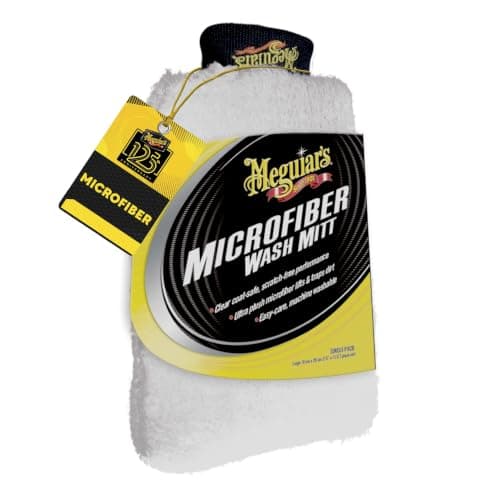
Foam-core microfiber wraps a sponge in plush fiber. You lose depth, you gain shape — the mitt holds its form in your hand instead of collapsing into a wet rag, which makes it the easiest format to control at arm's length on a roof or down a quarter panel. It is the sensible compromise for anyone who finds a noodle mitt unwieldy.
What none of these are is a clay mitt. A clay or synthetic-rubber mitt is a decontamination tool with a deliberately abrasive polymer face, used once the car is already clean and properly lubricated. It shares a shape with the products on this page and nothing else. Using one as a wash mitt will mar paint; using a wash mitt to decontaminate will do nothing at all.
The mitt is half of the method
The best mitt in the world, used in one bucket, is a device for redistributing grit. Two buckets — one with your soap solution, one with plain rinse water, both with grit guards — is the other half of the product, and it is free. The sequence is: load the mitt in the soap bucket, wash one panel with straight overlapping passes, then rinse the mitt in the plain-water bucket against the guard before it goes back into the soap. Every particle you dislodge from the mitt in the rinse bucket is a particle that cannot be dragged across the next panel.
Two other rules do most of the remaining work. Wash top-down, because the lower quarter of a car — rockers, lower doors, behind the wheels — carries the hardest and most concentrated grit, and a mitt that has been there should never go back on a roof. And use two mitts, not one: a clean mitt for the upper two-thirds of the paint, a second for the lower sections, and never the reverse order. That is why two of the picks below are multi-packs rather than premium singles. The full method, including the drying step that undoes a careful wash more often than the wash itself does, is in how to wash a car without scratching it.
A mitt is also a consumable, and most people keep theirs about three times too long. Retire it when the noodles have matted into stiff clumps, when it stops holding suds through a panel, or the instant it picks up something you cannot flush out — a fleck of tar, a grain of grit lodged in the backing. A stiff mitt is an abrasive one. At these prices, retiring one early is the cheapest insurance in the hobby.
A note on what this page does not rank
There is no wash brush, boar's-hair mop or powered wash tool on this page, and no foam cannon either. A cannon is a genuinely useful pre-soak step, but it depends on a pressure washer, and this site does not research pressure washers — so recommending the accessory while staying silent on the machine it needs would be the kind of half-answer we try not to publish. The mitts below are ranked as hand-wash media on paint, which is the job where the swirl damage actually happens.
How to buy and use a wash mitt properly
Buy two, in two colors
One mitt for the upper two-thirds of the paint, one for the lower sections and wheels, in visibly different colors, and treat the boundary as absolute. This is the whole reason the two-packs on this page are ranked where they are — the discipline only survives a busy Saturday if the distinction is obvious at a glance in a soapy bucket.
Pre-rinse before the mitt ever touches paint
Everything you can remove with water pressure is grit the mitt never has to carry. A thorough rinse from the top down, with particular attention to the rockers and behind the arches, removes most of the loose material. The mitt should be dealing with bonded road film, not with sand.
No pressure, straight lines, one panel at a time
Let the weight of the saturated mitt do the work and move it in straight overlapping passes rather than circles. Straight-line marring, in the unlikely event you cause any, is far less visible than circular marring because it does not catch light from every angle — the same reason buffer holograms look so much worse than random wash marks. Pressure buys you nothing: if a spot is not coming off, it is bonded contamination and it belongs to the decontamination stage, not to a harder scrub.
Rinse the mitt more often than feels necessary
Every panel, against the grit guard, with a squeeze and a shake. Most people rinse about half as often as they should. The rinse bucket is where the grit is supposed to end up, and a mitt that goes back into the soap bucket still loaded is quietly contaminating the solution you are about to put on the rest of the car.
Wash the mitt separately, and never with fabric softener
Microfiber mitts go in the machine on their own — not with cotton, which sheds lint into the pile permanently — in a detergent with no softener and no bleach, and dry on low or air dry. Fabric softener leaves a waxy film that destroys absorbency, which is the entire property you paid for. Wool mitts want hand washing in cool water and air drying, full stop. Then store them dry and off the floor, because a damp mitt left in a bucket grows things and a mitt dropped on a garage floor is finished.
If you drop it, it is done
Not "rinse it off and carry on" — done, for paint at least. A mitt dropped on asphalt or a concrete garage floor picks up embedded grit that a rinse will not reliably remove, and the next panel pays for it. Demote it to wheels and arches and reach for the spare. This is the single best argument for buying mitts in pairs.
The damage is cumulative, and that is the good news
No single wash ruins paint. What ruins paint is fifty washes with the wrong media, each one adding marks too fine to notice until the car sits in direct sun and the whole hood glitters. The flip side is that the fix is permanent the moment you change the media: a corrected car washed with a deep-pile mitt and two buckets stays corrected. If yours is already marked, how to remove swirl marks covers getting back to zero — and this page covers staying there.