Skip to content
Pad & Polish

HUB 04 · Ceramic Coatings

Best Tire Shine

Any dressing looks good in the driveway. Six products ranked on the only failure that matters: whether it stays on the sidewall instead of flinging onto paint you just spent a weekend correcting.

By Stephen V.Updated How we research
#ad

We earn a commission when you buy through our Amazon links, at no extra cost to you. It never affects our rankings, and we say so when the cheaper product is the better buy. How this works.

Dressing the tires is the last five minutes of a detail and the step with the highest ratio of visual payoff to effort on the whole car. Black sidewalls frame the wheels, the wheels frame the paint, and a corrected car on gray, chalky tires reads as unfinished from across a parking lot.

It is also the one product category that can actively undo the work you just did. A dressing that slings puts an oily, dust-grabbing spatter along the lower third of panels you have just polished and protected, and it does it on the first drive. That is why this page ranks on sling resistance and published durability rather than on how wet the tire looks in the first photo - a tire that is still clean and evenly dark after a week of driving beats a tire that was spectacular for an afternoon.

What sling actually is, and whose fault it is

A tire dressing is a film sitting on rubber that is about to be spun at speed. At highway pace a sidewall is generating many times the centrifugal force needed to overcome the adhesion of a wet film, so anything that has not soaked in, cured or been wiped off leaves the tire - and the only place for it to go is up and outward, onto the rocker panels and lower doors.

That means sling is mostly an application failure rather than a product failure. Excess product is the thing that flings. A thin coat, allowed to flash, then leveled with a cloth will stay put on nearly any product on this page; a heavy coat sprayed on at dusk and driven on at dawn will spatter even from a product advertising a no-sling formula. Chemistry still matters - a bonded coating has far less to shed than a wet silicone film does - but the technique in the buyer's guide below removes most of the problem regardless of which bottle you buy.

Why tires turn brown

Tire rubber is compounded with antiozonants and waxes that migrate to the surface over time, by design, to protect the rubber from ozone and UV. When they reach the surface and oxidize they go brown, and water alone will not remove them. That brown bloom is the thing people are usually trying to cover when they reach for a dressing.

A gloss dressing applied over a browning sidewall hides it for a day and then looks worse, because the film traps the bloom underneath and reflects unevenly. The fix is cleaning, not covering: a general-purpose cleaner and a stiff brush, agitated and rinsed, until the rinse water stops running brown. Only then does any product on this page do what it promises. Solvent-heavy dressings also tend to accelerate the migration that causes the bloom in the first place, which is the quiet argument for the water-based and ceramic picks above.

The three chemistries

Solvent and silicone dressings - including most aerosols - dissolve a silicone film in a carrier that flashes off, leaving a glossy layer on the rubber. They are the fastest to apply, the glossiest on day one, and the highest sling risk, and silicone residue is the hardest of the three to remove when you want to start again. They are a legitimate choice for a car that is being photographed or shown.

Water-based dressings emulsify their actives in water, often with SiO2 added. They go on satin to semi-gloss, they can be leveled with a cloth, overspray rinses off paint rather than needing a solvent, and they are the sensible default for a driven car. The gloss ceiling is lower than a solvent dressing, which is the trade.

Ceramic tire coatings use the same SiO2 cross-linking chemistry as a paint ceramic coating, formulated for rubber. They bond rather than sit, which is why they shed the least and last the longest, and they give a natural satin rather than a wet look. They also demand the cleanest prep of the three - a coating over old dressing bonds to the dressing.

How we ranked them

Sling resistance - how much the chemistry itself resists being thrown off, before technique is accounted for. Bonded coatings lead, water-based dressings follow, wet-look silicone films come last.

Published durability - what the manufacturer claims, in the units it chose. Several products here publish no figure at all, and we treat that absence as information rather than filling the gap with a number of our own. We have run no longevity test and how we research sets out exactly what our scores are built from.

Finish realism - does the result look like a new tire or like a dressed tire? A satin finish reads as factory rubber. A high gloss reads as product, which is exactly right for a show car and slightly wrong on a daily driver.

Value - cost per application rather than bottle price. The smallest bottle on this page is also the longest-lasting per coat, and the cheapest is the one you will reapply most often.

Satin or wet - decide before you buy

This is the real fork in the category and nobody frames it honestly, because every bottle is marketed as both. A satin finish looks like rubber: slightly open, evenly dark, no reflection. It is what a new tire actually looks like, it hides imperfection, and it is the finish that still looks correct three days later.

A wet finish looks like glass: high reflection, deep black, obviously treated. It photographs better than anything else in detailing and it is a film sitting on the surface, which means more to sling, more to attract dust, and a faster drop-off as it wears. Buy it knowingly, for the right occasion, and apply it thinly.

The same honesty applies one surface over. If the plastic cladding next to those tires has gone chalky, a tire dressing is the wrong product for it - that is a different chemistry with a different mechanism, covered in best trim restorer.

Where tires sit in the order of work

Tires are dirty, and tire cleaner is aggressive. Both facts put this job near the start of a wash and near the end of a detail, which sounds contradictory until you separate the two halves.

Clean the wheels and tires first, before the paint, so that wheel cleaner and brake-dust fallout never run down a washed panel. If the wheels are genuinely contaminated, that is a job for a dedicated product - the chemistry is in best iron remover for wheels.

Dress the tires last, after the paint is washed, dried and protected, and after any wheel coating has been applied and leveled. Dressing before you wash means washing the dressing off; dressing before you dry means dressing a wet sidewall, which is the other reliable way to get a streaky result.

What a dressing cannot do

It cannot save rubber that is cracking. Fine cracks across a sidewall or in the tread grooves are the rubber itself failing from age and ozone exposure, and a dressing makes them temporarily less visible while doing nothing about the fact that the tire is near the end of its service life. Date-code an older tire before you spend money making it shiny.

It also will not extend tire life in any meaningful way. The UV-protection claims in this category are real as far as they go - keeping a surface conditioned is better than letting it bake - but tires are replaced for tread depth and age, not for sidewall finish. And no dressing belongs on the tread, ever, for reasons the buyer's guide below makes explicit.

If a boxed kit sold you the dressing you are currently unhappy with, it is worth knowing that the tire bottle is the single most common weak link in a multi-product set - the coverage comparison is in best car detailing kit.

The short answer

Quick picks

#ProductBest forScorePrice
01
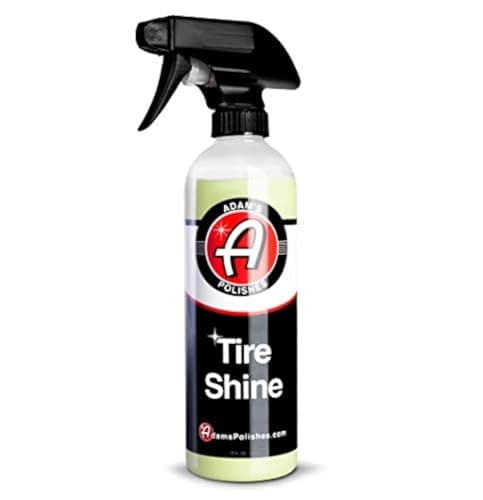
Adam's Polishes Adam's Tire Shine
Adam's Tire Shine

A water-based dressing with SiO2 in the formula, which is the combination that gets you gloss without the sling and browning silicone-heavy dressings are known for.

Gloss without sling
8.6
$14.44Amazon
02
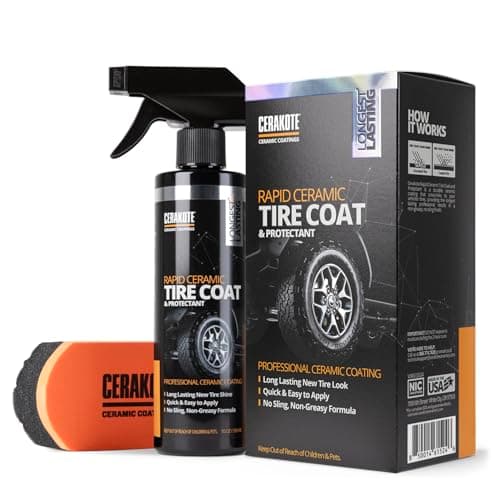
Cerakote Cerakote Rapid Ceramic Tire Coat
Cerakote Rapid Ceramic Tire Coat

The durability play on this page: Cerakote sells it as a ceramic tire coating rather than a dressing and claims up to 10 times the life of a traditional dressing, with a natural satin instead of a wet gloss.

The longest interval between applications
8.9
$14.95Amazon
03
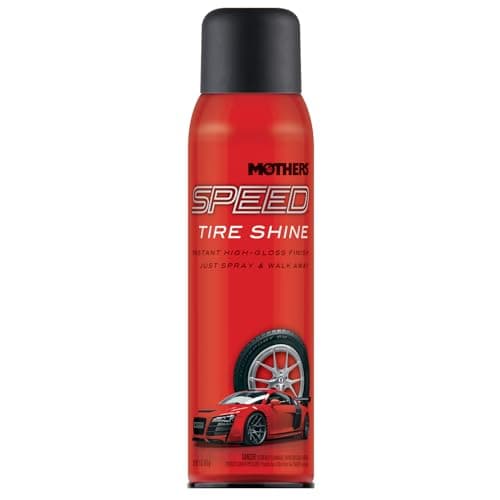
Mothers Mothers Speed Tire Shine
Mothers Speed Tire Shine

The fastest application here by a distance: a 15 oz aerosol Mothers specifies as a no-touch, high-gloss finish built on premium silicones, with a published claim of no sling, browning or run.

Four tires in under two minutes
8.0
$11.98Amazon
04
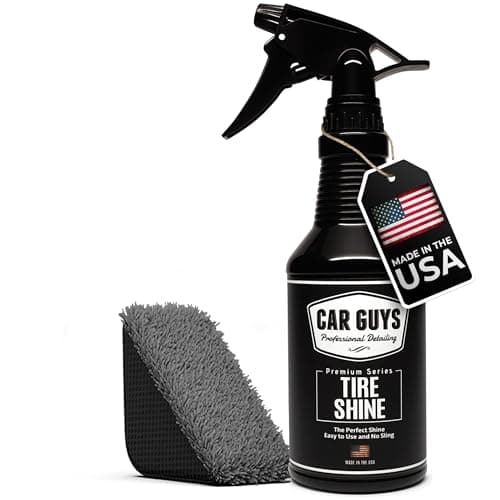
CAR GUYS CAR GUYS Tire Shine Spray
CAR GUYS Tire Shine Spray

An 18 oz bottle supplied with its own applicator that CAR GUYS specifies as dry to the touch and non-slinging — the deep-black, no-grease option for people who dislike how glossy dressings feel.

A deep black that is dry to the touch
8.2
$19.99Amazon
05
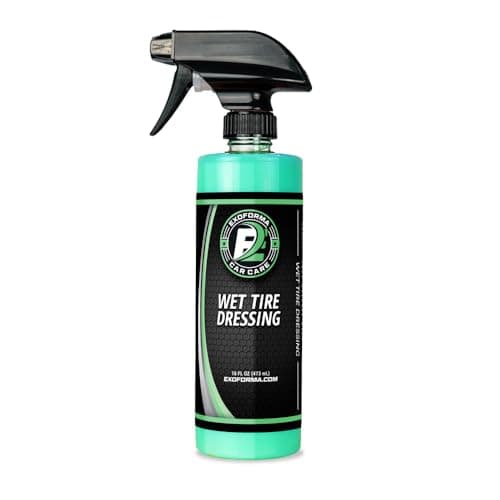
ExoForma ExoForma Wet Tire Dressing Spray
ExoForma Wet Tire Dressing Spray

The wet-look pick: ExoForma specifies an extremely high shine from a non-greasy silicone formula with UV protection, no sling and a minimal cure time, which is the hardest combination to get right in this category.

The glass-wet show finish
7.9
$19.95Amazon
06
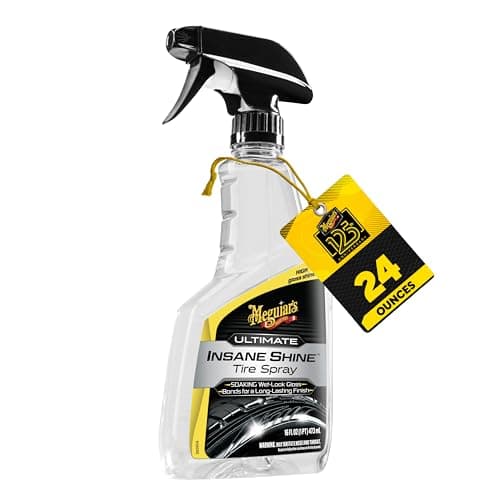
Meguiar's Meguiar's Ultimate Insane Shine Tire Spray
Meguiar's Ultimate Insane Shine Tire Spray

The shelf default done competently: Meguiar's specifies a deep black wet-look gloss with even coverage and long-lasting protection, and the spray pattern is the most forgiving here for a first attempt.

A first tire dressing
7.8
$13.49Amazon

#ad · Live prices from the Amazon Product API, as of October 23, 2026. Where we have no verified live price, we show none — we would rather leave a gap than print a number that has rotted.

In detail

The picks, in full

01
Adam's Polishes Adam's Tire Shine

Gloss without sling

Adam's Tire Shine

16 ozWater-basedAdded SiO2No-sling claim
8.6/10

A water-based dressing with SiO2 in the formula, which is the combination that gets you gloss without the sling and browning silicone-heavy dressings are known for.

Sling resistance
8.8
Published durability
8
Finish realism
8.6
Value
8.8

Pros

  • Water-based chemistry rinses off paint if you over-spray, which solvent dressings do not
  • Adam's lists added SiO2 for rubber protection, so it is doing more than wetting the sidewall
  • Levels well enough that a wipe-down after application gives satin or gloss depending on how much you remove

Cons

  • Needs the wipe-level step to stay sling-free — flood it on and leave it and it will still fling
  • The gloss is a deep satin rather than the glass-wet look some people want
  • A trigger bottle is slower across four tires than an aerosol

Don't buy this if…

…you want the heavy wet look for a show weekend — a solvent-based dressing goes glossier, if you accept the sling risk.

$14.44View on Amazon

Price as of October 23, 2026. Prices change — Amazon's is the one that counts.

#ad · we may earn a commission from this link to Adam's Tire Shine

02
Cerakote Cerakote Rapid Ceramic Tire Coat

The longest interval between applications

Cerakote Rapid Ceramic Tire Coat

10 ozCeramic (SiO2)Satin finishMaker claims 10x dressing life
8.9/10

The durability play on this page: Cerakote sells it as a ceramic tire coating rather than a dressing and claims up to 10 times the life of a traditional dressing, with a natural satin instead of a wet gloss.

Sling resistance
9.2
Published durability
9.4
Finish realism
9
Value
7.8

Pros

  • Cerakote's published claim is up to 10x the life of a traditional dressing — the only product here claiming durability in that league
  • Satin reads as new rubber rather than dressed rubber, which is what most people actually want on a daily driver
  • A coating rather than a film, so there is far less to fling off at speed

Cons

  • Satin is the only look it does — if you are chasing wet-look gloss this is the wrong bottle
  • Like any coating it wants a genuinely clean, dry sidewall, so prep is less forgiving than a dressing
  • Smallest bottle on the page at 10 oz, and the highest price per ounce here

Don't buy this if…

…you dress tires after every wash anyway and enjoy doing it — you are paying for longevity you will overwrite.

$14.95View on Amazon

Price as of October 23, 2026. Prices change — Amazon's is the one that counts.

#ad · we may earn a commission from this link to Cerakote Rapid Ceramic Tire Coat

03
Mothers Mothers Speed Tire Shine

Four tires in under two minutes

Mothers Speed Tire Shine

15 oz aerosolNo-touch applicationPremium siliconesHigh-gloss finish
8.0/10

The fastest application here by a distance: a 15 oz aerosol Mothers specifies as a no-touch, high-gloss finish built on premium silicones, with a published claim of no sling, browning or run.

Sling resistance
8
Published durability
7.4
Finish realism
7.6
Value
9

Pros

  • Aerosol delivery means no applicator, no gloves and no kneeling with a foam pad
  • Mothers publishes a no-sling, no-browning, no-run claim, which is a specific commitment rather than an adjective
  • High gloss immediately, which is the whole point of a spray-and-walk product

Cons

  • No-touch application puts dressing on wheels and wheel wells unless you mask or wipe, and silicone on a wheel face is slippery and holds dust
  • Silicone-based, so it is the product here to keep furthest away from fresh paintwork
  • An aerosol means you are buying propellant along with the product

Don't buy this if…

…you have just coated your wheels — overspray onto a fresh wheel coating is exactly the contamination you were avoiding.

$11.98View on Amazon

Price as of October 23, 2026. Prices change — Amazon's is the one that counts.

#ad · we may earn a commission from this link to Mothers Speed Tire Shine

04
CAR GUYS CAR GUYS Tire Shine Spray

A deep black that is dry to the touch

CAR GUYS Tire Shine Spray

18 ozApplicator includedDry-to-touch claimDeep black finish
8.2/10

An 18 oz bottle supplied with its own applicator that CAR GUYS specifies as dry to the touch and non-slinging — the deep-black, no-grease option for people who dislike how glossy dressings feel.

Sling resistance
8.6
Published durability
7.2
Finish realism
8.4
Value
8.6

Pros

  • Largest bottle on the page, and the applicator means no separate purchase
  • Dries to the touch rather than staying tacky, which is what stops dust sticking to a dressed sidewall
  • Deep black rather than wet — a more believable look on an older tire

Cons

  • Needs the applicator and a wipe to look even; sprayed on freehand it streaks more than the aerosol
  • No published durability figure, so the reapplication interval is a guess until you run it
  • Deep black satin is a narrower look than the glossier sprays here

Don't buy this if…

…you want a one-pass no-touch job — the applicator is part of why this one looks right, and skipping it wastes product.

$19.99View on Amazon

$24.9920% off

Price as of October 23, 2026. Prices change — Amazon's is the one that counts.

#ad · we may earn a commission from this link to CAR GUYS Tire Shine Spray

05
ExoForma ExoForma Wet Tire Dressing Spray

The glass-wet show finish

ExoForma Wet Tire Dressing Spray

16 fl ozSilicone, non-greasyUV protectionMinimal cure time
7.9/10

The wet-look pick: ExoForma specifies an extremely high shine from a non-greasy silicone formula with UV protection, no sling and a minimal cure time, which is the hardest combination to get right in this category.

Sling resistance
7.6
Published durability
7.4
Finish realism
8
Value
8.4

Pros

  • Goes genuinely wet-look rather than satin, which no other pick here is really trying to do
  • ExoForma lists UV protection in the formula, which addresses the thing that actually browns a sidewall
  • Short cure time, so the car can move sooner after dressing

Cons

  • Silicone wet-look dressings carry the highest sling risk in the category — this one needs a thin coat and a level-off, not a flood
  • The wet look fades toward satin as it wears, so the finish changes across its life
  • No published duration figure to plan a reapplication interval around

Don't buy this if…

…the car is a daily driver on wet roads — you will see the first rain's worth of product on the lower panels.

$19.95View on Amazon

Price as of October 23, 2026. Prices change — Amazon's is the one that counts.

#ad · we may earn a commission from this link to ExoForma Wet Tire Dressing Spray

06
Meguiar's Meguiar's Ultimate Insane Shine Tire Spray

A first tire dressing

Meguiar's Ultimate Insane Shine Tire Spray

16 ozWet-look glossEven-coverage sprayWidely stocked
7.8/10

The shelf default done competently: Meguiar's specifies a deep black wet-look gloss with even coverage and long-lasting protection, and the spray pattern is the most forgiving here for a first attempt.

Sling resistance
7.4
Published durability
7
Finish realism
7.8
Value
8.8

Pros

  • The easiest product here to get an even result with the first time you try
  • Part of the Meguiar's Ultimate line, so it sits alongside chemistry already covered on this site
  • Stocked nearly everywhere, which matters more than enthusiasts admit when you run out mid-detail

Cons

  • Wet-look gloss means a film on the sidewall, and a film is what slings — thin coats only
  • No published durability figure, and in this chemistry class the honest expectation is weeks, not months
  • Gloss drops off faster than the ceramic and SiO2 picks above

Don't buy this if…

…you want to dress tires once and forget them for a month — the Cerakote coating is the product built for that.

$13.49View on Amazon

Price as of October 23, 2026. Prices change — Amazon's is the one that counts.

#ad · we may earn a commission from this link to Meguiar's Ultimate Insane Shine Tire Spray

Choosing and applying a tire dressing

Clean the sidewall properly, once

Spray a general-purpose cleaner on a dry tire, agitate with a stiff brush until the foam turns brown, rinse, and repeat until it stops. Most people have never done this, which is why most people's dressing does not last: every product here is being applied over layers of old silicone and oxidized tire wax. The first clean takes ten minutes per car and changes the result more than switching brands will.

Thin coat, flash, wipe level

This is the whole anti-sling technique and it works on every chemistry. Apply a thin, even coat with a foam applicator or the included pad. Let it flash for the time the label states. Then wipe the sidewall with a clean microfiber - lightly, taking off what did not absorb. You will think you are removing the shine. You are removing the part that would have ended up on your paint.

Keep it off the tread, without exception

Tread is the part of the tire doing the braking and the steering, and nothing that reduces friction belongs there. Aerosols are the easy way to get this wrong because the spray pattern does not respect the tread edge. Spray across the sidewall, not into the tire, and wipe the tread block edges if you overshoot.

Mask or wipe the wheel face

Dressing on a wheel face is slippery, holds brake dust and interferes with anything you later want to bond to the wheel. If you are using a no-touch aerosol, wipe the wheel lip afterwards as a matter of routine. If the wheels are coated, treat overspray as contamination - the maintenance argument is the same one in maintaining a ceramic coating.

Dress at the end of the day, not before a drive

Every product here benefits from sitting undisturbed while the carrier flashes off and the actives set. Dressing the tires and immediately driving is the most common cause of sling complaints about products that do not otherwise sling. If you have to drive, wipe the sidewalls level first and accept slightly less gloss.

Match the chemistry to how the car is used

A garaged weekend car can run a wet-look silicone dressing and look spectacular. A daily driver in rain wants a water-based or ceramic product, reapplied less often, with far less to lose on the first wet motorway run. A car that gets washed every weekend is a different purchase from a car that gets washed monthly, and the second one is where a published durability claim earns its money.

Buy the applicator, or buy the kit that includes one

Freehand spraying is why dressings streak. A cheap foam applicator - or one of the bottles above that ships with its own - turns an uneven spray into an even film and cuts how much product you use per tire by a noticeable margin. The same logic as every other contact step on this site: the thing touching the surface decides the result, which is the argument made at length in best car wash mitt.
How we picked

We do not run a testing lab

We compiled published specifications, manufacturer data sheets and aggregated owner reviews, computed the cost of ownership from real sizes and coverage, then scored each product against a published rubric. The scores are judgments from documented research — they are not measurements we took, because we do not own a lab and we are not going to pretend we do. Where a number came from someone else, we name them and link them in Sources.

Questions

Frequently asked

What is the best tire shine that does not sling?
A bonded ceramic tire coating sheds the least, because it cross-links to the rubber rather than sitting on it as a film, and a water-based SiO2 dressing is the next best option. But technique matters more than chemistry here: a thin coat, flashed and then wiped level, will stay put on almost any product, and a flooded coat will sling from all of them.
Why does tire shine turn tires brown?
The brown is antiozonant waxes migrating out of the rubber - a designed-in protective process - which then oxidize at the surface. A dressing applied over that bloom traps it and looks worse within days. Clean it off with a general-purpose cleaner and a brush until the rinse runs clear, then dress. Solvent-heavy dressings tend to speed the migration up.
How long does tire shine last?
It depends entirely on the chemistry, and the only honest answer is to go by what each maker publishes. Cerakote claims up to 10 times the life of a traditional dressing for its ceramic tire coat; most of the dressings on this page publish no figure at all, which in this category realistically means weeks rather than months, and fewer if the car sees rain.
Is water-based or solvent-based tire shine better?
Water-based for a car that gets driven: less sling, overspray that rinses off paint, and a satin finish that looks like rubber. Solvent and silicone dressings go glossier and apply faster, which suits a show car or a photo day. Neither is better in the abstract - they fail in different ways and you should pick the failure you mind less.
Can you put tire shine on the tread?
No. The tread is what generates braking and cornering grip, and a dressing is designed to be slick. Keep every product on the sidewall, spray across the tire rather than into it, and wipe the tread edges if you overshoot. This is the one rule in the category with a safety consequence rather than a cosmetic one.
Do ceramic tire coatings actually work?
They last longer than dressings because they bond instead of sitting on the surface, and they sling far less for the same reason. What they will not do is give you a wet look - they finish satin - and they need a genuinely clean, dry sidewall to bond to, so a coating applied over old dressing fails in exactly the way the dressing would have.

Keep reading

Receipts

Sources

We do not run a testing lab, and we do not pretend to. Where a measured number came from someone else's lab, we name them and link them. Where we could not verify something, we say so on the page rather than quietly leaving it out. Read our full method.