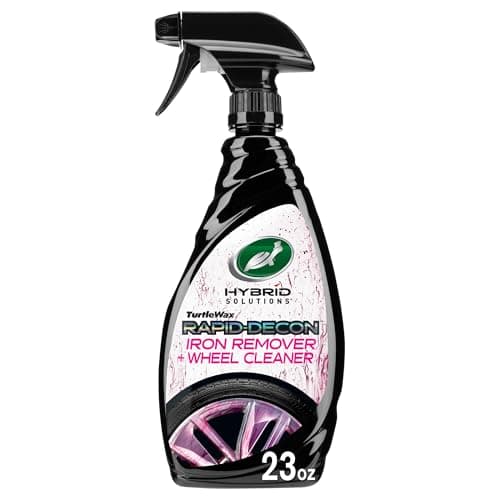
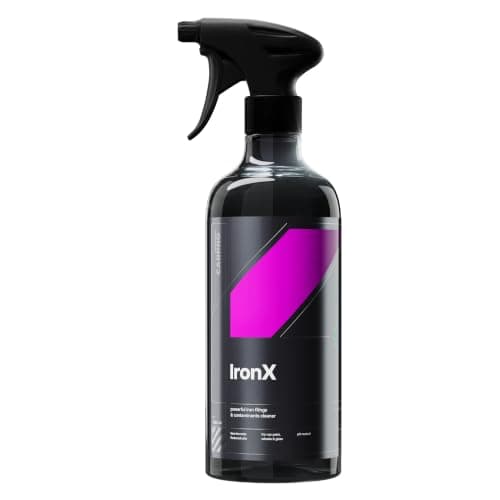
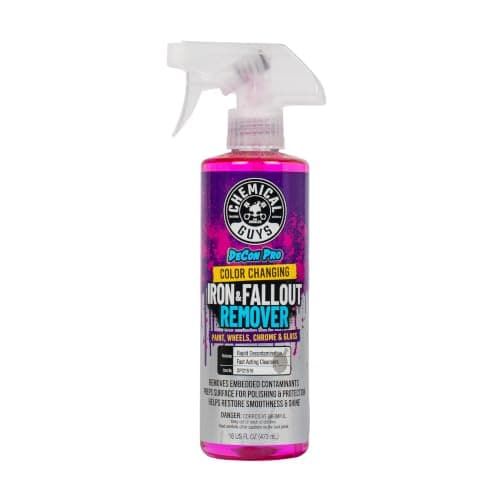
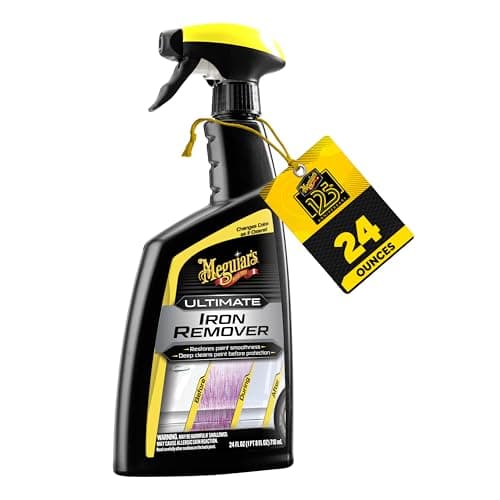
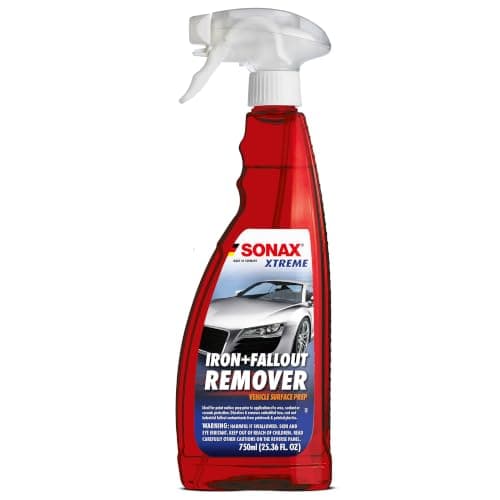
Wheels get the worst chemical abuse on a car, and brake dust is the reason. Every stop throws off hot metallic particles from the pad and rotor that land on the wheel face still hot enough to embed into the finish. Once they are in, they oxidize, and no amount of soap and pressure will move them — because the problem is not dirt sitting on the surface, it is iron bonded into it.
An iron remover fixes exactly that, chemically. It contains a compound that reacts with ferrous particles and dissolves them into a soluble form that rinses away. The purple bleed everyone photographs is that reaction happening — it is not a gimmick, it is the product working, and the intensity of the color is a genuinely useful indicator of how contaminated the wheel was.
Wheels are a harder job than paint
The same chemistry is sold for paint decontamination, and our paint-focused roundup ranks products for that job. Wheels are harder, for three reasons.
The contamination is far heavier — a wheel accumulates in a month what paint accumulates in a year. The surfaces are more varied and more delicate: painted, clear-coated, polished, anodized, machined and chrome faces all behave differently to chemistry. And the geometry is hostile, with barrels, spokes and lug recesses that a spray reaches unevenly at best.
The finish-safety question
This is the one that actually matters. Acidic wheel cleaners cut heavy contamination fast and can permanently dull or stain polished, anodized and bare-metal finishes. Every product on this page is acid-free and pH-balanced for that reason.
Be especially careful with polished aluminum and anodized finishes, which are far more reactive than a standard painted alloy, and with chrome, where staining does not polish out. If you have anything other than a conventional painted or clear-coated wheel, test on a small area at the back of one wheel first and check it after rinsing. Do not let any iron remover dry on any wheel, ever.
The smell, addressed honestly
Iron removers smell strongly of sulfur, and that is not a formulation flaw — it is a by-product of the chemistry that makes them work. Some products moderate it with fragrance, and some do not bother, but nothing eliminates it. Use them outdoors or in a well-ventilated space and it is a non-issue; use them in a closed garage and you will regret it. Gloves and eye protection are sensible for every product on this page.
One process point that saves a lot of frustration: run the iron remover on a wheel that has already been washed, not a filthy one. Its job is dissolving bonded iron, not shifting loose grime, and applying it over caked-on dirt wastes most of the bottle reacting with nothing. Wash, then decontaminate.
How to choose and use an iron remover on wheels
Dedicated iron remover or combined wheel cleaner?
A dedicated iron remover does one thing extremely well and assumes the wheel is already clean. A combined iron-removing wheel cleaner adds surfactants so it lifts road film and dissolves iron in one pass, which is genuinely more convenient and slightly less potent per application. If wheels are the main job, the combined product usually wins on time; if you are also decontaminating paint, the dedicated one covers both.
Check your wheel finish first
- Painted / clear-coated alloy — the common case, and safe with any acid-free product here.
- Polished or anodized — far more reactive. Test first, work quickly, rinse thoroughly.
- Chrome — test first; staining does not polish out.
- Matt or satin finishes — avoid anything that needs agitation with a stiff brush.
The routine that works
- Wash the wheels first with car shampoo and a wheel brush. Remove the loose dirt so the chemistry works on what is actually bonded.
- Work on cool wheels, in the shade. A hot wheel flashes the product dry before it has finished reacting, and dried iron remover is a staining risk.
- Spray generously and evenly across the face, the spokes and into the barrel. Uneven coverage gives you a wheel that is half decontaminated.
- Let it dwell for the stated time and watch it bleed. Do not let it dry — mist it again if the wheel is drying out.
- Agitate gently with a soft wheel brush in the recesses.
- Rinse thoroughly, including behind the spokes and inside the barrel.
- Protect afterwards. A sealant or coating on clean wheels makes the next brake-dust cycle far easier to wash off, and considerably delays the next decontamination.
How often
Two or three times a year is plenty for most cars, and more often is not better — this is strong chemistry, not a maintenance wash. The tell that you need it is a wheel that still feels gritty after washing, or fine orange-brown speckling on the face that soap will not shift.
The common mistake
Spraying it on a hot wheel in direct sun and walking away. It dries before it finishes reacting, leaves the contamination behind, and risks staining the finish. Cool wheels, shade, keep it wet, rinse thoroughly — that sequence is more important than which of these five bottles you bought.