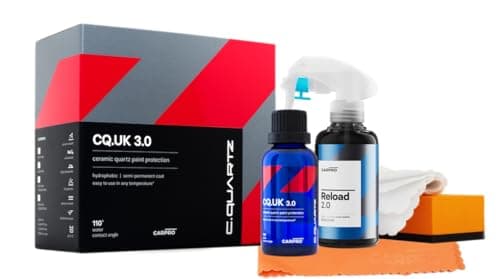
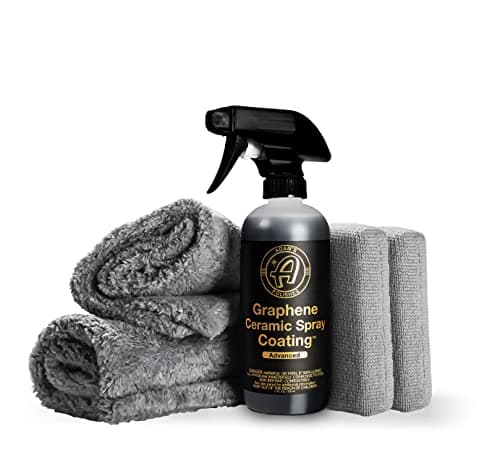
Graphene arrived in car care with the kind of language that should make anyone suspicious: a Nobel-winning wonder material, suddenly available in a thirty-milliliter bottle at your local detailing shop. The reasonable reaction is skepticism. The more useful reaction is precision — because there is a real chemical difference here, it is smaller than the marketing implies, and it does buy you something specific.
The essential thing to understand is that a graphene coating is not an alternative to a ceramic coating. It is a ceramic coating with graphene oxide added to the formulation. The silica backbone that does the bonding and the hard-wearing is still doing that job. Graphene is an additive that modifies the surface behavior, not a replacement chemistry. Anyone selling it as a fundamentally different class of product is overstating it.
The comparison, honestly
| Factor | Traditional ceramic (SiO2) | Graphene-infused |
|---|
| Core chemistry | Silicon dioxide bonded to clear coat | Same SiO2 backbone, plus graphene oxide |
| Water behavior | Tight, high-contact-angle beading | Flatter beads that sheet off more readily |
| Water spotting | More prone — beads sit and evaporate in place | Reduced, because water sheets rather than sits |
| Surface heat | Baseline | Claimed to run cooler; the practical effect is modest |
| Durability | Excellent on a well-prepared surface | Comparable to slightly better, product-dependent |
| Application difficulty | Demanding — flash times matter | Similar, and often marginally more forgiving |
| Price | Wide range | Usually a premium over the same brand's SiO2 product |
The one claim that genuinely holds up
Water behavior is the real, observable difference, and it is worth more than it sounds. A traditional SiO2 coating produces those tight, tall beads that make coating photography so effective. Graphene-infused coatings tend to produce flatter beads that sheet off the panel more readily.
That matters because water spots are caused by beads sitting on the surface and evaporating, leaving behind the dissolved minerals they were carrying. Water that sheets off takes those minerals with it. If you park outside, live somewhere with hard water, or have a dark car that shows every spot, this is a genuine functional advantage rather than a specification-sheet one.
The claims that are softer than they sound
Heat rejection. Graphene conducts heat well, and the claim is that a coated panel therefore runs cooler and is less prone to heat-related water spotting. The layer is a few microns thick on a steel panel in the sun — the effect is directionally real and practically small. Do not buy a coating for this.
Scratch resistance. Both coating types resist very light marring and neither resists real scratches. Any coating marketed as scratch-proof is describing resistance to the mildest possible wash marring. If impacts and chips are your concern, that is a film question, not a coating one.
Dramatically longer life. Some graphene products do outlast some ceramic products, but the variation between brands within each category is larger than the variation between the categories. Preparation and application quality affect real-world durability far more than which of the two chemistries is in the bottle.
What actually determines how long a coating lasts
Preparation, overwhelmingly. A coating bonds to whatever surface it lands on, and if that surface still carries polishing oils, wax residue or embedded contamination, the bond is compromised no matter how advanced the chemistry. A meticulously prepared traditional ceramic will comfortably outlast a graphene coating applied to a car that was merely washed. Wash, chemically decontaminate, clay, correct, then wipe down with a panel prep before a drop of coating comes out of the bottle — the full sequence is in how to apply ceramic coating.
So which should you buy?
Choose graphene if you park outside, deal with hard water, or own a dark car where water spots are the thing that actually annoys you. The sheeting behavior is the reason, and it is a real one.
Choose traditional ceramic if you want the hardest, longest-proven chemistry, you garage the car, or you simply prefer tight beading — and if the graphene version of the same product carries a premium you cannot justify for water behavior alone.
Either way, the coating you apply properly beats the coating you bought because the bottle had the better story on it. The full field, both chemistries, is ranked in our best ceramic coating roundup, and if you have already decided the sheeting behavior is what you want, the graphene field on its own — coatings, sprays and one paste wax, each with the durability figure its maker publishes — is ranked in best graphene coating.